American Muslim Poll 2019: Predicting and Preventing Islamophobia

PUBLICATION DATE
Published May 1, 2019

Biography

SUMMARY

ISPU’s fourth annual poll informs national conversations with the voices of everyday Americans. Researchers, policymakers, and the public have access to key insights and analysis into the attitudes and policy preferences of American Muslims, Jews, Catholics, Protestants, white Evangelicals, the non-affiliated, and the general public. For the second year, in partnership with the Georgetown University’s The Bridge Initiative, we track The National Islamophobia Index, measuring how much the public endorses anti-Muslim tropes. New this year: Our researchers examine protective factors against Islamophobia, as well as data-driven recommendations for those working to elevate American Muslim civic engagement and for those combating anti-Muslim bigotry.

Introduction

Triumphs and tribulations punctuated the year leading up to ISPU’s fourth annual poll of American religious communities. In June 2018, the Supreme Court upheld a fourth iteration of the travel ban, which allows vast immigration restrictions for travelers from Iran, Libya, North Korea, Somalia, Syria, Venezuela, and Yemen. Five of these seven nations are majority Muslim. In their scathing dissent of the majority decision, Justices Sonia Sotomayor and Ruth Bader Ginsburg said the ruling “leaves undisturbed a policy first advertised openly and unequivocally as a ‘total and complete shutdown of Muslims entering the United States’ because the policy now masquerades behind a façade of national-security concerns.”

Later that year, Ilhan Omar, a hijab-wearing former refugee originally from Somalia, and Rashida Tlaib, a Palestinian American, were the first Muslim women elected to the U.S. House of Representatives, each taking her oath on her personal Quran.

Analysts have credited the record-breaking voter turnout of the 2018 midterms for bringing Omar and Tlaib to Congress in an election that saw a number of “firsts,” mostly Democratic women of color and LGBTQ individuals. These Freshman lawmakers make up a new class of members of Congress who ran on some of the most progressive and anti-establishment platforms seen in years, and gave Democrats a majority in the House.

This new Congress witnessed the longest government shutdown in history (lasting from December 22, 2018, to January 25, 2019) over President Donald Trump’s demand for $5 billion to complete a wall on the U.S.-Mexico border, leaving large swaths of the American public without income for five weeks.

As women shattered the glass ceiling of Congress in record numbers, the #MeToo movement continued to race forward, bringing attention to sexual misconduct long normalized and left unacknowledged in the corporate sector, media, and government. It also brought attention to sexual misconduct within religious communities. This includes the Muslim community, where a new grassroots organization called FACE (Facing Abuse in Community Environments) began to investigate and document cases of alleged abuse in an effort to raise awareness and demand accountability.

It was against this backdrop that ISPU conducted its fourth annual 2019 poll of American faith and non-faith groups.

How were Americans of varying faith backgrounds feeling about the direction of the country in the midst of a government shutdown? In a year where voter turnout broke records, how likely were Americans who are Muslim to participate in the midterm election compared to other groups? More importantly, what factors predict their participation? Does a candidate’s support for the so-called Muslim ban help or hurt their run for public office? And with whom do Muslims find the greatest political common ground? How common are unwanted sexual advances from a faith leader in each religious community? And how likely is it that these alleged transgressions are reported to law enforcement or community leadership?

We also continue our annual measure of the Islamophobia Index with the Bridge Initiative, a measure of the level of public endorsement of anti-Muslim tropes. Have levels of Islamophobia in America increased, decreased, or stayed the same? Last year we examined the impact of Islamophobia on society, discovering that higher levels of anti-Muslim sentiment are linked to greater acceptance of violence against civilians, authoritarian policies, and anti-Muslim discrimination. This year, we sought to explore the drivers of Islamophobia. What predicts lower or higher anti-Muslim views? And with whom do Muslims find the greatest support?

We conclude our study with a set of data-driven recommendations for those working to elevate American Muslim civic engagement and for those combating Islamophobia. In light of the horrific massacre of 50 worshippers in a mosque in Christchurch, New Zealand, on March 15, 2019, by a man reciting every anti-Muslim trope in our index, these recommendations seem ever more urgent.

We hope this report continues to inform our national conversation with the voices of ordinary people.

Executive Summary

In January 2019, the Institute for Social Policy and Understanding conducted a survey of American Muslims, Jews, Catholics, Protestants, including white Evangelicals, and the non-affiliated, to examine their views on politics, religion, sexual and religious violence, minorities, and other faith groups. Our findings show that American Muslims are multi-dimensional; they share many characteristics with other faith groups and non-affiliated Americans and, yet, are unique. They are disappointed with some aspects of their country and express hope in others.

American Muslims are multi-dimensional; they share many characteristics with other faith groups and non-affiliated Americans and, yet, are unique. They are disappointed with some aspects of their country and express hope in others.

Muslims Least Likely to Approve of President but More Likely to Express Optimism with the Direction of the Country

We found that only 16% of American Muslims approve of the job Donald Trump is doing as President, the lowest of all groups surveyed. While other groups tallied between 24% and 50%, the majority of white Evangelicals (73%) reported approval of the President and highlighted a deep rift between the two religious groups. Among Muslims, white Muslims (29%) and those who are 30-49 years old (19%) are more likely to approve of Donald Trump than all others.

Despite the low opinion of the performance of the President, 33% of Muslims conveyed optimism about the future trajectory of the nation, more than any other faith group or unaffiliated Americans surveyed. While white Muslims (43%) are more likely than Black Muslims (20%) to be upbeat, Muslim women (70%) are more likely than Muslim men (58%) to be pessimistic about the future. We find Muslims’ overall positivity remarkable given the fact that all other groups surveyed registered a sharp decline in their satisfaction with the way things are going in the country. We posit that Muslim and Democratic gains in the 2018 midterm elections and the continued resistance to Trump’s anti-immigration policies are responsible for Muslims’ confidence.

Muslims Who Vote Overwhelmingly Favor Democrats

Our findings show that Muslims directed their frustration with the administration at the polls and voted overwhelmingly in favor of Democratic candidates. Three-quarters of Muslims (76%) cast their ballots for Democrats, a trend mirrored among the Jewish Americans (69%) we surveyed, as well as Black (91%) and Hispanic Americans (66%) more generally. Among Muslims, support for Democrats remains consistent with age as opposed to the general public where it decreases: 83% of Muslims aged 50 and older vote for Democrats in contrast with 44% of their generational peers in the general public.

Though Growing, Muslim Voter Registration and Engagement Still Lags Behind Other Groups

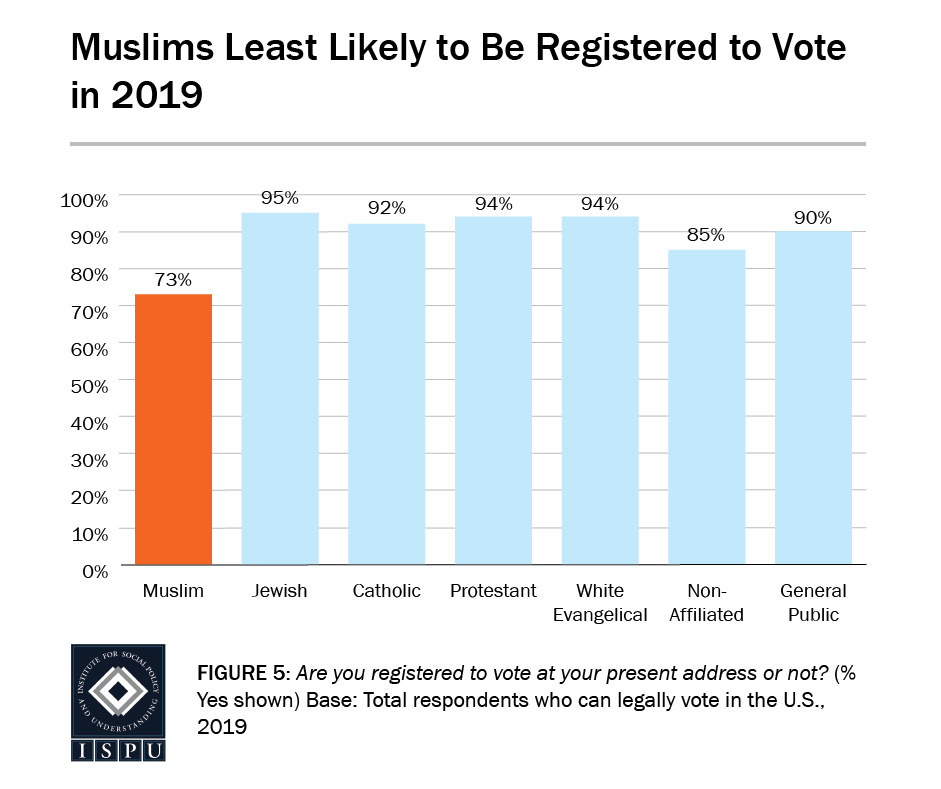
Despite being higher than in 2016 (60%), only 73% of eligible Muslim voters report being registered to do so, the least likely in our 2019 sample (85%-95%). [1]
Overall, Muslims’ voter eligibility is 80%, which is less than the other groups in our survey and this gap may persist because 47% of American Muslims are not native-born. The voter registration gap is most pronounced among Muslim young adults (aged 18-29), only 63% of whom report being registered to vote compared to 85% of their peers in the general population. Muslim voter engagement further suffers due to the inconsistency of Muslim voters who express their intentions to vote (83%) but show up at the polls in fewer numbers (59%), either due to lack of choice of candidates or distrust in the electoral system. Despite these large gaps, Muslims contested in the 2018 midterm elections in unprecedented numbers, recording as many as 131 wins at local and state levels, and securing three Congressional positions.

The voter registration gap is most pronounced among Muslim young adults (aged 18-29), only 63% of whom report being registered to vote compared to 85% of their peers in the general population.

Muslim Local Engagement with Elected Officials a Predictor of Voter Participation More Broadly

We found that some expected factors such as higher income and older age, as well as religious attendance as previously reported in ISPU polls, hold true as predictors of voter participation for Muslims as they do for other Americans. However, in the case of Muslims, contacting a local elected official emerged as the single strongest determinant of voter participation. We also found that Muslims are the group least likely to communicate with local and federal elected officials, with only 21% of Muslim men and 20% of Muslim women reporting communication with a local official.

Support for Muslim Ban Does Little to Help Candidates with Most Voters

Sixty-one percent of Muslims, 53% of Jews, and 56% of non-affiliated Americans report that a candidate’s endorsement of the Muslim ban would decrease their support for that individual. While white Evangelicals (44%) are the most likely of any group to say a candidate’s endorsement of the Muslim ban would increase their support of that candidate, a majority of even this faith group saw the issue as either decreasing their support (19%) of such a candidate or making no difference (37%). The plurality of the general public (44%) say a candidate’s endorsement of a Muslim ban would decrease their support, while 21% say it would increase their support. Thirty-four percent of the general public say it would make no difference to them whether or not a candidate supported the Muslim ban.

Muslims Profess More Private Religious Devotion, Less Public Religious Assertiveness

We found that Muslims (71%) and white Evangelicals (82%) are the most likely to say religion is very important in their daily life, more than all other faith groups and non-affiliated Americans. Despite facing higher levels of religious discrimination than other groups, Muslims hold steady to their faith. Forty-three percent of Muslims attend religious services once a week or more, on par with Protestants (49%) but less frequently than white Evangelicals (64%). More Muslims (78% of men and 79% of women) report satisfaction with the way things are done in their house of worship than the general public (62%).

Muslims are more likely to be privately devout—derive meaning and purpose from their faith (63%) and draw on their faith to forgive someone who has hurt them deeply (54%)—than all groups surveyed except white Evangelicals (75% and 63%).

However, Muslims are less likely to publicly assert their religious beliefs such as take unpopular stands to defend their faith (36%) or wish to use their faith as a source of law (33%) than white Evangelicals (58% and 54%). Muslims (55%) have a sense of linked fate, [2] that is, to believe that their fate is tied to that of their coreligionists, as much as Protestants (55%) and white Evangelicals (57%), but less than Jews (69%). Though it can be reasonably expected that greater personal spiritual engagement would translate into greater public assertion of faith, Muslims are highest on dimensions that reflect private spirituality and lower on the one that requires public risk, likely because of the threat of religious discrimination, which Muslims continue to report at higher frequencies (62%) than any other faith group (43% or less).

In comparison, white Evangelicals are high both on private and public dimensions of religiosity, with faith playing a central role in their personal lives as well as what they wish to see in their society. Jews are low on private measures of spiritual engagement such as frequency of religious services, but higher on public assertion of their faith identity and a sense of a linked fate with co-religionists.

Muslims Most Likely to Report Religious, Gender, and Sectarian Discrimination

As reported in our prior polls, Muslims are the most likely group to report experiencing religious discrimination (62%). Muslim women report higher levels of discrimination (68%) than men (55%). Second to Muslims, 43% of Jews report religious discrimination, while 36% of white Evangelicals report experiencing it. With 40% registering experiences of sectarianism, Muslims are the group most likely to have sectarian discrimination within their ranks as compared to other groups surveyed.

Our data show that 41% of Muslim women experience gender discrimination from within their community, the highest of any group examined. However, the misogyny they suffer from the public at large is still greater at 52%. Muslim women are also more likely to report gender discrimination from the public than are any other group of women surveyed (36% or less).

Though Unwanted Sexual Advances from a Faith Leader Equally Prevalent Across Communities, Muslims Most Likely Group to Report to Law Enforcement

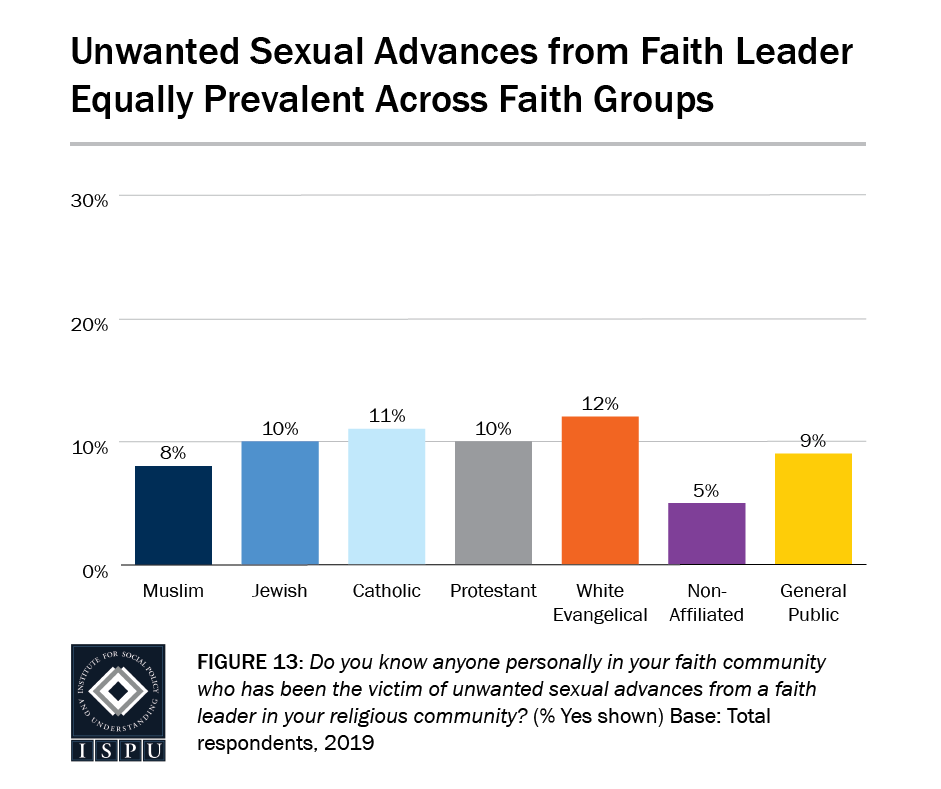
Unwanted sexual advances from a faith leader are equally prevalent among all groups we surveyed. All groups are also equally likely to report such advances to members of the community. However, Muslim victims of sexual crimes are most likely to speak up against perpetrators and more likely (54%) to involve law enforcement in such matters than other groups in our study.

Islamophobia Index Inches Up

A measure of the level of public endorsement of five negative stereotypes associated with Muslims in America, our Islamophobia Index inched up from 24 in 2018 to 28 in 2019. The Islamophobia Index calculates reported levels of agreement with the following statements:

  1. Most Muslims living in the United States are more prone to violence than others.
  2. Most Muslims living in the United States discriminate against women.
  3. Most Muslims living in the United States are hostile to the United States.
  4. Most Muslims living in the United States are less civilized than other people.
  5. Most Muslims living in the United States are partially responsible for acts of violence carried out by other Muslims
Jews and Hispanic Americans Are Most Favorable Toward Muslims and White Evangelicals Least

Of all faith groups apart from Muslims, Jews score the lowest on the Islamophobia Index. A majority (53%) of Jews report having positive views of Muslims with 13% reporting negative views. In contrast, white Evangelicals score the highest on the Islamophobia Index with as many as 44% holding unfavorable opinions about Muslims, which is twice as many as those who hold favorable opinions (20%).

Analyzed by race, Hispanic Americans are five times as likely to hold favorable opinions of Muslims as they are to have negative attitudes (51% vs. 10%). In comparison, white Americans are almost as likely to hold favorable as unfavorable opinions (33% vs. 26%), whereas 40% have no opinion. Black Americans are seven times as likely to hold positive opinions (35%) as negative views (5%) of Muslims, but the majority report having no opinion (51%).

Hispanic Americans are five times as likely to hold favorable opinions of Muslims as they are to have negative attitudes.

Knowing a Muslim Linked to Lower Islamophobia

Our analysis reveals that knowing a Muslim personally is among several protective factors against Islamophobia. When a Muslim is a close friend, Islamophobia is further reduced. We found that three in four Jews know a Muslim, about half of the general public know a Muslim, but only about one in three among white Evangelicals know an American who is Muslim.

Other predictors of lower Islamophobia include Democratic leanings; knowledge about Islam; favorable views of Jews, Black Americans, and feminists; and higher income. To a lesser extent, negative views of Evangelicals are significantly linked to a lower score on the Islamophobia Index (less Islamophobia), though the correlation is weak. Notably, respondents’ nativity, sex, age, education, and religiosity have no bearing on Islamophobia.

Methodology

ISPU created the questionnaire for this study and commissioned Social Science Research Solutions (SSRS) to conduct a nationally representative survey of self-identified Muslims and Jews and a nationally representative survey of the general American public. Researchers examined the views of self-identified Protestants (parsing out white Evangelicals), Catholics, and the non-affiliated. White Evangelicals are routinely studied in religion survey research as a separate subgroup due to their unique social and political characteristics (see, for example, this survey by the Public Religion Research Institute [PRRI] and this study by the Pew Research Center). In our analysis, we make comparisons among age and racial groups. For race comparisons among the Muslim sample, we do not include Hispanic Americans in the racial comparisons due to small sample size. In the general public, we exclude Asian Americans due to small samples sizes. A total of 2,376 interviews were conducted. ISPU owns all data and intellectual property related to this study.

SSRS conducted the survey of Muslims, Jews, and the general population for ISPU from January 8-25, 2019. SSRS interviewed 804 Muslim and 360 Jewish respondents. The sample for the study came from multiple sources. SSRS telephoned a sample of households that were prescreened as being Muslim or Jewish in SSRS’s weekly national omnibus survey of 1,000 randomly selected respondents (n = 648) and purchased a listed sample for Muslim and Jewish households in both landline (from Experian) and cell phone (from Consumer Cell) samples, sample providers that flags specific characteristics for each piece of a sample (n = 133). In an effort to supplement the number of Muslim interviews that SSRS was able to complete in the given time frame and with the amount of available prescreened sample, SSRS employed a web-based survey and completed the final 383 Muslim subject interviews via an online survey with samples from a non-probability panel (a panel made up of respondents deliberately [not randomly] chosen to represent the demographic makeup of the community in terms of age, race, and socio-economics). SSRS used their sample in the probability panel to administer the general population portion of the survey (n= 1,108). These are respondents who have completed a survey through the SSRS omnibus and signed up for the probability panel. In an effort to balance out the general population probability panel, SSRS interviewed 104 non-Internet respondents through the omnibus survey, which uses a fully replicated, stratified, single-stage, random-digit-dialing (RDD) sample of landline telephone households and randomly generated cell phone numbers. Sample telephone numbers are computer-generated and loaded into online sample files accessed directly by the computer-assisted telephone interviewing (CATI) system.

For the Muslim and Jewish samples, the data are weighted to: 1) adjust for the fact that not all survey respondents were selected with the same probability, and 2) account for non-response across known demographic parameters for the Jewish and Muslim adult populations. The survey has a margin of error at a 95% confidence level of Muslims ±4.9% and Jews ±7.6%.

For the general population sample, the data are weighted to provide nationally representative and projectable estimates of the adult population 18 years of age and older. The weighting process takes into account the disproportionate probabilities of household and respondent selection due to the number of separate telephone landlines and cell phones answered by respondents and their households, as well as the probability associated with the random selection of an individual household member. The survey has a margin of error at a 95% confidence level of general population ±3.6%.

Click here for more details on polling methodology.

Results

Civic Engagement

Muslims Least Likely to Approve of President and as Likely as Jews to Have Voted Democrat in the Midterms

Two years into the Trump presidency, American Muslims (16%) are the least likely group to report a favorable view of Donald Trump as President (Figure 1). Opinions about the current President have held broadly similar to those reported in our survey in 2018. On the whole, approval has inched up minimally higher across all groups but inter-group differences have held steady. Non-affiliated (24%) and Jewish (27%) sentiments are slightly more positive than Muslims’ (16%), yet on the lower end of the spectrum. Catholic views (37%) hover right around the general public average (39%), and Protestants’ are slightly higher (50%). By far and away, white Evangelicals (73%) are the group most likely to approve of the President. As in previous years, the data illustrate a schism between Muslims and white Evangelicals regarding the performance of Donald Trump as President.

Figure 1: A bar graph showing that Muslims are the least likely faith group to approve of the President's performance

Last year, we reported a tumble in Muslims’ rating of the U.S. President’s job performance (from 78% approval of President Barack Obama’s job performance in 2016 to 13% approval of President Donald Trump’s performance in 2018). Approval ratings in 2019 remain low (Figure 2).

Figure 2: A bar graph showing that Muslim approval of the President's job has declined sharply since 2016

Muslim Dissatisfaction with President Trump Varies by Race and Age

Within the Muslim community, approval of President Trump varies along age and racial lines: White Muslims (29%) and Muslims who are 30-49 years old (19%) are more likely to view Donald Trump positively compared to Muslims who are Arab (12%), Asian (16%), and Black (7%), and Muslims aged 50 and older (8%). Muslims’ approval for Donald Trump decreases as age increases, which is contrary to the trend that prevails among the general population. Nineteen percent of Muslims in the 30-49 year old age bracket report approval of Donald Trump’s job as president, while only 8% of Muslims aged 50 and older feel the same way. Among the general public, Donald Trump is approved of by 37% of those aged 30-49 and approval grows to 46% in the 50 and older group.

Despite Dissatisfaction with the President, Some Muslims Express Optimism with the Direction of the Country

Surprisingly, despite the large portion expressing negative perception of the current administration, a degree of optimism persists in the American Muslim community: 33% of Muslims report being satisfied with the current direction of the nation, more than Jews and the general public (both 19%), Protestants (20%), and non-affiliated Americans (13%). Muslims (33%) are statistically similar to Catholics (25%) and white Evangelicals (24%) in expressing hopefulness.

Our data also suggest that all faith groups and non-affiliated Americans show a decline in their satisfaction with the trajectory of the country in 2019 vs. 2018, except Muslims, who have maintained their stance (33% vs. 27%).

Figure 3: All faith groups, except Muslims, declined in satisfaction with the direction of the country over the past year

This hopefulness is still decisively lower than 2016 (Figure 4), but suggests that in spite of their low opinion of Donald Trump, American Muslims are likely buoyed by two important developments: historic Muslim gains in the 2018 midterm elections and pushback against Trump’s immigration policies. Conversely, satisfaction among white Evangelicals in our sample fell from 50% in 2018 to 24% in 2019.

Figure 4: A line graph showing that Muslim satisfaction with the direction of the country (33%) has declined since 2016 (63%)

Fielding this survey (January 8-25, 2019) in the wake of the 2018 midterm elections and during the government shutdown of 2018-2019 has uniquely captured the pulse of Americans. The longest federal government shutdown in U.S. history, which spanned from December 22, 2018, to January 25, 2019, showcased the stiff resistance to Donald Trump’s immigration policies and border wall proposal. The events that reaffirm Muslims’ faith in the future of the nation are likely the reason white Evangelicals, President Donald Trump’s staunchest supporters, in our sample have reported the most significant decrease in satisfaction “with the way things are going in this country” of all groups surveyed. While white Evangelicals’ optimism reduced by nearly half from 50% approval in 2018 to 24% in 2019, Protestants reported a 15 point decrease over 2018 (35% vs. 20%) and the general public reported a 10 point reduction (29% vs. 19%).

To be clear, positive sentiment about the country’s direction within the Muslim community is not uniform. White (43%) and Asian (41%) Muslims are twice as likely to be satisfied than Black Muslims (20%). However, Black Americans who are Muslim report satisfaction at much higher levels than their non-Muslim counterparts in our sample (3%), as do white Muslims compared with white Americans in the general public (43% vs. 20%). It is worth noting that roughly a third (36%) of Black Muslims compared to just 2% of Black Americans overall were born outside of the U.S. In our research, immigrants are often more optimistic about the direction of the country than native-born Americans. Muslim women (70%) are more likely to be dissatisfied about the country’s trajectory than men (58%), though Muslim women’s reported satisfaction is up from 17% in 2018 to 28% in 2019, possibly reflective of encouraging recent events.

Though Growing, Muslim Voter Registration Still Lags Behind Other Groups

Muslims Least Likely to Be Eligible and Registered to Vote

Though the vast majority of Muslims (80%) are eligible to vote, they are the least likely to be so among all faith groups and non-affiliated Americans in our survey. Since roughly half (47%) of American Muslims are born outside of the United States, a significant subset of the group may not have naturalized yet. In comparison, 92% of Jews, 94% of Catholics, 97% of Protestants, 99% of white Evangelicals, 97% of non-affiliated Americans, and 96% of the general population are eligible to vote. Voter eligibility among Muslims has remained relatively stable since 2016.

Among those eligible to vote, Muslims (73%) are still less likely than all other groups to be registered to vote. Other groups tally from 85% (non-affiliated Americans) to 95% (Jews). The gap is most pronounced in the 18-29 age group where Muslim voter registration (63%) is a full 22 points behind the same age group among the general population (85%). Older Muslims’ (88%) registration patterns are similar to the general population (93%). Muslims of all races are equally likely to be registered to vote, as are Muslim men and women.

Figure 5: A bar graph showing that Muslims are the least likely faith group to be registered to vote in 2019

Faith and Community

Muslims Profess More Private Religious Devotion, Less Public Religious Assertiveness

Muslims More Likely to Hold Religion Very Important Than All Other Groups, Except White Evangelicals

Muslims (71%) are far more likely to say religion is “very important to their daily lives” than Jews and Catholics (both 35%), Protestants (61%), or the general public (36%). The importance of faith to Muslims is only surpassed by white Evangelicals (82%) in our survey. Noticeably, though white Evangelicals and Muslims diverge in their views in most of our findings, the two groups stand out as the most devoted to their faith amidst a sea of growing secularism.

Though white Evangelicals and Muslims diverge in their views in most of our findings, the two groups stand out as the most devoted to their faith amidst a sea of growing secularism.

Muslim women and men are equally likely to say religion is important to them, despite the greater social cost that Muslim women incur for their faith identity in the form of a greater frequency of reported religious discrimination (55% of men vs. 68% of women). Though Muslim women continue to experience greater religious discrimination than all other groups studied—findings that remain the same in 2019 as in previous years—it has not distanced them from their faith.

The percentage of Muslims who hold religion very important to their daily lives has held steady since 2016.

Muslims as Likely to Attend Religious Services as Protestants

As with previous studies (ISPU poll 2016-2018, Gallup 2009, Pew 2011 and 2016), Muslims are on par with Protestants in religious attendance—43% of Muslims and 49% of Protestants report attending a religious service once a week or more. In our survey, Muslims’ and Protestants’ religious attendance is greater than Jews’ (23%) and Catholics’ (27%), but less than that of white Evangelicals (64%).

Uniquely among Muslims, religious service attendance does not differ by age. In the general public, those aged 50 and over are more likely to attend religious services once a week or more frequently than those in younger age brackets. As such, Muslim 18-29 year olds (31%) are more likely to attend weekly religious services than their peers in the general public (18%). Muslim women are less likely than men to attend a weekly service (29% vs. 55%), explained partially by the fact that traditional Islamic teachings require men to attend Friday congregational prayer and make it optional for women.

It is worth noting, however, that Muslim men and women are equally likely to say they are “satisfied with the way things are done at their house of worship” (78% of men and 79% of women). Overall, Muslims (78%) report being more satisfied with the way their houses of worship are run as compared to Catholics (63%) and the general public (62%).

Muslims aged 50 and older are more likely to be satisfied (89%) with their house of worship than young adults (18-29) and middle-aged (30-49) Muslims (both 76%). It is noteworthy that young adults (52%) and middle-aged Americans (60%) in the general public are also less likely to express satisfaction with their places of worship than their elders ages 50+ (68%). Opinions among Muslims are similar across race.

Muslims Profess More Private Religious Devotion, Less Public Religious Assertiveness

We aimed to measure not only outward religious practice, but the degree to which faith animated one’s inner reality. We designed a section of our survey to gauge private and public spiritual engagement. Two survey questions intended to measure private religious engagement and three captured public religiosity.

Religion in Private Life

We asked survey participants to indicate how much they agreed or disagreed with the following statement:
“Because of my religious faith, I have meaning and purpose in my life.”

This question is a measure of the meaning one draws from their religion. We expected this dimension of personal spirituality to closely track with the importance of religion reported by groups overall, and it does. Once again, Muslims (63%) are more likely than Jews (33%), Catholics (37%), Protestants (54%), and the non-affiliated (6%) to strongly agree with the statement. However, white Evangelicals are the group most likely to strongly agree (75%). Among Muslims, all ages and races are equally likely to find meaning and purpose through religion. In contrast, in the general public, those aged 50 and older as well as Black Americans are more likely to report the same.

Respondents also reported how strongly they agreed or disagreed with the following statement:
“Because of my religious faith, I have forgiven people who have hurt me deeply.”

This question is a measure of the power of faith to overcome vengeance and ego. We found that Muslims (54%) and white Evangelicals (63%) are most likely to “strongly agree” that they have forgiven someone who has hurt them deeply because of their faith, countering the popular trope that Islam teaches vengeance and Christianity forgiveness.

Religion in Public Life

Respondents were asked to choose one of the following statements that is closest to their point of view:

  • Your religion should be the MAIN source of American law.
  • Your religion should be a source of American law but not the only source.
  • Your religion should NOT be a source of American law.

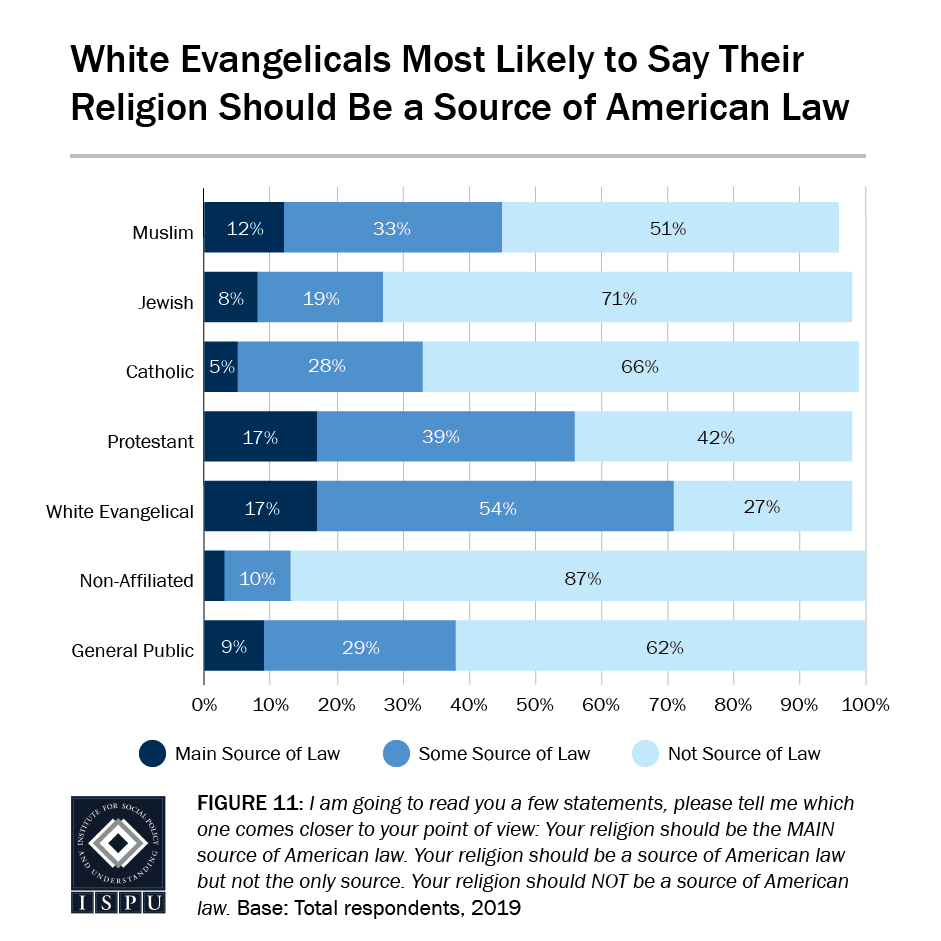
Muslims (33%) are less likely than white Evangelicals (54%) to say they want their religion to be a source of American law but not the only source. Muslims are on par with Catholics (28%), Protestants (39%), and the general public (29%) to hold this view. All these groups are more likely than Jews (19%) and non-affiliated Americans (10%) to agree.

This finding confirms our hypothesis that a group’s wish to link religion to law would mirror the importance of religion to them. These data suggest that people who see their faith as an important part of their personal life also want to see their values reflected in the laws of the land. Muslims are not unique in this regard, nor are they the group most prone to this view.

Within the Muslim community, Arabs (70%) are most likely to see no role for their faith in American law, while other age and racial groups do not differ in their responses. Among the general public, Black Americans (25%) are the most likely to see a role for their faith as the main source of American law.

Figure 11: A bar graph showing that white Evangelicals are the most likely to say their religion should be a source of American law

Muslims Most Likely to Report Religious, Gender, and Sectarian Discrimination

Religious Discrimination: Who Feels It Worse?

Across all faith groups and non-affiliated Americans we surveyed, Muslims are the most likely group to report experiencing any religious discrimination (62%). The incidence of discrimination reported by Muslims has remained the same since ISPU began tracking it in 2016. As in previous years, Muslim women report higher levels of discrimination than Muslim men: only 31% of Muslim women report never experiencing discrimination as compared to 44% of Muslim men. These trends have remained static over time. While there are no reported racial differences, Muslims aged 18-29 report higher levels of religious discrimination (69%) than Muslims aged 30-49 (58%) and 50+ (52%). Jews (43%) and white Evangelicals (36%) follow Muslims as most likely to be targeted with discrimination.

Sectarianism

Among Muslims, 40% report experiencing some frequency of discrimination (5% regularly, 17% occasionally, and 18% rarely) from another member of their larger faith community because of their sect, as compared to 18-24% of other faith groups. Unlike religious discrimination from broader society that targets women disproportionately, Muslim women and men experience similar levels of sectarian discrimination. However, sectarianism within the Muslim community has a racial dimension: Black Muslims (43%) report higher levels of sectarian discrimination than Arab Muslims (26%).

Intra-Religious and Public Gender Discrimination

As a group, 34% of Muslims report experiencing gender-based discrimination from within their faith community, which is higher than Jews (16%), Protestants (19%), and white Evangelicals (13%), and on par with Catholics (27%) and the general public (36%). However, Muslim women are more likely than Muslim men to say they experience either “occasional” (17% vs. 9%) or “rare” (21% vs. 12%) gender discrimination inside their community. As many as 41% of Muslim women experience gender discrimination at the hands of other Muslims at some frequency. Muslim women are still more likely to experience gender discrimination from outside their religious community than from within it (41% vs. 52%). Muslim women are also more likely than women of any other faith community to report gender discrimination from the public at large (52% vs. 36% or less). Since Muslim women are also more likely to experience religious discrimination than Muslim men (68% vs. 55%), they bear a twofold burden.

Views of Feminism

Muslims (41%) are more likely than white Evangelicals (21%) and Protestants (28%) to have favorable views of feminists and are on par with Catholics (37%). Jews (55%) are the faith group most likely to view feminists positively. Among Muslims, women surpass men in their support for feminism (47% vs. 37%), whereas among other faith groups, women and men are on par. The notion that Muslim women have been socialized into expecting and accepting “second-class status” crumbles under the weight of evidence that shows that they decry gender discrimination inside and outside their community. Moreover, the data show that Muslim women are four times more likely to have favorable opinions as unfavorable opinions (47% vs. 11%) of those who work for women’s empowerment.

Muslims (41%) are more likely than white Evangelicals (21%) and Protestants (28%) to have favorable views of feminists and are on par with Catholics (37%). Jews (55%) are the faith group most likely to view feminists positively.

Muslims Who Experience Discrimination from Other Muslims More Likely to Endorse Anti-Muslim Stereotypes

The Islamophobia Index, which we will discuss in more detail in the next section, is a measure of public endorsement of anti-Muslim stereotypes often perpetuated in the media and in divisive political rhetoric. Muslims are not immune to internalizing this rhetoric, as we discussed at length in the 2018 ISPU poll report “Pride and Prejudice.”

One noteworthy finding is that Muslims who have personally experienced discrimination from other Muslims, either for their sect or gender, are more likely to have a higher score on the Islamophobia Index, meaning they are more prone to endorsing anti-Muslim stereotypes. Negative real-life interactions from other Muslims are linked to a generalized endorsement of negative perceptions of the group, even among Muslims themselves. Muslims experiencing gender discrimination from outside their faith community is also linked to higher scores on the Islamophobia Index for reasons that are not immediately apparent. It is interesting to note that experiencing religious discrimination has no predictive power at all, either in increasing or lowering Islamophobia Index scores.

Reported Discrimination Type Link to Higher Islamophobia Index Scores Among Muslims
Gender Discrimination (External) Significant
Gender Discrimination (Internal) Significant
Sectarian Discrimination Significant
Religious Discrimination Not Significant
TABLE 1: How often, if at all, have you personally experienced discrimination by someone OUTSIDE your faith community because of your gender in the past year? How often, if at all, have you personally experienced discrimination by someone INSIDE your faith community because of your gender in the past year? How often, if at all, have you personally experienced discrimination in the past year from another member of your larger faith community because of your sect or denomination? How often, if at all, have you personally experienced discrimination in the past year because of your religion? Base: Total respondents, 2019
Though Unwanted Sexual Advances from a Faith Leader Equally Prevalent Across Communities, Muslims Most Likely Group to Report to Law Enforcement

Following a year where sexual violence dominated the news due to the continuing traction of the #MeToo movement and the Brett Kavanaugh hearings for the United States Supreme Court, our survey takes a closer look at how communities approach sexual violence within their ranks. Our data show that roughly 10% of all faith groups say they personally know someone who experienced unwanted sexual advancement from a faith leader in their community (Figure 13).

Figure 13: A bar graph showing that unwanted sexual advances from faith leaders are equally prevalent across faith groups

Though Muslims are no more likely than anyone else to know a person who experienced unwanted sexual advances from a faith leader, they are among the most likely to say this incident was reported to law enforcement (54% vs. 2-36% among other groups).

All faith groups surveyed were equally likely to say the person who experienced unwanted sexual advances from a faith leader in their community reported it to another community or faith leader. However, in every group except Muslims, victims are more likely to have reported the incident internally to their faith leadership than to law enforcement. Though Muslims are as likely as other groups to have also reported the incident to community leadership, unlike other groups, they are slightly more likely (54% vs. 44%) to have reported the incident to law enforcement (Figure 14).

Figure 14: A bar graph showing that all faith groups, except Muslims, are more likely to report unwanted sexual advances from a faith leader to community leadership than law enforcement

This finding seems to negate the notion of the Muslim community as an exceptionally insular group reluctant to involve law enforcement in their internal affairs. In fact, these data suggest the opposite.