In March 2020, during the 2020 primary elections and in the early days of the global COVID-19 pandemic and nationwide shutdowns, the Institute for Social Policy and Understanding (ISPU) conducted its fifth annual survey of the American general public and faith groups, including Muslims, Jews, Catholics, Protestants (including white Evangelicals), and the non-affiliated. Our findings shed light on progress made over the last five years, especially in civic engagement, as well as challenges that persist for each of these faith communities.
Muslims Remain More Satisfied Than the General Public with the Direction of the Country
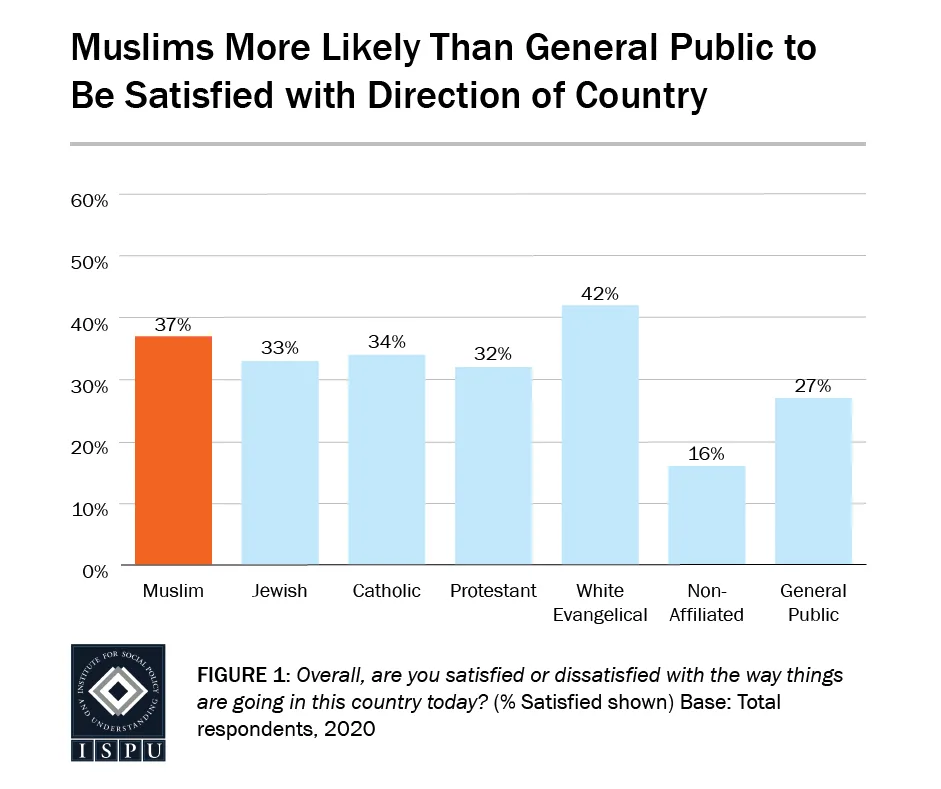
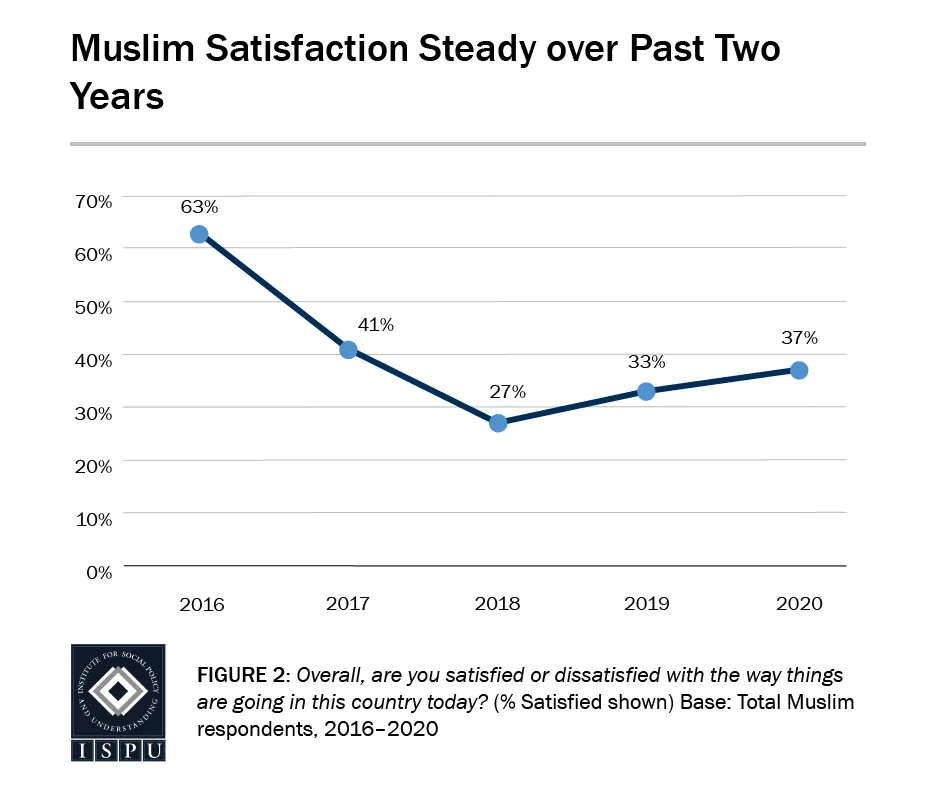
American Muslims are more likely than the general public and the non-affiliated to report being satisfied with the direction the country is taking (37% vs. 27% and 16%, respectively). Muslim satisfaction is on par with that of other faith groups (32–42% among Jews, Catholics, Protestants, and white Evangelicals). Looking over the past five years, we find that aside from a peak of 63% in 2016 and a low in 2018 of 27%, Muslims’ satisfaction with the country has mostly held steady with 41% reporting satisfaction in 2017, compared to 37% in 2020. Within the Muslim community, white Muslims (46%) are more likely than Black Muslims (28%), and Muslim men (41%) are more likely than Muslim women (31%) to report satisfaction with the direction of the country, reflecting the racial and gender trends of the country overall.
Though Higher Than Previous Years, Muslim Approval of President Trump Remains Lower Than Other Groups
Among Muslims, approval of President Trump’s job performance has increased from 13% in 2018 and 16% in 2019 to 30% in 2020. This is in contrast to the general public, for whom approval of President Trump has remained stable (35% in 2018 and 39% in 2019 and 2020). Again, we find gender and racial group differences in approval ratings. About one third of Muslim men (34%) approve of Trump, compared with one quarter of Muslim women (24%). Half of white Muslims (50%) approve of President Trump, compared with one fifth to one quarter of non-white Muslims (20% of Black Muslims, 21% of Arab Muslims, and 27% of Asian Muslims).
The racial breakdown in Trump’s approval within the Muslim community mirrors differences found among the general public; white Americans (48%) approve of the president more than their non-white counterparts (e.g., approval was 16% among Black Americans and 24% among Hispanic Americans). Nonetheless, American Muslim approval of President Trump is lower than other groups surveyed (30% of Muslims vs. 44% of Catholics, 46% of Protestants, 70% of white Evangelicals, and 39% of the general public).
Muslims Continue to Make Gains in Voter Registration, but Remain Lower Than Other Groups
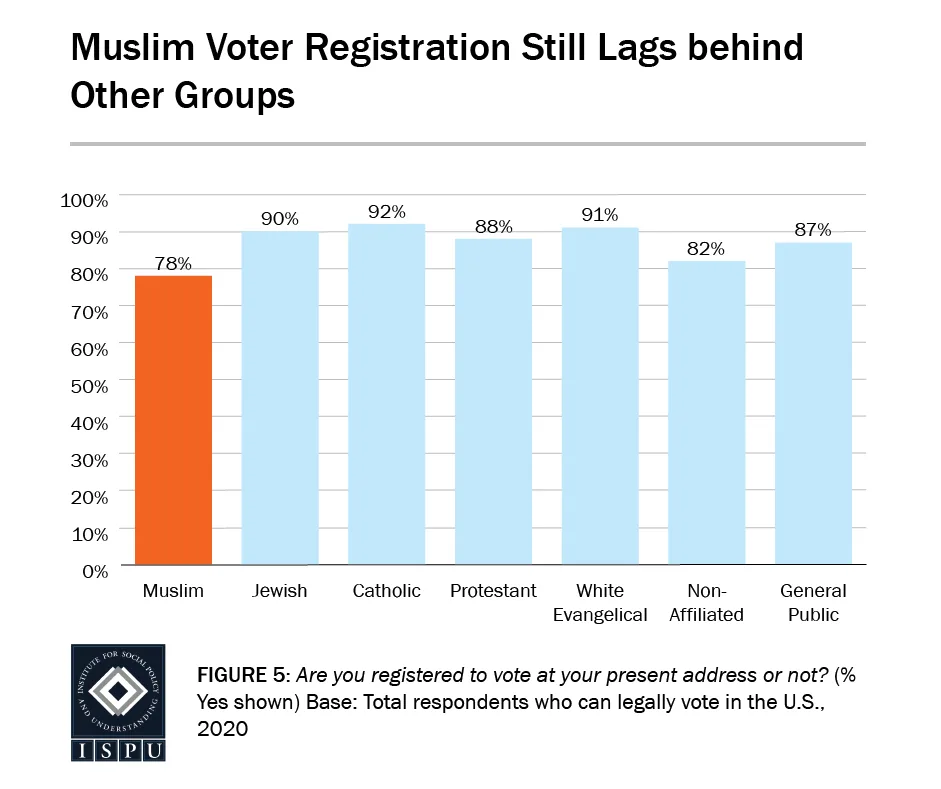
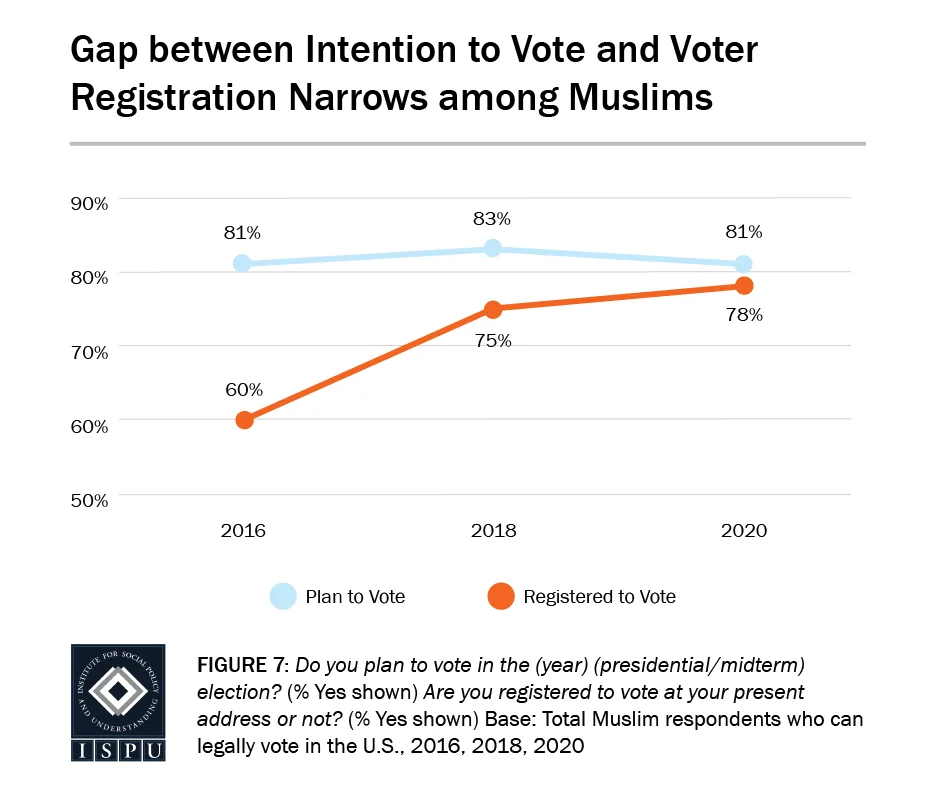
In 2020, 78% of eligible Muslims report being registered to vote, a continued upward trend since 2016 (60%). In other words, the proportion of eligible Muslim voters who are not registered to vote has decreased by roughly half from 39% in 2016 to 21% in 2020. We also find fewer “insha’Allah voters” (those who intend to vote in an upcoming election but have not registered to do so) in 2020, where 78% are registered to vote and 81% say they plan to vote, a difference of only 3% between intentions and action (planning to vote and registering). In 2016, in contrast, 60% were registered to vote while 81% said they planned to vote, a difference of 21%. The number of voters who do not plan to vote remains constant at about 15% (14% in 2016 and 16% in 2020).
Muslims Exceed or Are on Par with General Public in Political Activity beyond Voting
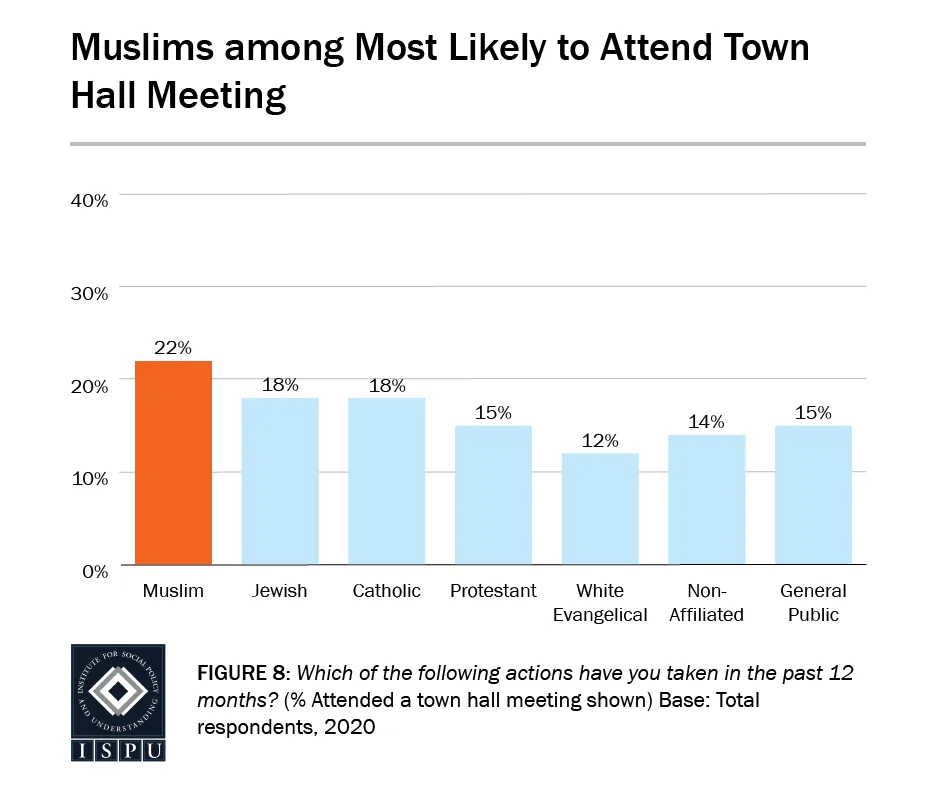
Nearly one quarter of Muslims attended a town hall meeting in the year prior to the survey (22%), compared with 15% of Protestants, 12% of white Evangelicals, 14% of the non-affiliated, and 15% of the general public. Muslims and Jews (both at 16%) are the most likely to volunteer for a political campaign in the past year, compared with 5% of Catholics, 8% of Protestants, 9% of white Evangelicals, 4% of the non-affiliated, and 7% of the general public. Finally, we asked survey respondents if they made a financial contribution to a political campaign in the past year. Muslims are on par with other groups; 21% of Muslims, 18% of Catholics, 21% of Protestants, 18% of white Evangelicals, 19% of the non-affiliated, and 19% of the general public reported that they made a campaign contribution. Jews were the most likely at 35%.
When Assessing Presidential Hopefuls, Muslim Support for Trump as Next Presidential Election Winner Has Climbed, but Remains Lower Than All Other Candidates
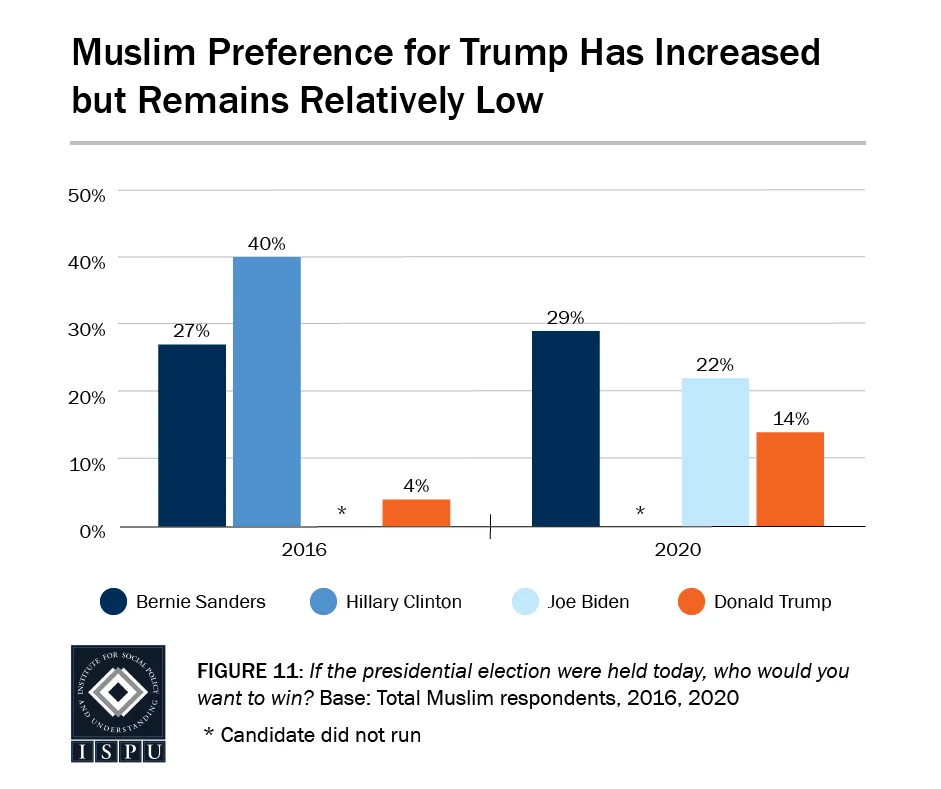
Our survey field dates (March 17–April 22, 2020) occurred during a hotly contested Democratic primary and included the exit of Senator Bernie Sanders from the contest (April 8, 2020). As was the case in 2016, in 2020 American Muslims prefer a Democrat over a Republican for president (51% selected a Democrat as their candidate of choice, and 16% chose a Republican). Muslims (28%) are more likely than the general public (19%) to be undecided with respect to presidential vote choice. During the primary season, Muslims split their support among Democratic candidates: 29% report supporting Bernie Sanders, and 22% support Joe Biden. Among Muslims, 14% selected Trump as their candidate of choice in 2020, compared with 4% in 2016. Again, we find the relatively higher percentage in favor of Trump as the next president may be driven by the 31% of white Muslims who chose Trump, compared with 6–8% of non-white Muslims.
Muslims and the non-affiliated are the least likely to select Trump as their candidate of choice (14% of Muslims and 16% of the non-affiliated vs. 27% of Jews, 34% of Catholics, 39% of Protestants, 61% of white Evangelicals, and 30% of the general public).
Muslim Trump Supporters Similar to the President’s Supporters in the General Public
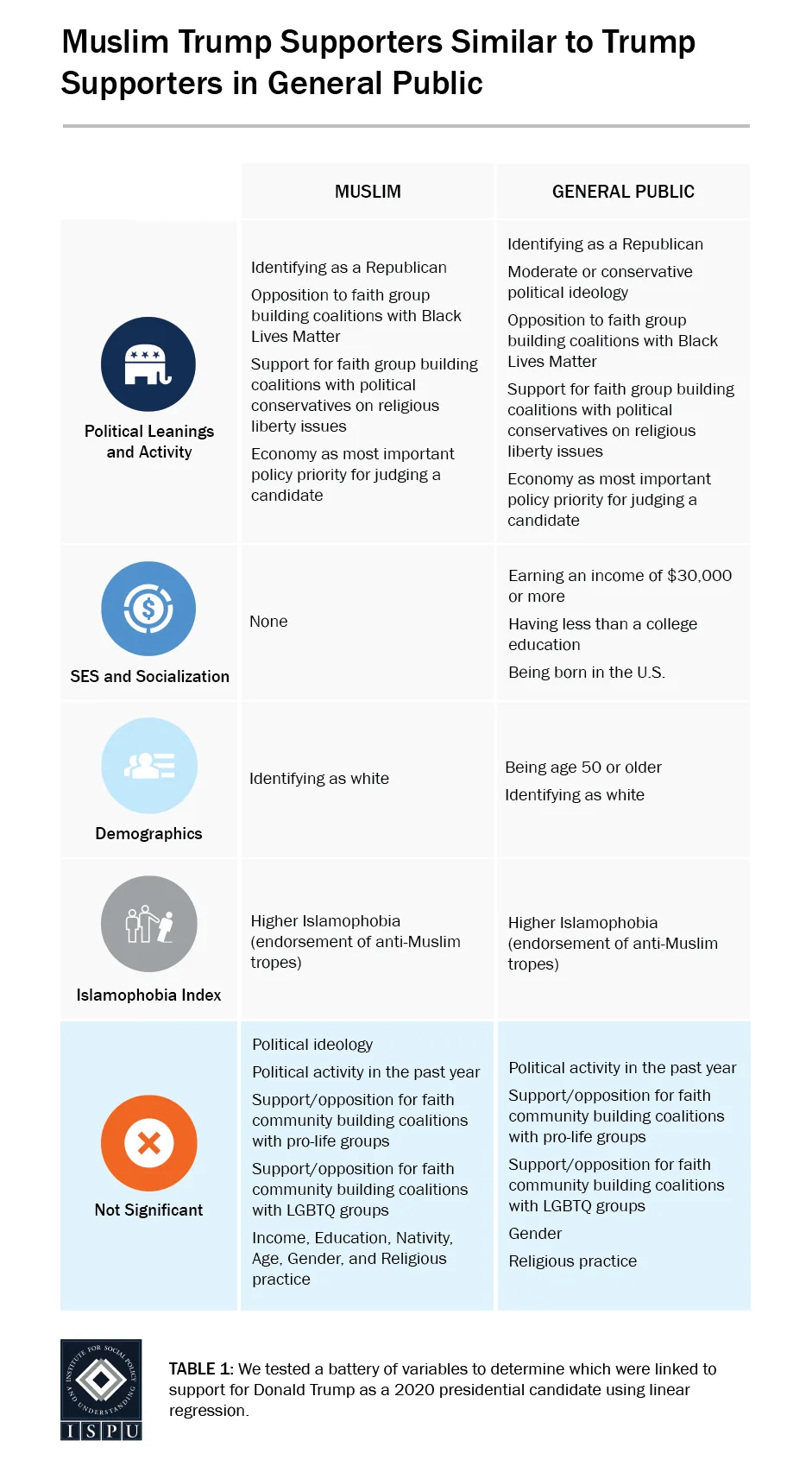
We used regression analysis to better understand Muslim and general public Americans who prefer Trump as their presidential candidate in 2020. We find similarities between the two groups. In terms of political leanings, both Muslim and general public Trump supporters are more likely to identify as Republican, oppose coalition building between their faith community and Black Lives Matter, support coalition building between their faith community and political conservatives on religious liberty issues, and prioritize the economy as their most important policy issue. Additionally, both groups of Trump supporters are more likely to identify as white. Notably, Muslim and general public Trump supporters are also more likely to endorse anti-Muslim tropes.
Some variables of note that had no predictive power for both groups include support or opposition for coalition building between their faith community and pro-life or LGBTQ groups, the respondent’s gender, or their religious practice. Interestingly, support for Trump among Muslims and the general public is not predicted by religiosity.
Muslims Most Likely to Favor Coalition Building with Black Lives Matter
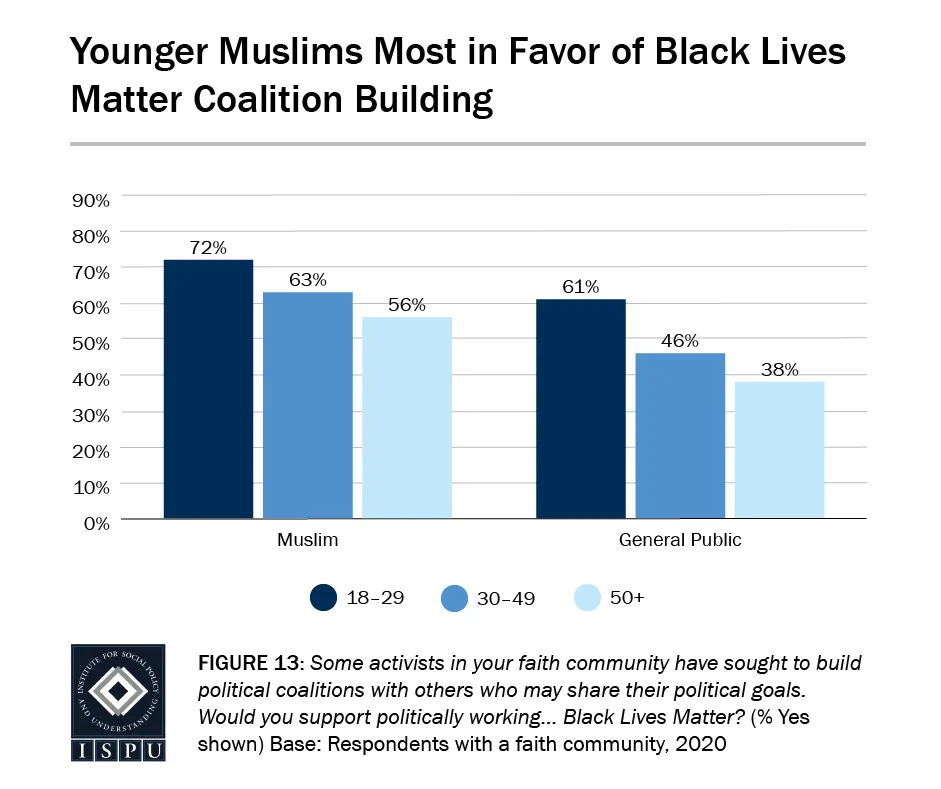
Months before the murder of George Floyd and the subsequent protests, nearly two thirds of Muslims (65%) express support for activists in their faith community to build coalitions with Black Lives Matter (BLM), compared with 54% of Jews, 42% of Catholics, 37% of Protestants, 30% of white Evangelicals, and 44% of the general public. Among Muslims, women (74%), youth (72% of 18–29-year-olds), and Black (72%) and Arab (62%) Muslims are more likely than men (58%), elders (56% of those 50+ years old), and white (58%) and Asian (58%) Muslims to support building such coalitions. Of all the political groups respondents were asked about building coalitions with, Muslims show the greatest support for coalition building with Black Lives Matter (65% with BLM vs. 49% with political conservatives on religious liberty issues, 47% with pro-life groups, and 39% with LGBTQ groups).
Muslims Split on Coalition Building with LGBTQ Groups, on Par with Catholics
Fifty-five percent of Muslims oppose forming political alliances with LGBTQ activists, similar to Catholics (61%). Opposition to such alliances is even more widespread among the general public (62%), Protestants (69%), and white Evangelicals (82%). Younger Muslims (48% of 18–29-year-olds) are more likely to support coalition building with LGBTQ groups, compared with older Muslims (38% of 30–49-year-olds and 26% of those 50+ years old). This same age trend exists in the general public.
Muslims Similar to White Evangelicals in Support for Coalition Building on Religious Liberty Issues and with Pro-Life Groups
Muslims and white Evangelicals are split in their support for allying with political conservatives on religious liberty issues (49% of Muslims and 53% of white Evangelicals favor vs. 47% of Muslims and 46% of white Evangelicals oppose). White Muslims (56%) favor such coalitions more than Asian (42%) and Arab (35%) Muslims.
Forty-seven percent of Muslims favor coalition building with pro-life groups while 46% oppose. Muslims show greater support than Jews (21%), Catholics (36%), and the general public (40%). White Muslims (57%) are more likely than Asian (40%) and Arab (41%) Muslims to support pro-life coalitions.
For Muslims, Political Leanings Predict Preferences for Coalition Building but Religiosity Does Not
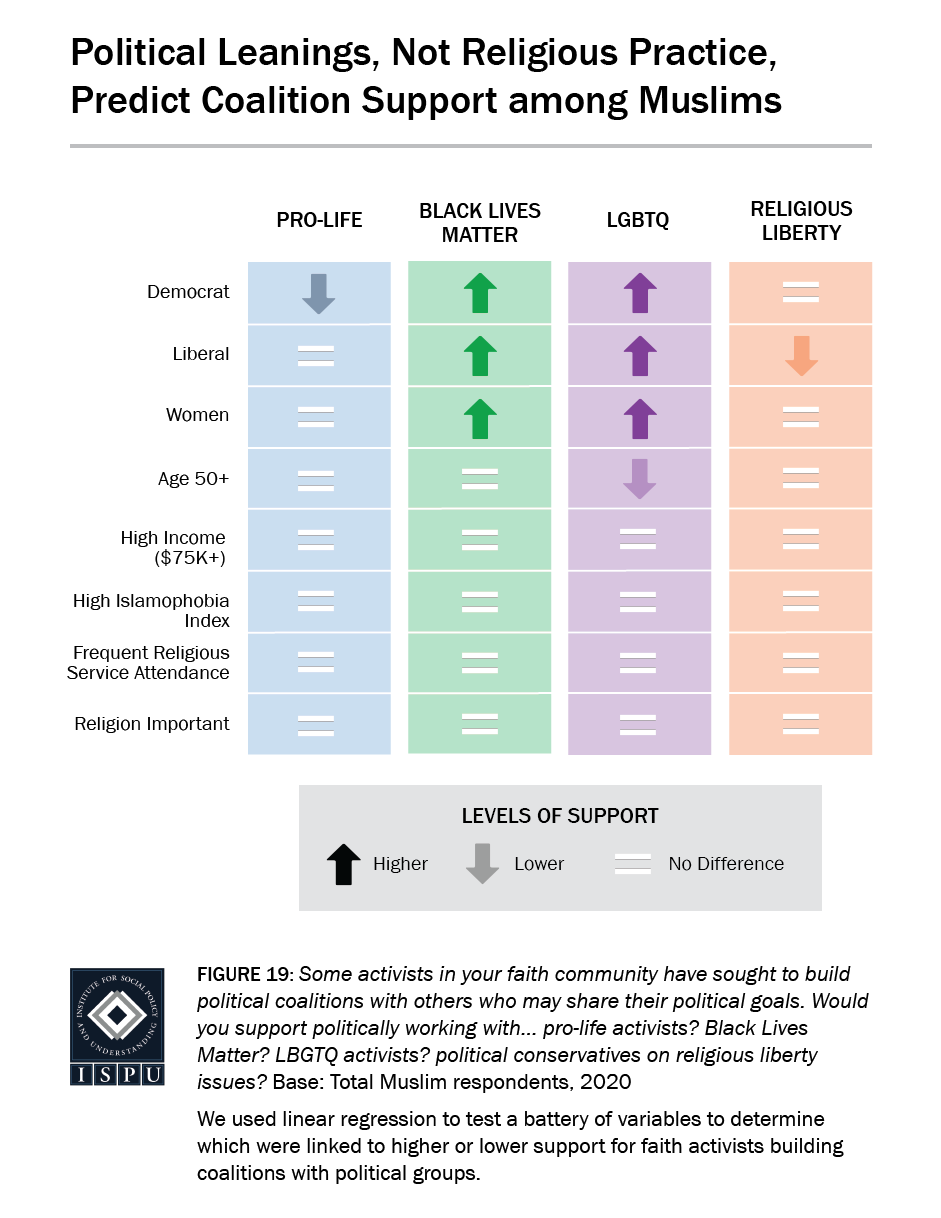
We used regression analysis to identify predictors of support for coalition building with four political groups: BLM, LGBTQ activists, religious liberty groups, and pro-life organizations.
Partisanship and ideology are significantly associated with coalition building in expected ways, while religiosity has no predictive power. For Muslims and the general public, identifying as a Democrat is associated with more support for Black Lives Matter and LGBTQ coalition building. For Muslims only, Democratic affiliation is also associated with lower support for pro-life coalition building. For Muslims and the general public, liberal (vs. conservative) political views are associated with greater support for LGBTQ coalition building and less support for religious liberty coalition building. Among Muslims, liberal political ideology is linked to greater support for Black Lives Matter coalition building, while for the general public it is associated with lower support for pro-life coalitions.
For Muslims, the only other variables that significantly predict support or opposition to coalition building are gender (women are more likely to support Black Lives Matter and LGBTQ coalitions), age (older Muslims are less likely than the youngest to support LGBTQ coalitions), and race (white Muslims are more likely than Arab Muslims to support coalition building on religious liberty issues). Notably, for Muslims as well as the general public, religiosity is not significantly associated with support for coalition building with any political groups.
Among the general public, support for coalitions follows expected demographic patterns. One striking finding, however, was that endorsement of anti-Muslim tropes is associated with lower support for building coalitions with Black Lives Matter, underscoring how anti-Black racism and Islamophobia are linked.
Over the Past Three Years, Jewish Endorsement of Anti-Muslim Tropes Has Declined
On the Islamophobia Index, a measure of the level of public endorsement of five negative stereotypes associated with Muslims in America, the general public scored 27 (on a scale of 0 to 100), on par with 28 in 2019. The Islamophobia Index calculates reported levels of agreement with the following statements:
- Most Muslims living in the United States are more prone to violence than others.
- Most Muslims living in the United States discriminate against women.
- Most Muslims living in the United States are hostile to the United States.
- Most Muslims living in the United States are less civilized than other people.
- Most Muslims living in the United States are partially responsible for acts of violence carried out by other Muslims
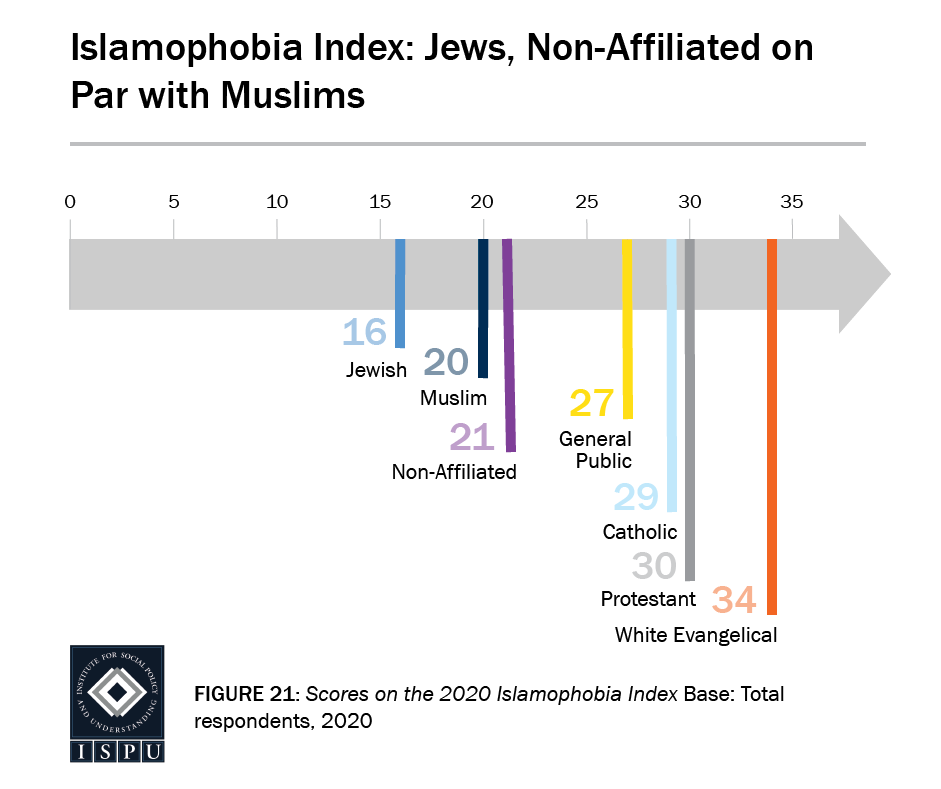
Muslims (20 on the index), Jews (16), and the non-affiliated (21) averaged lower on the Islamophobia Index, compared with Catholics (29), Protestants (30), white Evangelicals (34), and the general public (27). Among Muslims, Islamophobia increased between 2019 and 2020 (14 vs. 20), but the 2020 measure is on par with the 2018 level of 17, perhaps suggesting a rising tide of internalized Islamophobia among segments of the Muslim community.
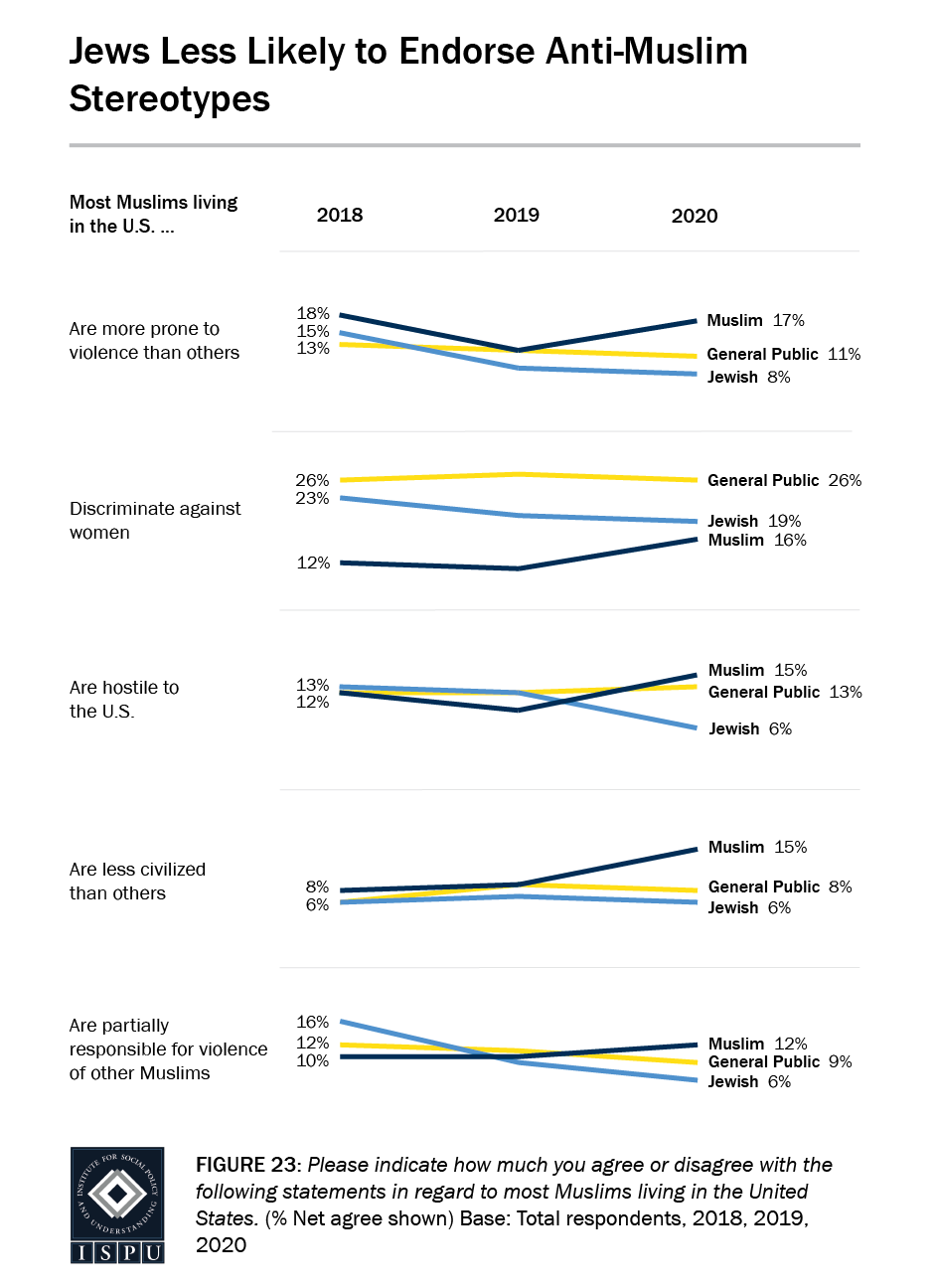
Most notable is the consistent decline in Islamophobia among Jewish Americans from 22 in 2018 to 18 in 2019 to 16 in 2020. Upon examination of the five stereotypes that comprise the Islamophobia Index, we find that Jews report less agreement that most Muslims are prone to violence than other people (15% in 2018 vs. 8% in 2020), that most Muslims are hostile to the United States (13% in 2018 vs. 6% in 2020), and that most Muslims are partially responsible for acts of violence carried out by other Muslims (16% in 2018 vs. 6% in 2020). Jews remain low in their agreement that Muslims are less civilized than other people (6% in both years). Finally, in 2020, Jews are more likely to reject the notion that Muslims discriminate against women (44% disagreed in 2016, compared with 64% who disagreed in 2020).
For the General Public, Political Ideology and Party Affiliation Predicts Islamophobia While Religiosity Does Not
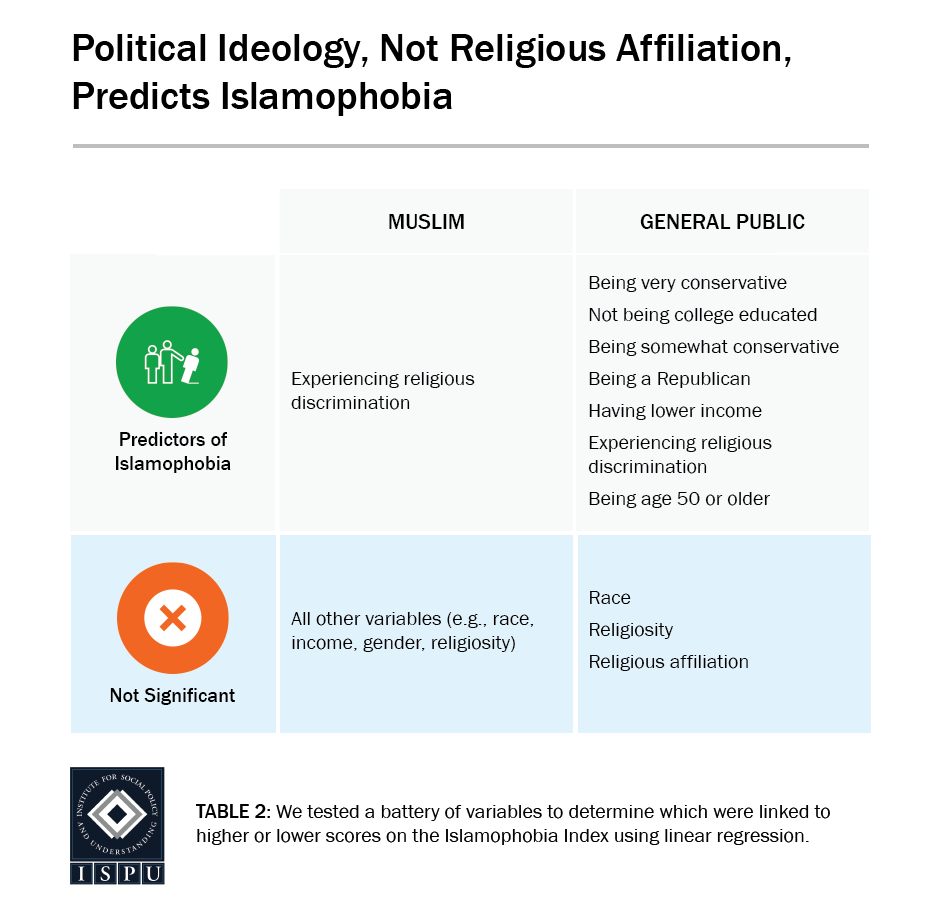
We used regression analysis to identify predictors of Islamophobia for the general public and for Muslims. For the general public, holding a conservative political ideology and/or identifying as a Republican are associated with higher levels of endorsement of anti-Muslim tropes. Other factors associated with higher Islamophobia include less than a college education, lower income, being older (50+ years old), and reporting religious discrimination. Race and religiosity do not emerge as significant predictors of Islamophobia for the general public.
Interestingly, for Muslims, experience with religious discrimination is associated with being more likely to endorse anti-Muslim tropes. In fact, no other factors proved significant for Muslims. Looking more closely at experience with religious discrimination among Muslims, we find that white Muslims are most likely to report “regularly” experiencing religious discrimination (22% of white Muslims vs. 8–12% of non-white Muslims). Islamophobia is particularly high among this 22% of white Muslims.
For Muslims, Experience with Religious Discrimination Remains High
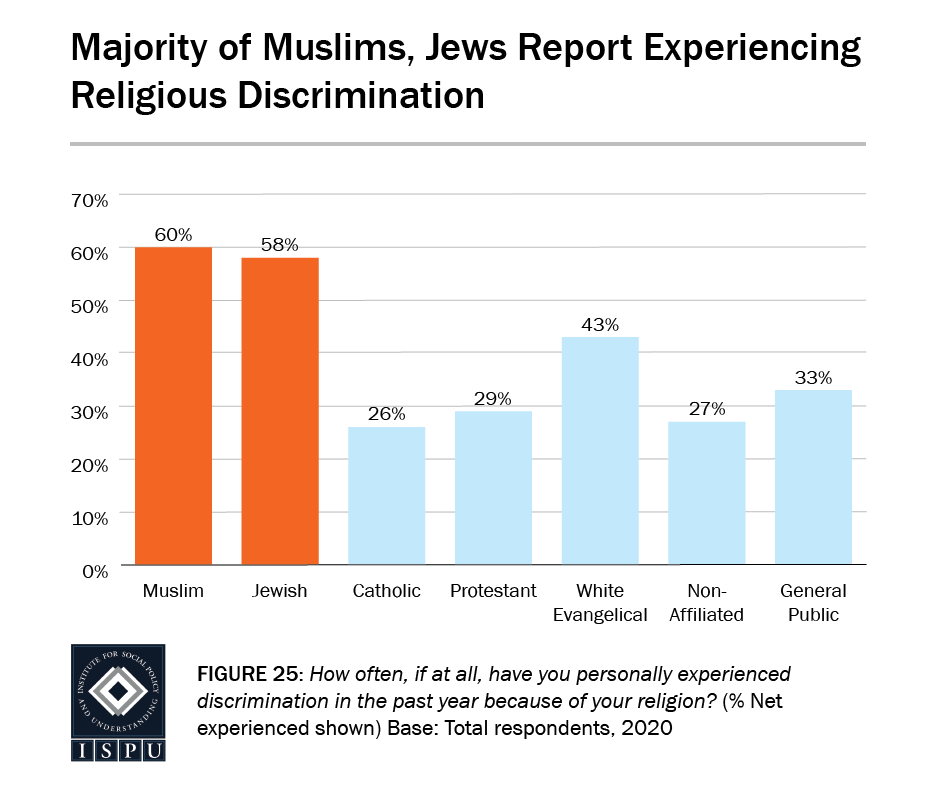
In 2020, Muslims and Jews are most likely to report experiencing any religious discrimination (60% of Muslims and 58% of Jews, compared with 26% of Catholics, 29% of Protestants, 43% of white Evangelicals, 27% of the non-affiliated, and 33% of the general public). Over the past five years, Muslim experiences with religious discrimination have remained steady, ranging from 60% to 62%. Reported experiences with religious discrimination among Jews, in contrast, have increased over time from 38% in 2017 to 58% in 2020.
Muslims Are More Likely Than Other Groups to Experience Religious Discrimination in Institutional Settings
We asked those who reported experiencing any religious discrimination about places where the discrimination may have occurred. Muslims are more likely than Jews and the general public to face religious discrimination in institutional settings such as at the airport (44% vs. 2% of Jews and 5% of the general public), when applying for jobs (33% of Muslims vs. 5% of Jews and 8% of the general public), in interactions with law enforcement (31% of Muslims vs. 2% of Jews and 8% of the general public), and when receiving healthcare services (25% of Muslims vs. 5% of Jews and the general public).
Muslims are also more likely to face discrimination on an interpersonal level such as at a restaurant or other public place (49% vs. 30% of Jews and 23% of the general public) and when interacting with peers at work or school (42% of Muslims vs. 22% of Jews and 24% of the general public). Muslims, Jews, and the general public are equally likely to experience religious discrimination from family and friends (30%, 27%, and 33%, respectively).
Unlike prior years, Muslim men are as likely as Muslim women to experience religious discrimination, in general and by setting.
Half of Muslim Families Report Religious-Based Bullying, Twice as Likely as the General Public
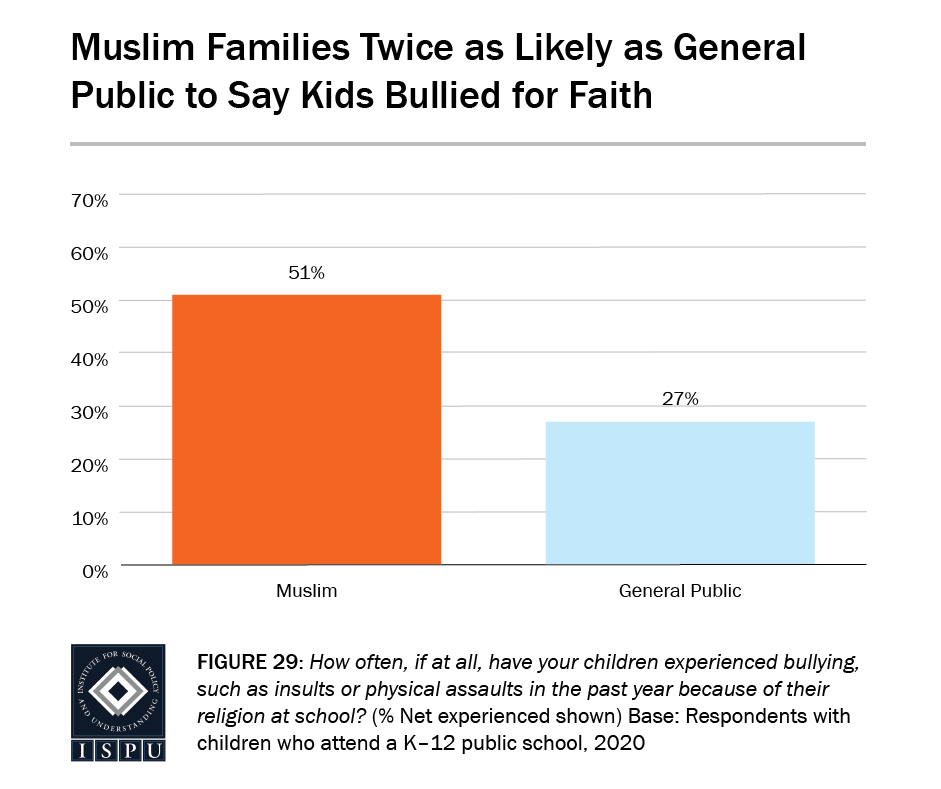
We asked respondents with children in K–12 public schools if they had ever experienced bullying (insults or physical assaults) at school in the past year because of their religion. Half of Muslim parents (51%) surveyed reported that their kids experienced religious-based bullying in 2020, compared with 27% of parents among the general public. The 51% of Muslim families who experienced religious-based bullying is statistically on par with 42% reported by Muslims in 2017. When asked who bullied their child, 30% of Muslims indicated that a teacher or other school official was the source of the bullying, and 69% reported that the bully was a student or group of students. Respondents were asked to select all who bullied their child.