A bald man in a white shirt with suspenders sits facing away in a director’s chair, raising his right hand. The background is light with a film strip graphic at the bottom.

Stereotypes on Screen:

The Effects of Muslim Portrayals in Entertainment Media on Attitudes Toward Democracy and Policy

Biography

For decades, entertainment media has harmfully portrayed historically marginalized communities. Muslims, in particular, are frequently cast as villains, such as terrorists or aggressors, in film and television. These kinds of biased portrayals have measurably harmful impacts–and new research out today proves it.

ISPU’s new study, Stereotypes on Screen, is the first of its kind to test how portrayals of Muslims in scripted TV affect public attitudes and policy preferences.

ISPU would like to acknowledge our generous supporters whose contributions made this report possible, including the Doris Duke Foundation and the Tides Foundation.

This work was also made possible through the support of the Pop Culture Collaborative Fund, a sponsored project of Rockefeller Philanthropy Advisors.

READ THE FULL DIGITAL REPORT

Stereotypes on Screen: Online Reports and PDFs

View the Report PDF

VIEW THE REPORT PDF

View the Supplementary Materials

VIEW APPENDIX A
VIEW APPENDIX B

Graphs for Stereotypes on Screen

Anti-democratic and Anti-Muslim Policies

Bar graph showing viewers of negative depictions of Muslims (mean score 3.04) express more support for anti-democratic policies than viewers of positive depictions (mean score 2.67).

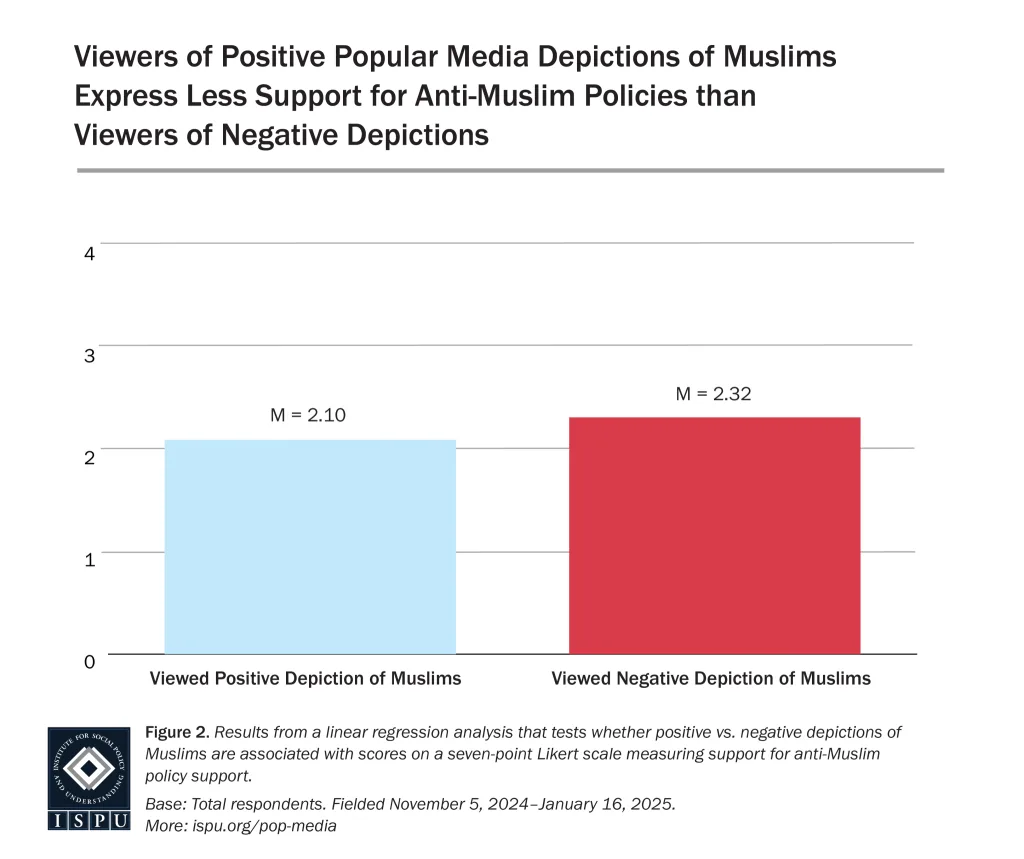
Bar graph showing that viewers of negative depictions of Muslims (M = 2.32) support anti-Muslim policies more than viewers of positive depictions (M = 2.10); based on a 1–7 scale survey.

Warmth and Treatment of Muslims

Bar chart comparing viewers of positive vs. negative media depictions of Muslims. Both groups score highly on support for positive treatment, with positive viewers slightly higher (5.73) than negative viewers (5.46) out of 7.

Bar chart comparing viewers of positive and negative popular media depictions of Muslims. Viewers of negative depictions report a higher desire to socially distance from Muslims (mean 2.14) than viewers of positive depictions (mean 1.78).

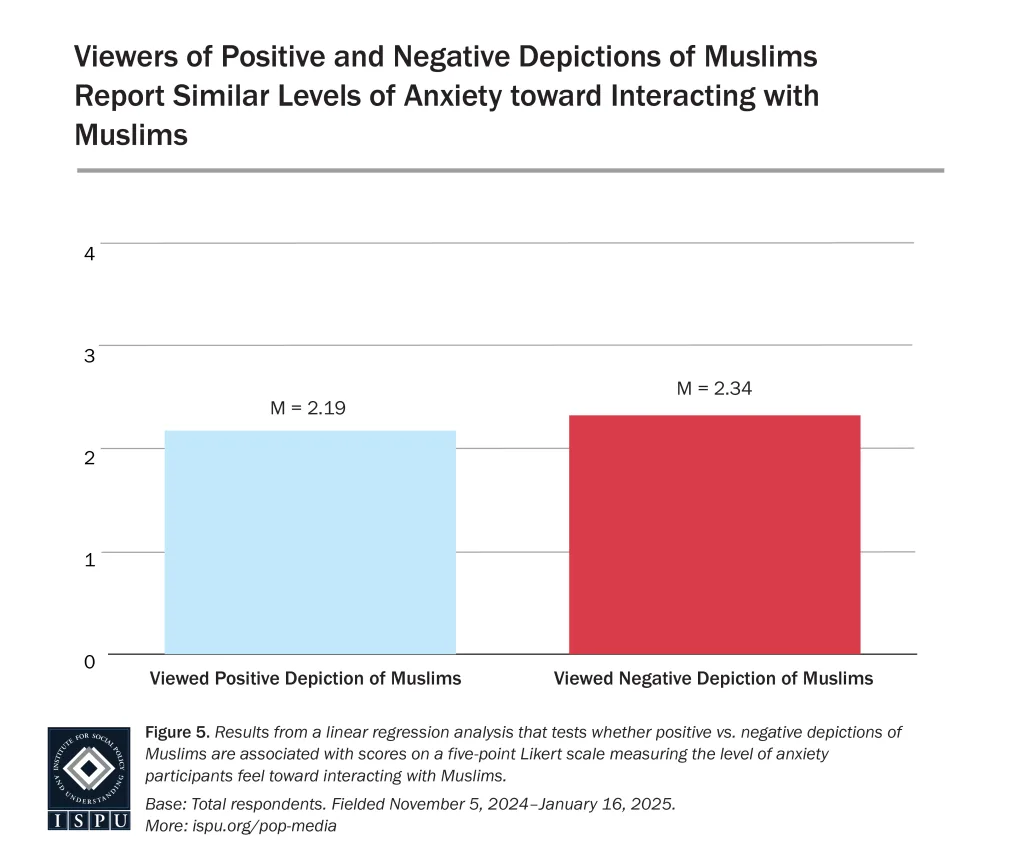
Bar chart comparing anxiety levels toward interacting with Muslims: viewers of positive depictions reported a mean score of 2.19, while viewers of negative depictions reported a mean score of 2.34.

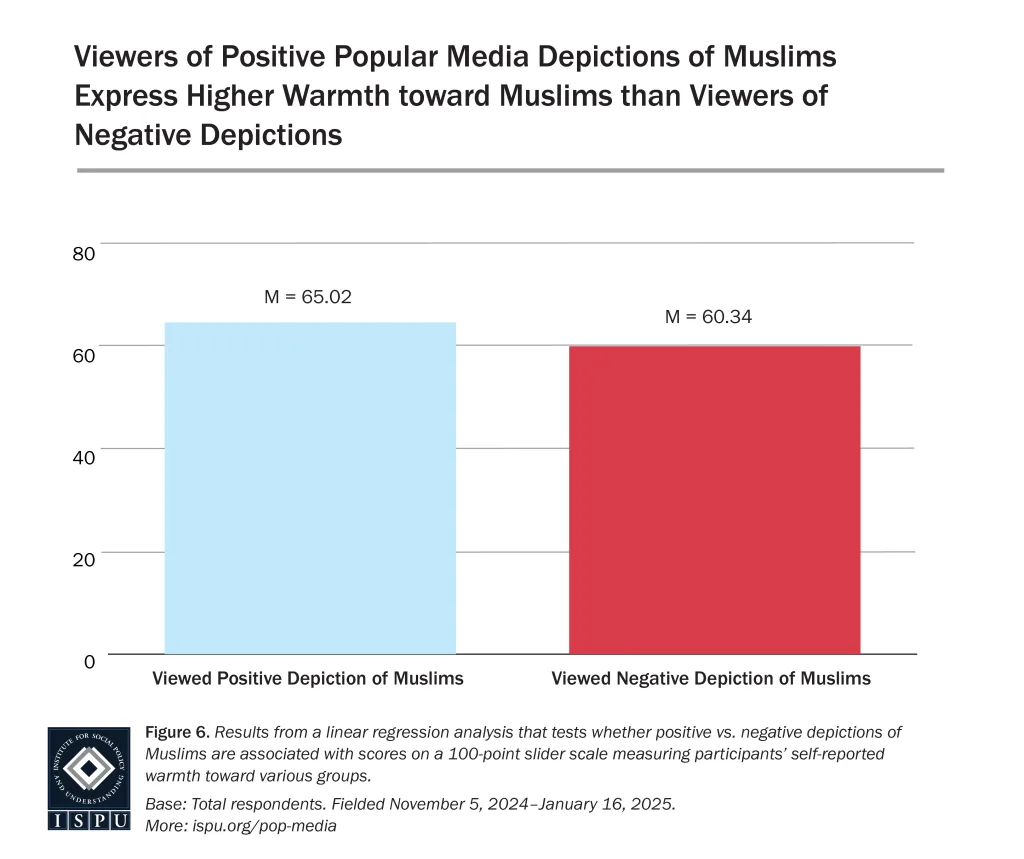
Bar graph showing that viewers of positive depictions of Muslims report higher warmth (mean score 65.02) than viewers of negative depictions (mean score 60.34) on a 100-point scale; source: ISPU survey.

Bar graph showing that viewers of positive depictions of Muslims report higher warmth (mean score 65.02) than viewers of negative depictions (mean score 60.34) on a 100-point scale; source: ISPU survey.

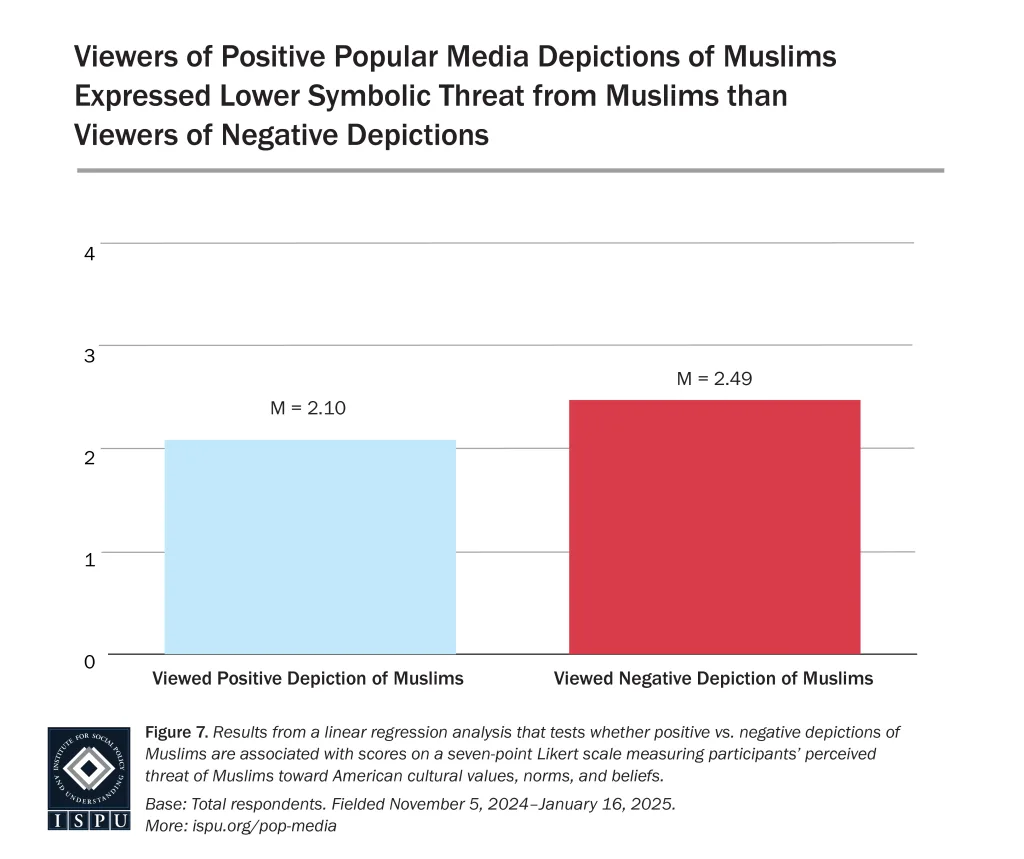
Bar chart comparing perceived symbolic threat from Muslims. Viewers of positive depictions scored 2.10, while viewers of negative depictions scored 2.49 out of 7. Chart source: ISPU, 2025.

Bar chart comparing identification with Muslims: viewers of positive depictions scored 41.13, while viewers of negative depictions scored 35.33. Positive portrayals increased identification, based on survey results.

Islamophobia and Society

Bar chart showing viewers of positive depictions of Muslims scored 2.29 and viewers of negative depictions scored 2.42 on the Islamophobia Index, indicating similar levels of Islamophobia among both groups.

Bar chart comparing support for diversity in society. Both viewers of positive (mean 5.58) and negative (mean 5.50) depictions of Muslims show similar high levels. Source: ISPU, November 2024–January 2025.

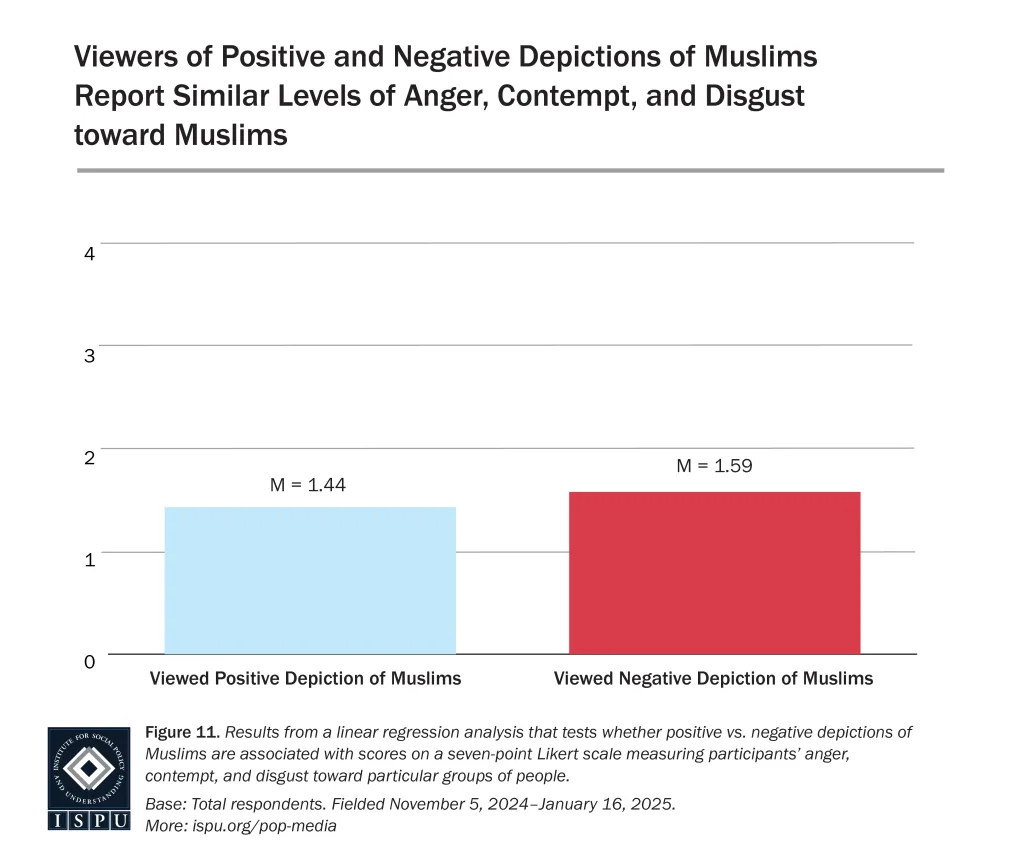
Bar chart showing viewers of negative depictions of Muslims report slightly higher levels of anger, contempt, and disgust (mean 1.59) than viewers of positive depictions (mean 1.44).

Bar graph comparing mean perceived homogeneity scores for viewers of positive (M=2.91, blue bar) and negative (M=2.84, red bar) depictions of Muslims, showing similar levels.

Research Team

Sohad Murrar, PhD
Primary Investigator

Lina Saud, PhD
Research Assistant

Zahra Mirnajafi, PhD
Research Assistant

Saher Selod, PhD
Director of Research, ISPU

Sarah Baker
Research Project Manager, ISPU

Communications Team

Katherine Coplen
Director of Communications, ISPU
Bushra Aljaber
Creative Communications Specialist, ISPU

Advisors

Nour Kteily, PhD
Professor of Management and Organizations, Northwestern University
Muniba Saleem, PhD
Associate Professor, Department of Communication, University of California, Santa Barbara & Adjunct Faculty Associate, Research Center for Group Dynamics, Institute for Social Research, University of Michigan
Maryam Arshad
Organizer, Writers Guild of America East
Marya Bangee
Partner, SILA, Inc.
Rebecca Littman, PhD
Assistant Professor, Department of Psychology, University of Illinois Chicago