In late February 2022, masses of Russian military forces invaded Ukraine, beginning the deadliest and most intense episode in the Russo-Ukrainian War that began in 2014 with Russia’s attempt to reclaim and annex portions of Ukraine. The invasion sparked an outpouring of support for Ukraine among the American public, evident on social media and in donations to humanitarian efforts. Some placed Ukrainian flags in front of their businesses, homes, and places of worship. Public condemnation of Russian has been nearly unanimous.
With the latest invasion creating a precarious geo-political situation, the Biden administration turned to levying economic sanctions against Russia to condemn its actions and providing aid to Ukraine as a way to show support. The American public overwhelmingly approved of this response, with the Pew Research Center reporting that 85% of Americans are in favor of keeping strict economic sanctions on Russia. Moreover, a Washington Post-ABC News poll found that two-thirds of Americans support increasing economic sanctions on Russia. Governors in California, Vermont, Utah, and New Jersey signed legislation and issued Executive Orders bolstering their states’ support for federal sanctions against Russia.
With the government and public aligned on these economic actions, the private sector followed suit, with nearly 1,000 companies pulling operations, business and/or investment from Russia, also known as “divesting”. This included energy giants like Shell, ExxonMobil, and BP; large public companies like McDonald’s, Uber, Starbucks, and Apple; and financial institutions like MasterCard and Visa.
News of Russia’s deadly campaign in Ukraine has covered front pages for most of 2022. But how much do American Muslims, and Americans of other faith and non-faith groups, know about other divestment campaigns and how supportive are they of those campaigns? Data from the Institute for Social Policy and Understanding’s (ISPU) American Muslim Poll 2022 sheds light on this topic, specifically with regards to the Boycott, Divestment, and Sanctions movement directed at Israel to pressure Israel to comply with international law and end their occupation of Palestinian territory.
A large majority of Jews and half of Muslims have heard something about the BDS movement directed at Israel, unlike other Americans
Nearly three-quarters of Jewish Americans (72%) have heard at least a little about BDS efforts directed at Israel, more than any other group surveyed, including American Muslims (52%). Similar levels of Jews and Muslims have heard “a little” (18% and 19%, respectively) and “a good amount” (17% and 12%, respectively), however Jews were more likely than Muslims to have heard “a great deal” about BDS directed at Israel (37% vs. 21%).
About one-third of white Evangelicals (35%) have heard something about BDS directed at Israel, with 26% having heard “a little,” 5% “a good amount,” and 4% “a great deal.” White Evangelicals were more likely than Catholics (24%), Protestants (27%), the non-affiliated (23%), and the general public (24%) to have heard at least a little about BDS directed at Israel. Like white Evangelicals, however, the largest share among these groups have heard just ”a little” – 18% of Catholics, 21% of Protestants, 15% of the non-affiliated, and 17% of the general public.

Graph displaying: A bar graph showing that Jewish Americans are more likely than American Muslims, Catholics, Protestants, white Evangelicals, the non-affiliated, and the general public to have heard about the boycott, divestment, and sanctions movement directed at Israel.

Graph displaying: A bar graph showing that Jewish Americans are more likely than American Muslims, to have heard a great deal about the boycott, divestment, and sanctions movement directed at Israel.
Among Muslims, men and 30-49 year-olds are more likely to know about BDS directed at Israel, while Black Muslims are less likely
Among both Muslims and Catholics, men were more likely than women to have heard at least a little about BDS directed at Israel (59% vs. 45% among Muslims and 34% vs. 15% among Catholics).
Among Muslims, 30-49 year olds are more likely than those 50 and older to know anything about BDS (62% vs. 39%, respectively) and are on par with younger Muslims aged 18-29 (51%). A closer look reveals that 30-49 years olds differ from other age groups in knowing “a great deal” or “a good amount” about the BDS movement directed at Israel. Twenty-nine percent of 30-49 year olds Muslims report knowing “a great deal”, compared with 18% of 18-29 year olds and 13% of 50+ year olds. Additionally, nearly 1 in 5 (18%) of 30-49 year olds report knowing “a good amount,” compared with 9% of younger Muslims and 7% older Muslims.

Graph displaying: A bar graph showing that Muslims between the ages of 30 and 49 are more likely than Muslims aged 18-29 and Muslims aged 50 years old or older to have heard about the boycott, divestment, and sanctions movement directed at Israel.
When looking by race and ethnicity, we find that Black Muslims (37%) are less likely than white and Asian Muslims to report any knowledge about BDS. White (62%), Asian (65%), and Arab (50%) Muslims are on par with each other in having heard anything about BDS directed at Israel. Looking more closely at the level of knowledge, we find that Black Muslims (8%) are less likely than White (33%), Asian (22%), and Arab (29%) Muslims to have heard “a great deal” about BDS. While Asian Muslims were on par with other groups in knowing “a great deal” about BDS, nearly a third (30%) reported knowing “a little” which was more likely than 15% of white Muslims.
Among the general public, there are no differences in knowledge about BDS by age and racial/ethnic groups. However, Muslims in all three age groups are significantly more likely than their age counterparts in the general public to have heard about BDS directed at Israel. White Muslims (62%) were more likely than white Americans (24%) in the general public to have heard about BDS directed at Israel, while Black Muslims (37%) were on par with Black Americans in the general public (26%).
A slight majority of American Muslims who know something about BDS express support for the movement, while most Jews oppose it
Survey respondents who reported knowing anything about BDS directed at Israel were additionally asked about their level of support for the movement. Nearly 6 in 10 American Muslims (57%) who know something about BDS express support for the movement, including 36% who ‘strongly support’ and 21% who ‘somewhat support’ the movement. Nearly one-third (30%) of Muslims who know about BDS neither support nor oppose it and 11% oppose it. The general public tends to remain neutral or in opposition with one-fifth (20%) of those who know about it in support, one-third (34%) neither support nor oppose, and nearly half (46%) oppose it.
While American Muslims have a significant portion who support BDS and the general public has a significant share who opposes it, about one-third of both groups remain neutral. For Jewish Americans, on the other hand, there is overwhelming opposition (80%), little neutrality (13%) and minimal support (6%).
Among American Muslims who have heard about BDS directed at Israel, men are more likely than women to express support (62% of men vs. 49% of women).
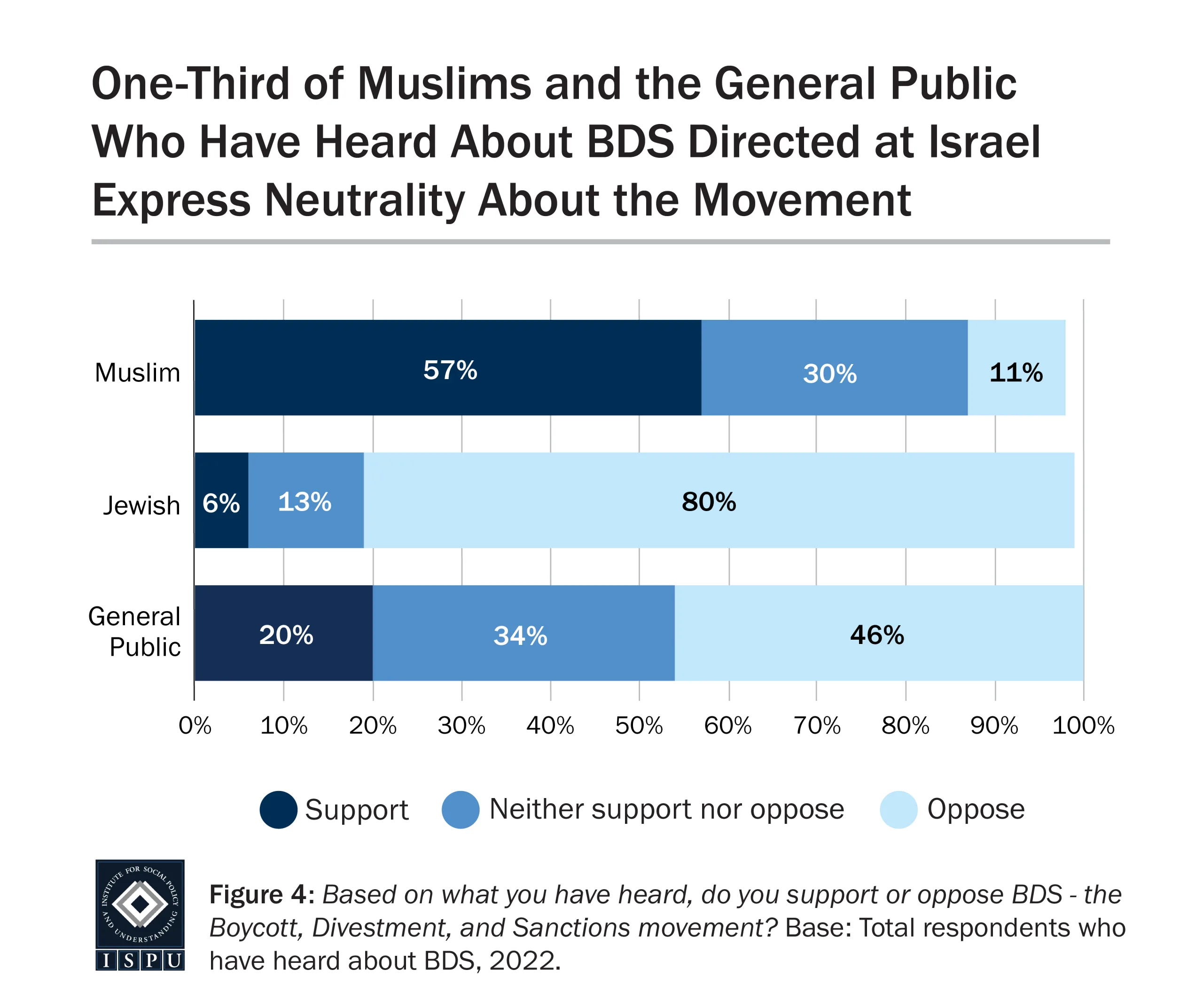
Graph displaying: A bar graph showing that one-third of American Muslims and the General Public who have heard about BDS directed at Israel remain neutral about the movement while just 13% of Jewish Americans express neutrality.
Asian and Black Muslims less likely than white Muslims to express support for BDS directed at Israel
While a significant portion of Asian Muslims indicated knowledge about the BDS movement directed at Israel, about half (48%) support the movement compared to nearly 3 in 4 white Muslims (73%). Thirty-nine percent of Black Muslims expressed support for BDS directed at Israel, which is less likely than white Muslims and on par with Asians. Thirty-nine percent of Asian and 44% of Black Muslims who know about BDS directed about Israel express neutrality about the movement, compared with 14% of white Muslims. While Arab Muslims are the most likely Muslim ethnic group to be directly impacted by the topic, we cannot make bivariate comparisons to Arab Muslims due to a small sample size.
Among Muslims who know about the BDS movement directed at Israel, 30-49 year olds are more likely than 18-29 year olds to express any support (66% vs. 44%, respectively) and strong support (45% vs. 26%). On the other hand, 18-29 year old Muslims who know about BDS are more likely to remain neutral, compared with 30-49 year olds (41% vs. 23%). To better understand the factors that predict any level of support for BDS directed at Israel, we ran a regression analysis among Muslims, Jews, and the general public who had any knowledge of BDS.
Asian Muslims less likely than Arab Muslims to express support for BDS directed at Israel
Based on the regression analysis, we also find that Asian Muslim identity is associated with a 23% lower likelihood of support for the BDS movement directed at Israel, relative to Arab Muslim identity. So, while Asians and Arabs are on par in their self-reported knowledge about the BDS movement directed at Israel, Asians are less likely than Arabs to express support.

Graph displaying: A graphic showing significant predictors of support for the boycott, divestment, and sanctions movement directed as Israel among Muslims based on regression analysis. Knowledge about the movement is strongly associated with greater support while Asian identity is strongly associated with less support. College education, weekly religious attendance and democratic party affiliation are moderately associated with greater support.
Regardless of knowledge about BDS and level of support, 4 in 5 in the American general public, as well as majorities of all faith and non-faith groups, hold the view that laws penalizing people for participating in BDS directed at Israel are an infringement of constitutional rights
The American Muslim Poll 2022 also included the follow question about Americans of different faiths and no faith’s view about the constitutional right to participate in the BDS movement directed at Israel:
Which of the following statements comes closer to your view, even if neither is exactly right?
Laws that penalize people who boycott Israel help protect Israel.
OR
Laws that penalize people who boycott Israel infringe on the Constitutional right to free speech and peaceful protest.
While there is overwhelming support and participation in divestment and pulling business from Russia from Americans of all backgrounds, BDS directed at Israel is often portrayed as demonizing and even described as anti-Semitic. Local laws have been passed in numerous states barring the individual right (as well as the right of businesses) to express support for or participate in the BDS movement towards Israel, resulting in several high profile cases of people losing their jobs as well as companies losing business, most notably Ben and Jerry’s Ice Cream. But is this the overwhelming view of the American public?
While 20% of the general public who know about BDS expressed support for the movement, just 20% of the general public (with and without knowledge of BDS) believe that laws penalizing those who participate in the movement protect Israel, while 80% believe that laws penalizing participation in BDS are an infringement of constitutional rights. In fact, the general public, Catholics (73%), Protestants (79%), white Evangelicals (78%) and the non-affiliated (81%) were all more likely than Muslims to hold the view that laws penalizing BDS towards Israel are a constitutional infringement. A majority of Muslims, 69%, also hold this view. While Jewish Americans were less likely than all other groups to hold this view, at 57%, more than half did so.

Graph displaying: A bar graph showing that the majority of American faith and on-faith groups believe that laws which penalize people who support or participate in BDS directed at Israel are a violation of Constitutional rights.
Still, one quarter of Muslims (25%) hold the opinion that laws penalizing people who participate in BDS help protect Israel, more likely than the general public (19%). One-third of Jews (34%) believe that laws penalizing people who participate in the BDS movement against Israel help protect Israel, more likely than Muslims, Protestants (19%), white Evangelicals (21%), the non-affiliated (17%), and the general public.
Older Muslims, Black and white Muslims less likely than their counterparts in the general public to view laws penalizing the boycott of Israel as an infringement of constitutional rights
Among Muslims, 18-29 year olds are more likely than 30-49 year olds and 50+ year olds to align with the view that laws penalizing people who boycott Israel are a constitutional violation (77% vs. 65% and 59%, respectively). Young Muslims are also less likely than 30-49 year olds to hold the view that laws penalizing people who boycott Israel help protect Israel (19% vs. 29%). Young Muslims are less supportive of BDS than middle aged Muslims yet are more likely to see laws barring them from boycott as unconstitutional. This may be because young Muslims are more focused on the rights of Americans to boycott.
There are no racial/ethnic differences among Muslims. Among the general public, Hispanics were more likely than whites to view these laws as helping to protect Israel (28% of Hispanics vs. 17% of whites).
Comparing age groups between Muslims and the general public, we find that 30-49 and 50+ year old Muslims are less likely than their counterparts in the general public to view these laws as an infringement of constitutional rights. Specifically, 65% of 30-49 year old Muslims and 59% of 50+ year old Muslims, compared with 79% of 30-49 years old and 81% of 50+ year olds in the general public. Furthermore, 50+ year old Muslims are more likely than their age counterparts in the general public to view these laws as helping to protect Israel (27% of 50+ Muslims vs. 17% of 50+ in the general public). Perhaps older Muslims see classification of anti-BDS laws as protection of Israel because they are less informed about this topic from the perspective of constitutional rights and more informed from the point of view of the occupation of Palestine. Further research is needed to test this hypothesis.

Graph displaying: A bar graph showing that Muslims aged 30-49 and 50 years old and older are less likely than their age counterparts in the general population to view anti-BDS laws a violation of Constitutional rights.
Comparing racial/ethnic groups between Muslims and the general public, we find that Black (64%) and white (64%) Muslims are less likely than Black (81%) and white (82%) people in the general public to view laws penalizing the boycott of Israel as a violation of constitutional rights. Additionally, about one-third of white Muslims (32%) view these laws as protecting Israel, compared with 17% of white people in the general public.

Graph displaying: A bar graph showing that Black and white Muslims are less likely than their racial counterparts in the general population to view anti-BDS laws a violation of Constitutional rights.
This research reveals that Americans, including American Muslims, vary in their level of knowledge and opinions about the BDS movement directed at Israel. However, despite levels of knowledge and opinions in support of or opposition to the movement, the majority of Americans of all faiths and no faith believe that enacting laws penalizing people who participate in BDS directed as Israel are a violation of the constitutional right to free speech and peaceful protest.
About ISPU’s American Muslim Poll and additional ISPU data on this topic:
Now in its sixth iteration, ISPU’s American Muslim Poll captures a snapshot of American Muslim experiences in all their diversity, as well as tracking trends over time. The survey not only polls Americans who are Muslim, but Americans of other faiths and no faith. This allows readers to understand American Muslims’ perspective within the context of their nation’s faith landscape, not as an isolated specimen.