Introduction
A record number of voters showed up to the polls for the 2020 general election, including Muslims. President Joe Biden was elected by a narrow margin, powered by electoral wins in swing states like Georgia, Michigan, and Pennsylvania, where he inched out Trump by just tens of thousands of votes. Significant numbers of Muslims reside in these swing states, and, coupled with Get Out The Vote campaigns and voter registration efforts led by Muslim civic engagement organizations over the past decade, these Muslim voters have the potential to influence the outcome of close elections. Research shows Muslims, as a group, are both highly politically engaged and more likely than any other religious group measured to identify as Independents. This means Muslim votes cannot be taken for granted by either party, and must be earned.
While election season always comes with high numbers of polls breaking public opinion down by race, gender, education level, and partisanship, this poll stands apart, highlighting Muslim voter opinions during a time when the war on Gaza is galvanizing this electorate. These findings illustrate where this small but incredibly important group of voters may fall during an election that may come down to the margins.
This report is a followup to a preview of key findings released July 31, 2024. This research was conducted by the Institute for Social Policy and Understanding (ISPU) in partnership with Change Research, with generous support and partnership from the Emgage Foundation.
Executive Summary
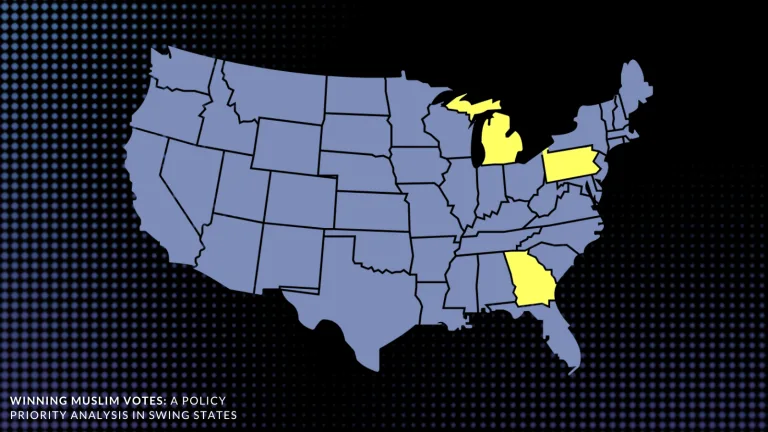
The following sheds light on Muslim voter preferences and opinions compared to the general public in three swing states (Georgia, Pennsylvania, and Michigan) fielded between June 20-July 8, 2024. A total of 1,604 likely voters were surveyed, including 888 Muslims and 716 members of the general public across the three states.
While President Biden is no longer the Democratic nominee, insights from this survey remain relevant to any candidate of any party wishing to win Muslim votes in three key swing states.
The war in Gaza is the top issue for Muslims in three swing states
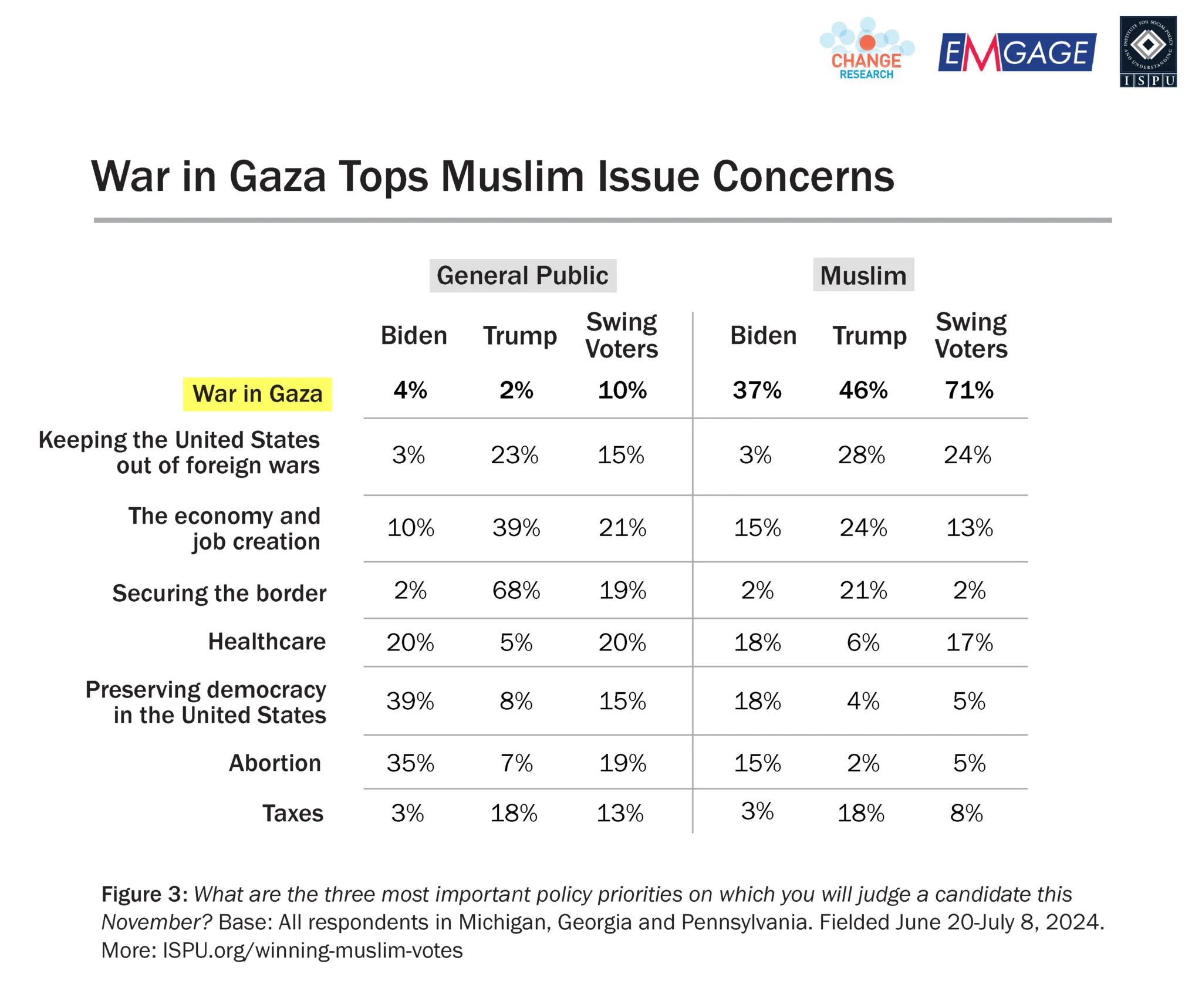
The war in Gaza is the most widespread Muslim priority regardless of partisanship, age, or ethnicity. The majority (61%) of all Muslims across the three states say that the war in Gaza is one of the top three most important priorities on which they will judge a candidate. The second most widespread Muslim priority is to keep the US out of foreign wars (22%).
We define “swing voters” as those who said they would choose either a third party candidate, are yet undecided, or would not vote; “Biden voters” are those who supported the President before he withdrew from the race. Among Muslim Biden voters, 37% say the war in Gaza is a top priority for this election. This is also true of 46% of Muslim Trump voters and 71% of Muslim swing voters.
Age also makes little difference as to the importance of the war in Gaza, where 67% of Muslims aged 18-34 years old, 59% of Muslims aged 35-49 years old, 61% of Muslims aged 50-64 years old, and 56% of Muslims aged 65+ years old say the war in Gaza is a top priority for this election. The war in Gaza is also the most frequently chosen policy priority among Muslim voters, regardless of race. We found 53% of white Muslims, 38% of Black Muslims, 63% of Asian Muslims, and 74% of Arab Muslims say the war in Gaza is a top priority for this election. Unlike previous elections, only one issue dominates the concerns of Muslim voters with no close second. The war in Gaza unites Muslim voters around one issue.
Securing a permanent ceasefire improves candidate electability among all Democrats
- The majority of Biden voters in the general public in these states would be more likely to vote for a 2024 presidential candidate if they secured a ceasefire in Gaza at 57% vs. 3% that would be less likely and 34% for whom it makes no difference.
- Among Muslims, regardless of their chosen candidate for 2024, the majority say a permanent ceasefire in Gaza would make them more likely to vote for a candidate. This includes 89% of those who had planned to vote for Biden, 72% of those who chose Trump and 91% of “swing voters”.
- The plurality of Trump voters in the general public in these states say a candidate supporting a ceasefire makes no difference (45%), with equal portions saying it would improve their chances of voting (23%) and lessen their likelihood of voting for a candidate (21%). This marks a critical distinction between Muslim Trump voters and their partisan counterparts.
Biden loses significant Muslim support, driven by his Gaza policy; gained mostly by third party, or Trump
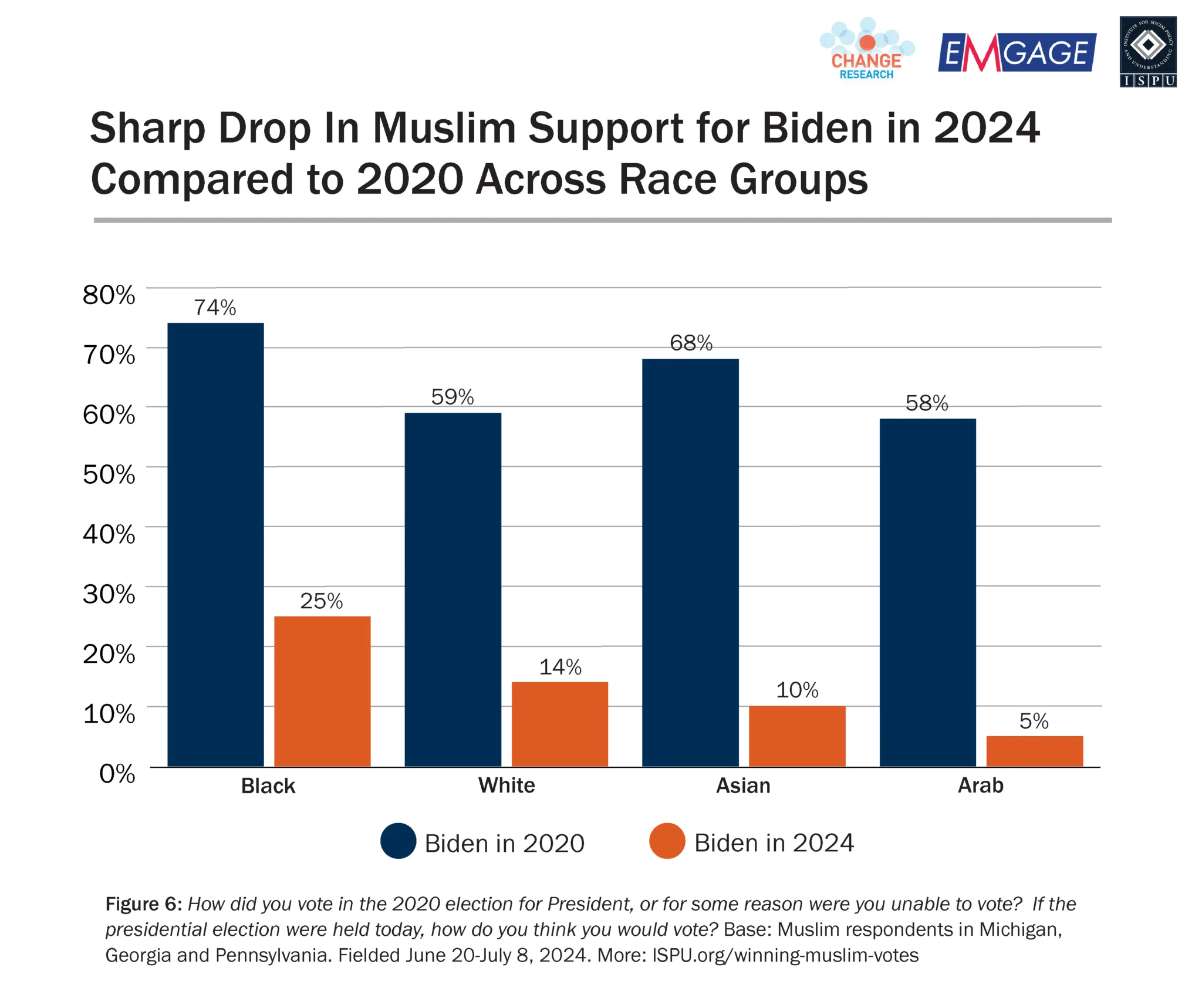
In 2024, only 12% of Muslims planned to vote for Biden before he exited the race, compared with 65% of Muslims who voted for him in 2020. Of those who voted for Biden in 2020 but said they wouldn’t vote for him again in 2024, 67% say that the war in Gaza is a top priority. By race, 14% of white Muslims, 25% of Black Muslims, 10% of Asian Muslims, and 5% Arab Muslims intended to vote for Biden in 2024.
However, the majority of Muslims who voted for Biden in 2020 but did not plan to vote for him in 2024 before he left the race are not switching to the other side of the aisle. Muslim support for Trump has remained roughly the same, where 18% say they voted for him in 2020 and 22% plan to vote for him in 2024.
This suggests that the shift away from Biden among Muslims is, for the most part, not being absorbed by Trump, but rather moving to third parties and those who are undecided.
- Nearly a third of Muslim voters (30%) will either vote third party (27%) or write in (3%).
- Muslim voters are more likely than the general public to say they do not plan to vote (13% vs 3%). This is not much higher than in 2020, where 9% did not vote.
- Of Muslims, 17% say they have yet to decide on a candidate vs. 6% of the general public.
Staying out of foreign wars
Keeping the United States out of foreign wars is a popular policy position across the board, regardless of partisanship or faith background, especially among Muslim swing voters. A strong majority of Muslim swing voters (83%) say a candidate’s support for staying out of foreign conflicts would make them more likely to vote for that candidate. Roughly the same portion of Muslim 2024 Trump voters (80%) say the same. The majority of Muslims who supported Biden in 2024 (64%) hold the same view.
In the general public, this position is popular with the majority of voters across the partisan spectrum. The majority of Biden voters (52%), Trump voters (82%) and swing voters (66%) say a candidate’s support for staying out of foreign wars would increase their likelihood of voting for that candidate. Staying out of foreign wars is second only to the war in Gaza as the most frequently mentioned top issue for Muslim swing voters (24%) and Muslim Trump voters (28%), but only 3% of Muslim Biden voters.
Countering Islamophobia
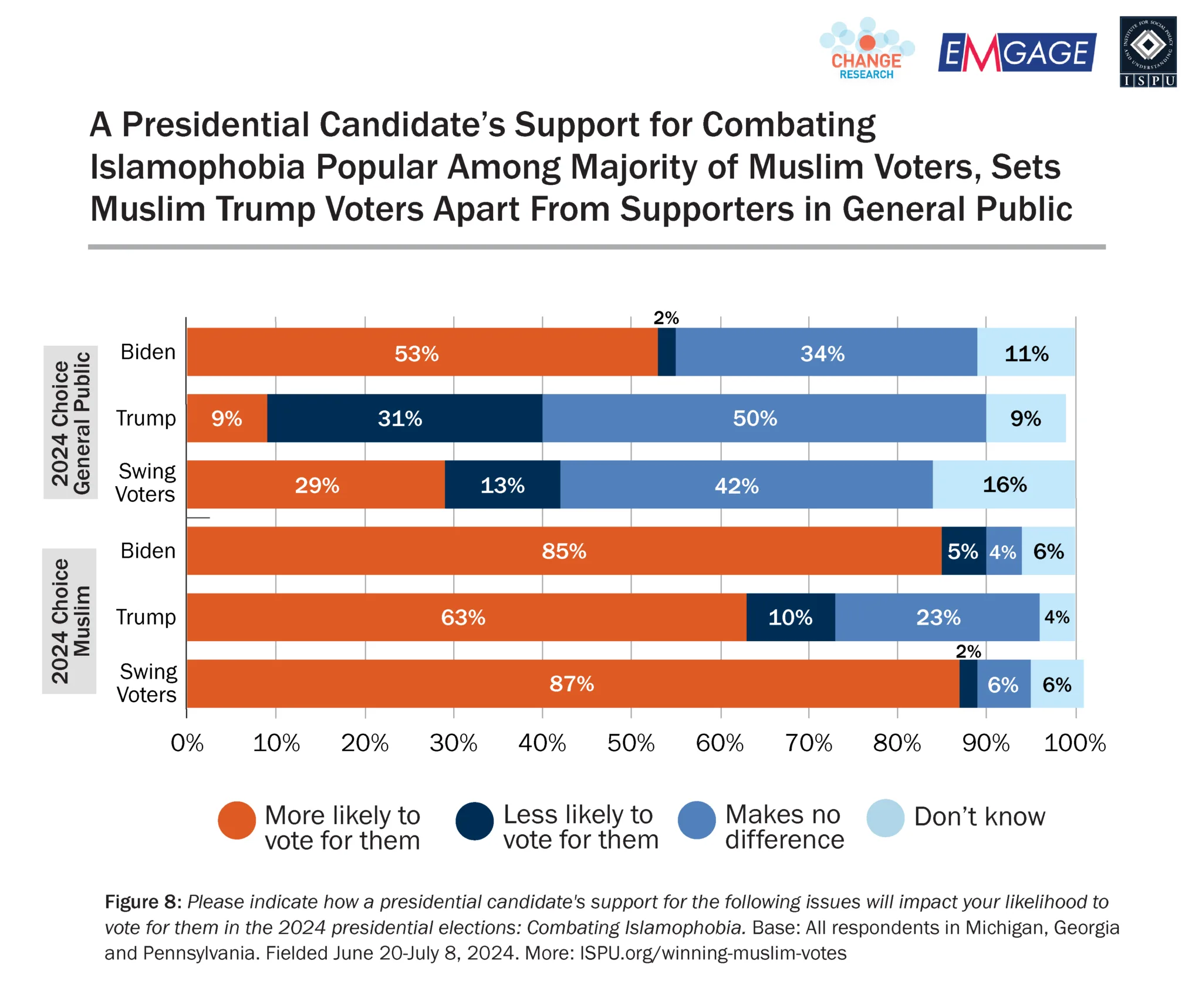
Countering Islamophobia, predictably, would make the majority of Muslims, regardless of partisanship, more likely to vote for a candidate. Among most Muslim Biden voters (85%) and Muslim swing voters (87%), a candidate’s support for combating Islamophobia would increase their likelihood of voting for that candidate, with only 5% and 2%, respectively, saying it would decrease it. Among Muslim Trump voters, 63% agree with their fellow faithful across the aisle, with 10% saying it would make them less likely to vote for a candidate on account of this position. This marks one of the issues Muslim Trump voters stand sharply apart from other Trump voters in the general public.
This position is a net negative for Trump voters in the general public, where 9% say it would increase their support and 31% say it would decrease it. In contrast, it is a net positive among the majority of Biden voters in the general public where 53% say it would increase their likelihood to vote for a candidate with only 2% saying it would decrease their support.
Support for traditional family and gender structures
Support for traditional family and gender structures is not a top policy priority for Muslim voters. There are many other policy issues like the war in Gaza, keeping the United States out of foreign wars, healthcare, the economy and job creation, student loan forgiveness, and freedom of speech on college campuses that rank higher. In fact, only 6% of Muslim voters state that preserving traditional values concerning gender and marriage is a top policy issue for them. However, whereas Gaza and Islamophobia set Muslim Trump voters apart from their partisan counterparts, support for traditional family and gender roles distinguishes Muslim Biden voters from their party members. Among Muslim Biden voters, 40% say support for this position would increase their likelihood to vote for a candidate compared to 18% who say it would decrease their support. Among Muslim swing voters, support for this position is also a net positive, with 58% saying it increases their support and 8% saying it decreases it. Muslim Trump voters are the most swayed by this issue, with 76% of Muslim Trump voters saying it increases their support and only 8% saying it decreases it.
Affordable healthcare and environmental protection
Support for affordable healthcare is a net positive across the partisan spectrum, but especially among Muslim Biden voters (85% say increase support vs. 2% say decrease support) and swing voters (83% increase support vs. 2% decrease support). The majority of Muslim Trump supporters (63% increase support vs. 9% decrease support) also regard a candidate’s support for affordable healthcare as a net positive for their vote. In the general public, a near consensus of Biden voters (94% increase support vs. 1% decrease support) say the same.
A strong majority of Muslim swing voters (72%) and Biden voters (88%) say a candidate’s support for protecting the environment would improve their chances of voting for that candidate. This is similar to Biden voters (91% say increase support vs. 1% say decrease support) in the general public. Among Muslim Trump voters, this position is a net positive (43% increase support vs. 11% decrease support), but a net negative among their partisan counterparts in the general public (19% increase support vs. 24% decrease support).
Muslim preferences similar across swing states
Our study found that Muslim preferences for candidates and policies do not differ substantially from state to state. Across the three swing states studied, Muslim support for Biden is low, ranging from Michigan (5%) to Georgia (17%). In all three states the war in Gaza dominates Muslim concerns, with the majority in Georgia (63%), Michigan (65%), and Pennsylvania (58%) choosing it as a top issue on which to judge a presidential candidate in November. This underscores the importance of addressing Muslim concerns about the war and a ceasefire regardless of the battleground state a candidate is hoping to win.
Muslim civic engagement grows
Our study found that Muslim voters across three battleground states were slightly more likely than the general public in these same states to contact a federal elected official, but slightly less likely to do the same with a local official. What is most striking about these results is that they significantly differ from earlier findings where ISPU’s national American Muslim poll found that in 2019 17% of Muslims nationally reported contacting a federal elected official compared to 31% of the general public. Whereas Muslims were almost half as likely as the general public to engage a federal elected official in 2019, in 2024 American Muslims have slightly surpassed those in the general public. This trend is also true when it comes to Muslims in three swing states contacting a local official. In 2019, 20% of Muslims nationally contacted a local official compared to 33% of the general public. While Muslims in 2024 still slightly trail the general public in those states in their likelihood to reach out to a local official, this gap has closed significantly since 2019.
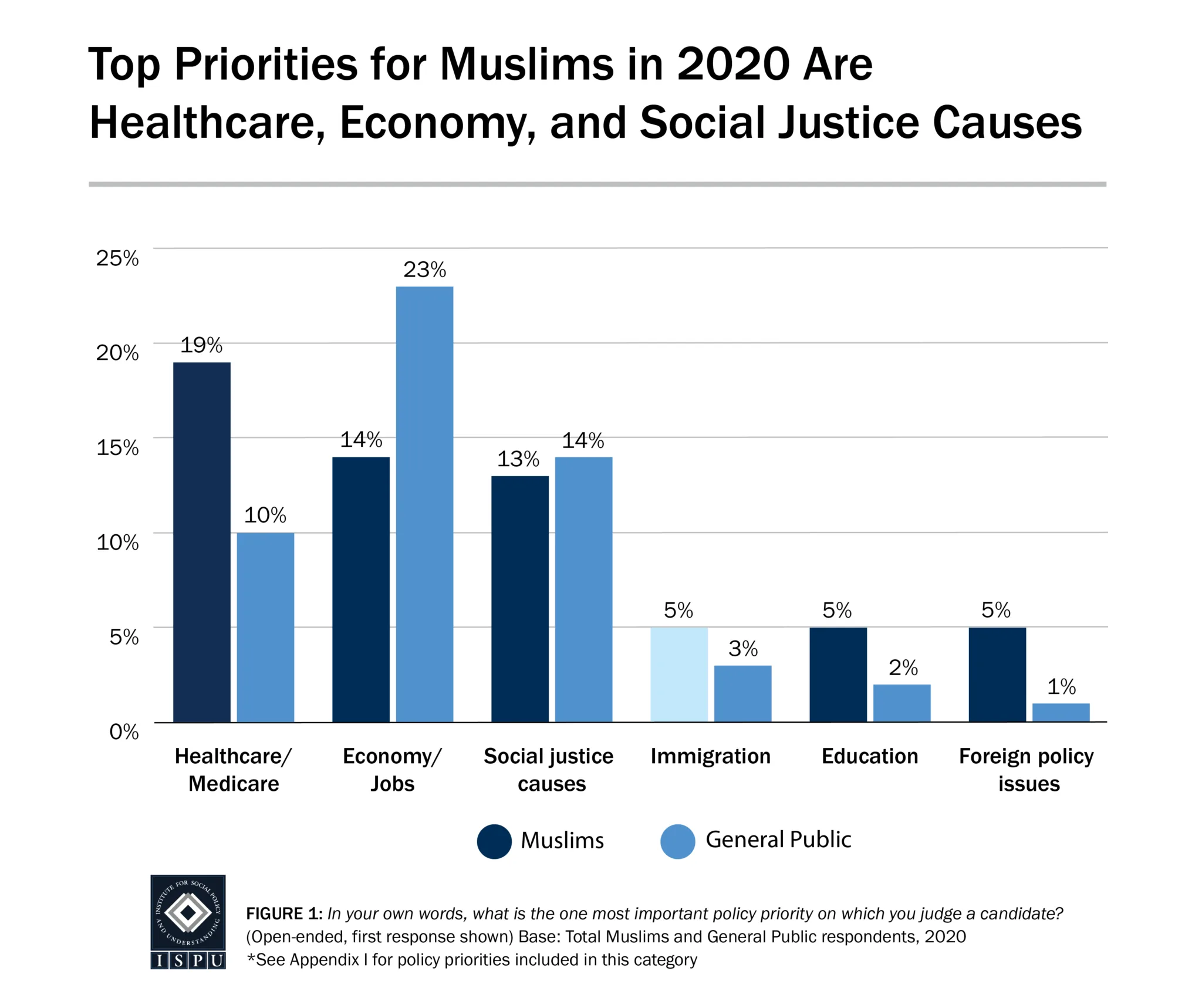
This suggests that the war in Gaza, which tops Muslim concerns, may have galvanized Muslims toward greater civic engagement. This assertion is further supported when considering national Muslim respondents’ response to an open-ended question asking them about the policy priorities they consider when judging a candidate in 2020. Healthcare (19%), economy and jobs (14%), and social justice causes (13%) topped the list, with “foreign policy issues” trailing at 5%. Not only did Muslims and the general public not differ dramatically on their priorities with the economy (23%), healthcare (10%), and social justice issues (14%) also topping the list for the general public, but no issue dominated the list for either group. That is in sharp contrast to 2024 where the majority of Muslims (61%) across three swing states cite the war in Gaza as a key issue on which they will judge a candidate–without a close second.
Among Muslims, Biden supporters are least likely to turn to social media for news
As has been widely reported, younger Americans are more likely to rely on social media as a source of news than older Americans in the general public. Among Muslims, this trend is still present, but less pronounced.
A more surprising trend in news sourcing appears when comparing Muslims across candidate preference. Only 5% of Muslim Biden supporters rely on social media for news compared to 25% of Trump voters and 28% of swing voters. Instead Muslim Biden voters (66%) are twice as likely as Muslim Trump voters (33%) and swing voters (32%) to rely on mainstream media sources such as TV news, radio or newspaper. This stark difference in news sourcing and the apparent importance of the war in Gaza in driving many 2020 Muslim Biden supporters away highlights the role of social media in shaping perceptions about the war.
American Muslim voters have overwhelmingly supported a Democratic candidate for president since 2004, and helped President Biden win a close victory in key swing states like Michigan, Pennsylvania and Georgia in 2020 when he got an average of 65% of the Muslim vote across these states. Before he left the race, only 12% still planned to vote for him, reversing a two decades trend. Our study suggests that this dramatic change was driven by Biden’s handling of the war in Gaza. Any candidate wishing to win over Muslim swing voters would do well to distance themselves from this policy in favor of one that pushes for a permanent ceasefire, and reduces military aid to Israel.
Analysis: Winning Muslim Votes in 2024
For the purposes of this analysis, the three states studied have equal weight and “Muslim Biden voters” or “Muslim Trump voters” refer to weighted representative samples of Muslims across the three swing states who chose these candidates in 2024 before Biden dropped out of the race. We refer to Muslims who were neither committed to Trump nor Biden at the time of the poll as “Muslim swing voters.” This group includes those who plan to vote for a third party candidate or write in, are undecided, or do not plan to vote. A representative sample of the general public in each state was also collected for comparison. While President Biden is no longer the Democratic nominee, insights from this survey remain relevant to any candidate of any party wishing to win Muslim votes in three key swing states.
In 2020, 65% of Muslim voters across the swing states of Michigan, Pennsylvania, and Georgia voted for Biden in what would become a narrow victory for the Democratic candidate. Before Biden exited the race in July, only 18% of Muslims across these states who voted for him in 2020 still planned to vote for him in 2024. This reflects 12% of all Muslim voters in these states, down from 65% in 2020. Our study shows few of those who abandoned Biden planned to switch sides of the aisle and vote for former President Donald Trump. Trump’s support among Muslims remained fairly unchanged, with 22% of Muslim voters planning to support Trump in 2024 compared to 18% in 2020. Muslim voters who say they do not plan to vote edged up only slightly from 9% in 2020 to 13% in 2024.
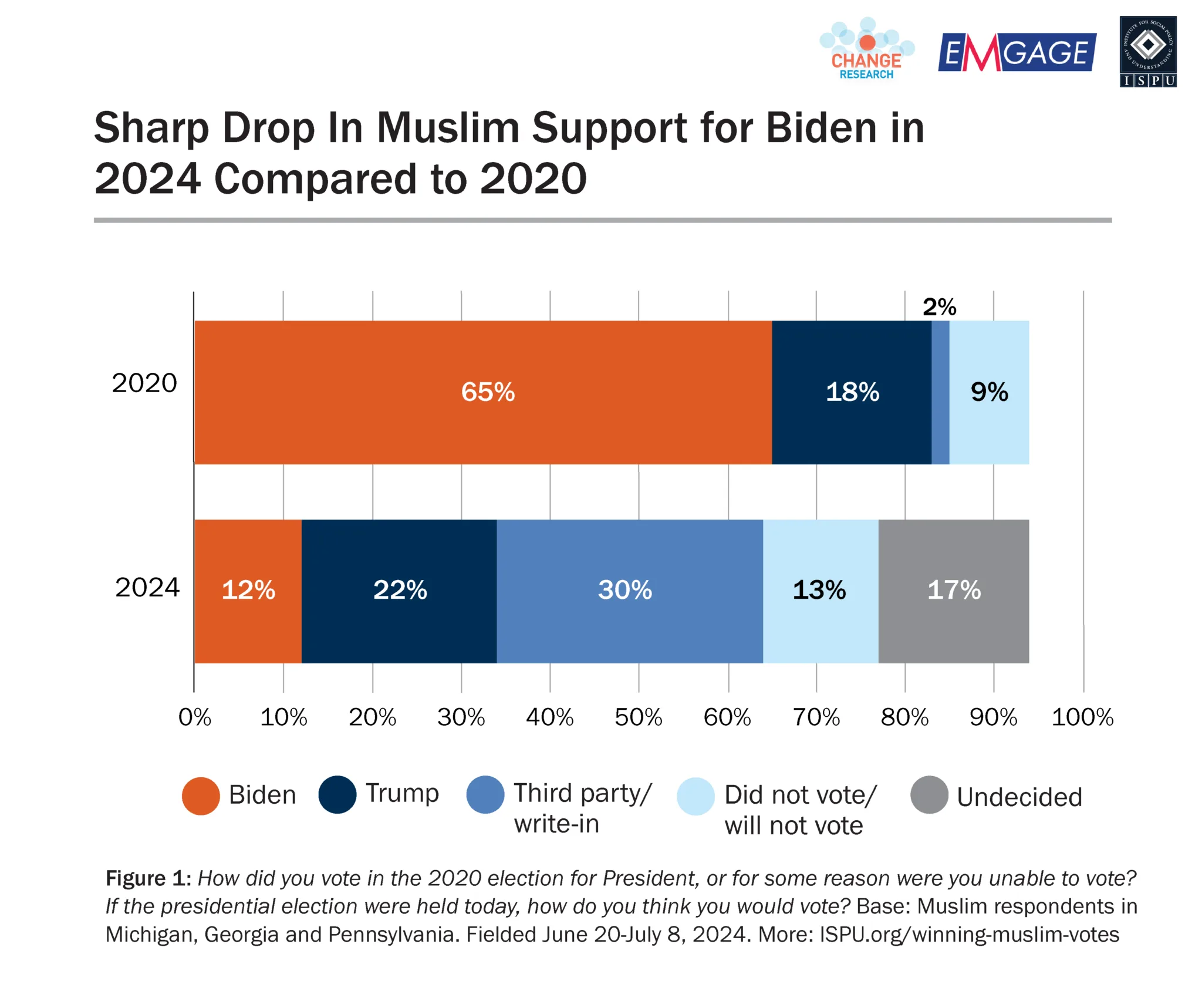
Instead, most of those who had decided against voting for Biden again intended to either vote for a third party candidate or write in a candidate (30%), or were as yet undecided (17%). Muslims (18%) in this survey are also more likely than the general public (11%) to identify as Independent, a finding that is consistent with ISPU’s nationally representative studies over the years showing that Muslims are the most likely religious group to consider themselves Independent. Muslims in these three swing states (20%) are also more likely to choose “other” for their political ID compared to the general public (8%).

This means that many Muslims were still uncommitted to a presidential candidate before Biden dropped out, and therefore could be won over by political hopefuls in any party willing to address their concerns. This group of Muslim swing voters includes those who plan to vote for a third party candidate or write in, are undecided, or do not plan to vote.
Ending the war in Gaza
Muslim swing voters’ top issue is the war in Gaza. The war in Gaza is the top issue among all Muslims, regardless of partisanship, but even more so among Muslim swing voters. When asked, “What are the three most important policy priorities on which you will judge a candidate this November?” 71% of Muslim swing voters chose the war in Gaza, compared to 46% of Muslims who plan to vote for Trump and 37% of those who had planned to vote for Biden this election.
When respondents were asked to indicate how a presidential candidate’s support for a number of issues will impact their likelihood to vote for them in the 2024 presidential elections, support for a permanent ceasefire in Gaza increased the support of the majority of Muslims, with 91% of Muslim swing voters, 89% of Biden voters, and 72% of Trump voters saying it would make them more likely to choose a candidate who supported this policy. This was also true of the majority of Biden supporters in the general public (57%), with just 3% saying it would decrease their likelihood of voting for the candidate.

The reduction of military aid to Israel also garnered the support of the majority of Muslim voters, regardless of party. Muslim swing voters (88%), Biden supporters (80%), and Trump supporters (75%) all overwhelmingly see support for this policy as a reason to vote for a candidate. It is also a net positive among those who had planned to vote for Biden in the general public, with 41% saying it would increase their likelihood to support a candidate, and 11% saying it would decrease their support and 35% saying it makes no difference.
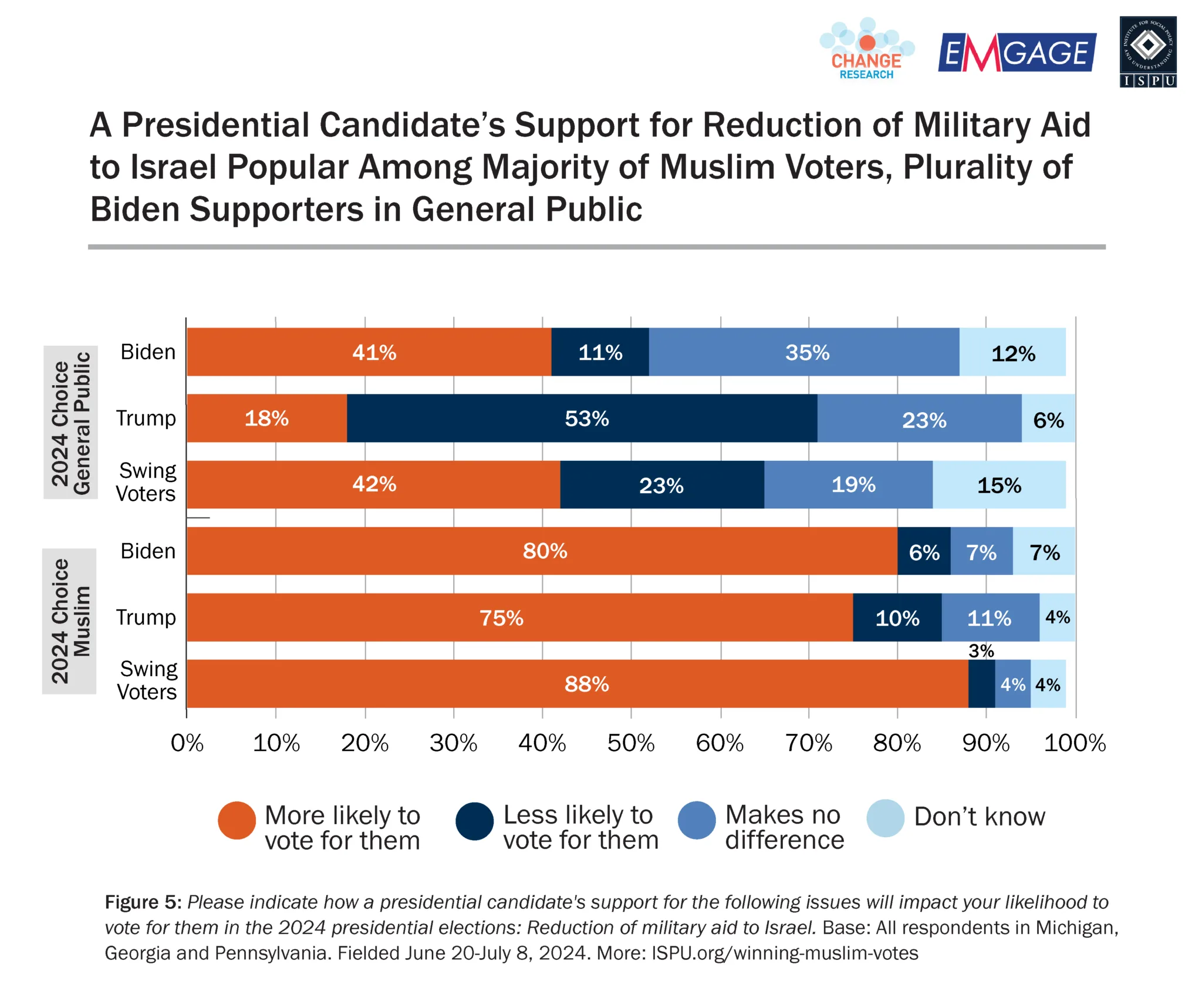
This issue sets Muslim Trump voters most apart from their partisan counterparts in the general public, with the majority of Trump voters in the general public (53%) saying reducing military aid to Israel would decrease their support for a candidate, compared to 10% of Muslim Trump supporters. Just 18% of Trump supporters in the general public say it would increase their likelihood of supporting a candidate, compared to 75% of Muslim Trump voters.
War in Gaza Dominates Muslim Concerns
The war in Gaza is the top issue for Muslims regardless of gender, age, race, nativity, or political affiliation
-
- The majority of Muslim voters (61%) include the war in Gaza as one of the top three most important policy priorities on which they will judge a candidate this November, without specifying whether the candidate is presidential, compared to 4% of the general public.
- This is by far the most salient concern among Muslim voters. The next most frequent response is staying out of foreign wars, at 22% (also a foreign policy issue).
- Gaza is a top issue for Muslims across gender (60% of men and 63% of women). Among Muslims, young people and their elders do not differ significantly on the importance of Gaza. It is the top issue in all age groups (67% of 18-34 year olds, 59% of 35 to 49 year olds, 61% of 50-64 year olds, 56% of 65+).
- Gaza is a top issue for all Muslims regardless of race: Arab (74%), Asian (63%), white (53%), and Black Muslims (38%).
- Among Muslims, Gaza is a top issue across partisan lines: Gaza is most often chosen among both those who voted for Biden (68%) and those who voted for Trump (47%) in 2020, as well as those who voted for a third party (51%).
- There is a similar trend when breaking down Muslim voters by party ID.
- Among voters who voted for Biden in 2020 and no longer planned to vote for him in 2024, the top issue for them (67%) is Gaza, without a close second.
- Muslim voters who intend to vote for Biden in 2024 still rate the war in Gaza as among the most important issues more frequently than any other issue (37%), but less so than those who intend to vote for Trump (46%), and half as likely as those who intend to vote third party (71%), or write in. This suggests the Muslim migration away from Biden is primarily animated by anger at his Gaza policy.
Securing a permanent ceasefire improves candidate electability among all Democrats
-
- The majority of Biden voters in the general public would be more likely to vote for a 2024 presidential candidate if they secured a ceasefire in Gaza at 57%, vs. 3% that would be less likely and 34% for whom it makes no difference.
- Among Muslims, regardless of their chosen candidate for 2024, the majority say a permanent ceasefire in Gaza would make them more likely to vote for a candidate. This includes 89% of those who had planned to vote for Biden, 72% of those who chose Trump, and 91% of swing voters.
- The plurality of Trump voters in the general public say a ceasefire makes no difference (45%), with equal portions saying it would improve their chances of voting (23%) and saying it would lessen their likelihood to vote for a candidate (21%). This marks a critical issue of distinction between Muslim Trump voters and their partisan counterparts.
Biden Loses Significant Muslim Support, Driven by His Gaza Policy; Gained Mostly by Third Party, Not Trump
Only 18% of Muslims who voted for Biden in 2020 still planned to vote for him in 2024
-
- In 2020, 65% of Muslim voters chose Biden. In 2024, 12% say they intended to vote for the current president, before he withdrew as nominee.
- By race, this breaks down as 14% of white, 25% Black, 10% Asian, and 5% Arab Muslims who intended to vote for Biden in 2024.
-
- In contrast, Muslim support for Trump has remained roughly the same, where 18% say they voted for him in 2020 and 22% plan to vote for him in 2024.
- Among the general public, 46% said they voted for Biden in 2020, while only 37% say they intend to vote for him in 2024, three times as likely as Muslims.
- In contrast, Trump voter support in the general public has remained unchanged at 45% in 2020 and 2024.
- In 2020, Biden (46%) narrowly beat Trump (45%) in these three swing states among the general public, suggesting the strong Muslim support Biden enjoyed in 2020 (65%) was critical to his victory.
- Muslim voters are more than twice as likely to say they will vote third party or write in (30%) than for Biden (12%), and nearly twice as likely to say they will vote for Trump (22%) as Biden (12%).
- Biden’s approval ratings in each group roughly mirror those who intend to vote for him, where again the general public is three times as likely (33%) as Muslims (10%) to approve of his job performance.
- Nationally, Biden’s approval rating among Muslims in 2022 was 60% according to ISPU’s American Muslim Poll.
- This suggests that the Muslim migration away from Biden is, for the most part, not being absorbed by Trump, but rather moving to third parties and those who are undecided.
- Nearly a third of Muslim voters (30%) will either vote third party (27%) or write in (3%).
- Muslim voters are more likely than the general public to say they do not plan to vote (13% vs 3%). This is not much higher than in 2020, where 9% of Muslims did not vote.
- Of Muslims, 17% say they have yet to decide on a candidate vs. 6% of the general public.
Staying out of foreign wars
Keeping the United States out of foreign wars is popular across the board, regardless of partisanship or faith background, especially among Muslim swing voters. A strong majority of Muslim swing voters (83%) say a candidate’s support for staying out of foreign conflicts would make them more likely to vote for that candidate. Roughly the same portion of Muslim Trump voters (80%) say the same. The majority of Muslims who planned to support Biden in 2024 (64%) hold the same view.
In the general public, this position is popular with the majority of voters across the partisan spectrum. The majority of Biden voters (52%), Trump voters (82%), and swing voters (66%) say a candidate’s support for staying out of foreign wars would increase their likelihood of voting for that candidate. Staying out of foreign wars is the second most frequently mentioned top issue, after the war in Gaza, for Muslim swing voters (24%) and Muslim Trump voters (28%), but only 3% of Muslim Biden voters.

Countering Islamophobia
Countering Islamophobia, predictably, would make the majority of Muslims, regardless of partisanship, more likely to vote for a candidate. Among most Muslim Biden voters (85%) and Muslim swing voters (87%), a candidate’s support for combating Islamophobia would increase their likelihood of voting for that candidate, with only 5% and 2%, respectively, saying it would decrease their likelihood of voting. Among Muslim Trump voters, 63% agree with their fellow faithful across the aisle, with 10% saying it would make them less likely to vote for a candidate on account of this position. This marks one of the issues where Muslim Trump voters stand sharply apart from other Trump voters in the general public.
This position is a net negative for Trump voters in the general public, where 9% say it would increase their support, and 31% say it would decrease it. In contrast, it is a net positive among the majority of Biden voters in the general public where 53% say it would increase their likelihood to vote for a candidate, with only 2% saying it would decrease their support.
Support for traditional family and gender structures
Whereas Gaza and Islamophobia set Muslim Trump voters apart from their partisan counterparts, support for traditional family and gender roles distinguishes Muslim Biden voters from their party members. Among Muslim Biden voters, 40% say support for this position would increase their likelihood to vote for a candidate compared to 18% who say it would decrease their support. Among Biden voters in the general public, this trend is roughly reversed: 18% say it would increase their support, while 47% say it would decrease it. Among Muslim swing voters, this position is a net positive, with 58% saying it increases their support and 8% saying it decreases it. Muslim Trump voters are on par with their counterparts in the general public, with 76% of Muslim Trump voters saying it increases their support and only 8% saying it decreases it. Among Trump supporters in the general public, 82% say the same, and only 3% say it would decrease their support.

Affordable healthcare and environmental protection
Support for affordable healthcare is a net positive across the partisan spectrum, but especially among Muslim Biden voters (85% say increase support vs. 2% say decrease support) and swing voters (83% increase support vs. 2% decrease support). The majority of Muslim Trump supporters (63% increase support vs. 9% decrease support) also regard a candidate’s support for affordable healthcare as a net positive for their vote. In the general public, a near consensus of Biden voters (94% increase support vs. 1% decrease support) say the same.
A strong majority of Muslim swing voters (72%) and Biden voters (88%) say a candidate’s support for protecting the environment would improve their chances of voting for that candidate. This is similar to Biden voters (91% say increase support vs. 1% say decrease support) in the general public. Among Muslim Trump voters, this position is a net positive (43% increase support vs. 11% decrease support), but a net negative among their partisan counterparts in the general public (19% increase support vs. 24% decrease support).
Muslim Preferences Similar Across Swing States
Our study found that Muslim preferences do not differ substantially from state to state. Across the three swing states studied, Muslim support for Biden is low, ranging from Michigan (5%) to Georgia (17%). In all three states the war in Gaza dominates Muslim concerns, with the majority in Georgia (63%), Michigan (65%), and Pennsylvania (58%) choosing it as a top issue on which to judge a presidential candidate in November. This underscores the importance of addressing Muslim concerns about the conflict regardless of the battle ground state a candidate is hoping to win.


Muslims Distinct from Partisan Counterparts on Key Issues, While Sharing Others
Gaza and Islamophobia separate Muslim Trump voters from partisan counterparts in the general public
- Trump voters in the general public favor military aid to Israel and see securing the border as their top issue. Muslim Trump voters oppose military aid to Israel and choose the war in Gaza as their top issue.
- Muslims who favor Trump differ significantly from their counterparts in the general public who favor the same candidate when it comes to military aid to Israel. There is little difference among Muslims regarding whether a reduction of military aid to Israel would improve their likelihood of voting for a presidential candidate. A strong majority across political persuasions (75%-88%) say this proposed change would improve their likelihood to vote for a 2024 presidential candidate. While the question of military aid to Israel divides other Americans along partisan lines (41% of those who favor Biden stated the reduction of aid to Israel improves their likelihood of voting for a presidential candidate, compared to 18% of those intending to vote for Trump), it does not do so for American Muslims.
- While “keeping the US out of foreign wars” is a top concern for Trump voters regardless of faith, the majority (53%) of those who choose him as their 2024 pick in the general public say that reducing military aid to Israel would make them less likely to vote for a candidate, suggesting that these voters make a striking exception for Israel when it comes to American isolationism.
- Trump voters in the general public say a candidate’s support for combating Islamophobia would decrease their likelihood of voting for the candidate three times more than those who say it would increase their likelihood of voting (31% vs 9%). Half (50%) say it makes no difference.
- The majority of Muslims, across political persuasions, say combating Islamophobia would make them more likely to vote for a candidate (85% of Biden voters, 63% of Trump voters and 87% of swing voters²).
Muslim Trump voters share partisan concerns about staying out of foreign wars, gender and sexuality
- Those who chose Trump as their 2024 presidential candidate indicated “keeping the United States out of foreign wars” as one of their top three priorities in both the Muslim (second most frequently chosen) and the general public (third most frequently chosen).
- The majority of Americans of all political opinions, in the general public or the Muslim community, say a candidate keeping the United States out of foreign wars increases their chances of voting for that candidate.
- This especially resonates among Trump voters (82%) in the general public, as well as Biden (64%) and Trump (80%) voters in the Muslim community.
- When asked if a presidential candidate’s support for traditional gender roles and family structures would increase, decrease, or make no difference to their likelihood of voting for that candidate, Muslims (76%) are as likely as general public Trump voters (82%) to say it would improve their chances, with just 8% of Muslim Trump voters and 3% of general public Trump voters saying it would decrease their chances.
Issues of gender and sexuality separate Muslim Biden voters from Biden voters in the general public
Although issues of gender and sexuality are not a top priority for Muslim voters, Muslim Biden voters differ from their political counterparts in the general public on the question of traditional gender roles and family structures, highlighting an area where Muslims often feel alienated from their partisan counterparts.
- When asked if a presidential candidate’s support for traditional gender roles and family structures would increase, decrease, or make no difference to their likelihood of voting for that candidate, Muslim Biden voters (40%) are more likely than general public Biden voters (18%) to say it would improve their chances of voting for the candidate.
- Far more (47%) Biden voters in the general public would be less likely to vote for a candidate on account of their support for this issue, while this is true for only 18% of Muslim Biden voters.
- Muslim Biden voters are more similar to the public at large in these three states where 50% say support for traditional family and gender structures would increase their likelihood to vote for a candidate, and 25% say it would decrease it.
- Muslim swing voters roughly mirror Muslim Biden voters (58% increase support vs. 8% decrease support), suggesting their decision not to vote for Biden was not on account of gender or sexual identity issues.
Muslim Biden voters share partisan concerns on the environment, combating Islamophobia, and the desire for a ceasefire in Gaza
- The majority of Muslim Biden voters (88%) and Biden voters in the general public (91%) say a candidate protecting the environment improves their likelihood of voting for them.

- The majority of Biden voters in the general public (53%) say combating Islamophobia would improve their likelihood to vote for a candidate, while only 2% saying it would make them less likely to do the same. The majority of Muslims, across political persuasions, say combating Islamophobia would make them more likely to vote for a candidate (85% of Biden voters, 63% of Trump voters, and 87% of swing voters).
- The majority of Biden voters in the general public would be more likely to vote for a 2024 presidential candidate if they supported a permanent ceasefire in Gaza (57%) compared to 3% that would be less likely and 34% for whom it makes no difference.
- Among Muslims, regardless of their chosen candidate, the majority say support for a permanent ceasefire in Gaza would make them more likely to vote for a candidate.
- Biden voters in the general public are almost four times as likely (41%) to say reducing military aid to Israel would make them more likely to vote for a candidate in 2024, rather than less likely (11%).
Muslim Civic Engagement Grows
Our study found that Muslim voters across these three battleground states were slightly more likely than the general public in the same states to contact a federal elected official, but slightly less likely to do the same with a local official. What is most striking about these results is that they significantly differ from earlier national-level findings from ISPU’s American Muslim Poll. That study found that, in 2019, 17% of Muslims nationally reported contacting a federal elected official, compared to 31% of the general public. Whereas Muslims were almost half as likely as the general public to engage a federal elected official in 2019, in 2024 Muslims have slightly surpassed their counterparts in the general public. This trend is also true when it comes to Muslims in three swing states contacting a local official. In 2019, 20% of Muslims nationally contacted a local official compared to 33% of the general public. While Muslims in these swing states in 2024 still slightly trail the general public in those states in their likelihood to reach out to a local official, this gap has closed significantly since 2019 when ISPU fielded this question nationally.

This suggests that the war in Gaza, which tops Muslim concerns, may have galvanized Muslims toward greater civic engagement. This assertion is further supported when considering national Muslim respondents’ response to an open-ended question asking them about the policy priorities they consider when judging a candidate in 2020. Healthcare (19%), economy and jobs (14%), and social justice causes (13%) topped the list, with “foreign policy issues” trailing at 5%. Not only did Muslims and the general public not differ dramatically on their priorities with the economy (23%), healthcare (10%), and social justice issues (14%) also topping the list for the general public, but no issue dominated the list for either group. That is in sharp contrast to 2024 where the majority of Muslims (61%) across three swing states cite the war in Gaza as a key issue on which they will judge a candidate–without a close second.
Whereas the segment of Muslim voters who engaged an elected official has climbed in 2024 in three swing states compared to the 2019 national sample of Muslims, the segment of the community that reports contributing to a political campaign has stayed roughly the same since 2019. In 2024, Muslim voters (24%) in Michigan, Georgia, and Pennsylvania are as likely as the general public (21%) in those states to contribute to a political campaign in the last 12 months. This is comparable to 21% of Muslims nationally in 2020 and 19% in the general public. Whereas Muslims nationally were as likely to reach out to an elected official as donate to a campaign in 2019 and 2020 respectively, in 2024 Muslims are more likely to have contacted their elected official, both local (35%) and federal (38%), than to have donated to a campaign (24%). This may reflect multiple Muslim national calls to phonebank elected officials for a ceasefire in Gaza as early as October 2023, especially in swing states like Michigan. This mobilized significant segments of the Muslim community toward political action, including engaging elected officials, bringing them on par with the general public in their states.
While Muslim voters in three swing states have caught up to the general public in their likelihood to engage elected officials and are on par in contributing to political campaigns, Muslims in these states are more likely (13%) than the general public (3%) to say they do not plan to vote. This segment of eligible Muslims who do not plan to vote has remained largely unchanged since 2020 (9%) according to this study. Nationally, 15% of eligible Muslim voters say they do not plan to vote, staying roughly the same since 2016. In 2016, the top two reasons cited for not wanting to vote included “no one represents my priorities” and “my vote will make no difference.” While one segment of the community has been activated to become more civically involved because of the war in Gaza, another segment remains skeptical of the impact of their involvement.
Among Muslims, Biden Supporters Least Likely to Turn to Social Media for News
Media consumption patterns differ widely by age, especially in the general public. For example, younger people [18 to 34 year olds] (14%) are far less likely to get their news from TV news than older adults [50 to 64 year olds] (34%) or senior respondents [65+ years old] (54%). Among younger people, 32% turn to social media for their news, including Facebook, Instagram, TikTok, and X, while only 3% of 65+ say the same.
Interestingly, the difference across age groups is less stark among Muslims in terms of reliance on TV news. Across age groups, the range is narrower with 24% of 18 to 34 year old Muslims looking to TV news and 33% of 65+ saying the same. Variance with age regarding looking to social media for news is also narrower than the general public, but follows a similar trend. Younger [18 to 34 year olds] Muslims (38%) are more likely than older adults [50 to 64 year olds] (20%) and senior respondents [65+] (9%) to rely on social media for news. Muslims across age groups are more likely than their counterparts in the general public to rely on social media.
News websites other than social media and online versions of mainstream newspapers like the New York Times capture a significant segment of both the general public and Muslims across age groups. This fragmentation in news sources reflects the way mainstream news sources have lost their monopoly on information, and suggests a bias in favor of corporate and government interests.

A more surprising trend in news sourcing appears when comparing Muslims segmented according to candidate preference. Only 5% of Muslim Biden supporters rely on social media for news compared to 25% of Trump voters and 28% of swing voters. Instead, Muslim Biden voters (66%) are twice as likely as Muslim Trump voters (33%) and swing voters (32%) to rely on mainstream media sources such as TV news, radio, or newspaper. This stark difference in news sourcing and the apparent importance of the war in Gaza in driving many 2020 Muslim Biden supporters away underscores the role of social media in shaping perceptions about the war.

Conclusion
American Muslim voters have overwhelmingly supported a Democratic candidate for president since 2004. They also helped President Biden secure a close victory in key swing states like Michigan, Pennsylvania, and Georgia in 2020, where he got an average of 65% of the Muslim vote across these states. Before he left the race, only 12% still planned to vote for him, reversing a two-decade-long trend. Our study suggests that this dramatic change was driven by Biden’s handling of the war in Gaza. Any candidate wishing to win over Muslim swing voters would do well to distance themselves from this policy in favor of one that pushes for a permanent ceasefire and reduces military aid to Israel.
Footnotes
¹ The general public sample does not contain Muslim respondents.
² Others includes: third party, write-in, would not vote, undecided
Dalia Mogahed is a scholar at the Institute for Social Policy and Understanding. Mogahed is the former Director of Research at ISPU, where she led the organization’s pioneering research and thought leadership programs on American Muslims. She is also the former Executive Director of the Gallup Center for Muslim Studies, where she led the analysis of surveys of Muslim communities worldwide.
Learn more about Dalia→