The American Muslim narrative is often defined by Arab and South Asian immigration, but this only tells just one part of the story. Muslim converts–those Muslims who were raised in another religious or non-religious tradition–make up a significant segment of American Muslim communities, but are rarely included in media images of the community and even less often researched empirically. This data sheds light on the community Islam has attracted in America, using results from the Institute for Social Policy and Understanding’s (ISPU) American Muslim Poll 2022.
This research does not include data on how long a convert has been Muslim. Therefore this piece is not focused on facts or experiences of new Muslims, but rather is focused on facts about Muslims who were raised in another religious or non-religious tradition, regardless of when they became Muslim. The full poll methodology is available here.
American Muslims are the most diverse religious community in America and their pathway to the faith is but one way they vary. However, what unites all Muslims regardless of race, conversion, socio-economic status or partisanship is a shared set of spiritual beliefs. Whether a Muslim was raised in the faith or embraced it later in life, Islam is an important part of the daily life and identity of the vast majority, and for many, the mosque plays a central role. Muslim converts are as much a part of the American Muslim story as those raised in the faith and should be understood and represented accordingly.
Among U.S. Muslims, 20% were raised in some other religion (or no religion) and 80% were raised Muslim. In comparison, 88% of Jews and 89% of Catholics were raised in their current religion, and 12% were raised in some other religion (or no religion). Additionally, 85% of Protestants were raised as Protestant. Converts make up a sizable portion of Muslim communities, enriching the diversity of the American Muslim story.

Nearly nine in ten Muslim converts report being raised in the Christian religion (88%). Forty-five percent of Muslim converts report being raised “Christian,” 28% were raised “Protestant”, and 15% were raised Catholic. Additionally, 9% of Muslim converts reported being raised with “no religion.” Knowing the religious (or non-religious) background of Muslim converts provides greater understanding of their spiritual context.
Fifty-two percent of Muslim converts are male and 48% are female. In the U.S., Islam is as likely to attract women and men.

In terms of race and ethnicity, 50% of Muslim converts identify as non-Hispanic Black, compared with 22% of those born Muslim. Additionally, 17% of Muslim converts are Hispanic, compared with 6% of born Muslims. One in four (25%) Muslim converts are non-Hispanic white, similar to 28% of born Muslims. Three percent of converts are Native American vs. 1% of born Muslims. Five percent each of both converts and born Muslims are of mixed race/ethnicity.
None of our respondents who identified as converts identify as Arab or Asian, compared with 15% and 23% of born Muslims, respectively. In terms of nativity, 92% of converts were born in the United States, more likely than 55% of born Muslims.
Islam appears to attract racial minorities disproportionately in the United States, especially Black Americans, perhaps partially because of the religion’s message of racial equality and the long Black Muslim history in the United States dating back to the transatlantic slave trade and Muslim contributions to the Revolutionary war.

Among Muslim converts, 11% are between the ages of 18-24 years old, less likely than 30% of born Muslims. Nearly one-quarter of convert Muslims (24%) are between the ages of 50-64 years old, more likely than just 11% of born Muslims. Convert and born Muslims are equally likely to be between the ages of 25-29 years old (10% and 12%, respectively) and 30-49 years old (36% and 42%, respectively). Given the disparity between convert and born Muslims who are 18-24 years old, it makes sense that born Muslims are far more likely than converts to be students (41% vs. 14%, respectively). Perhaps unsurprisingly, converts’ age profiles more closely mirror the general American public than that of born Muslims who are far more likely to be immigrants.
Despite the converts being older, however, they have lower levels of education than born Muslims. Fifteen percent of converts hold a bachelor’s degree or higher, compared with 42% of born Muslims. It follows that convert Muslims are more likely than born Muslims to report a household income below $30,000 (44% vs. 30%, respectively). Islam’s initial followers during its founding in Mecca in the seventh century were mostly the disadvantaged of society. The religion’s message of human equality and its offering of a merit-based vs. a material wealth-based criteria for one’s standing with God has long been a source of hope for the less privileged. The more wealthy and elite joined the religion en masse when it was established as the dominant political force.
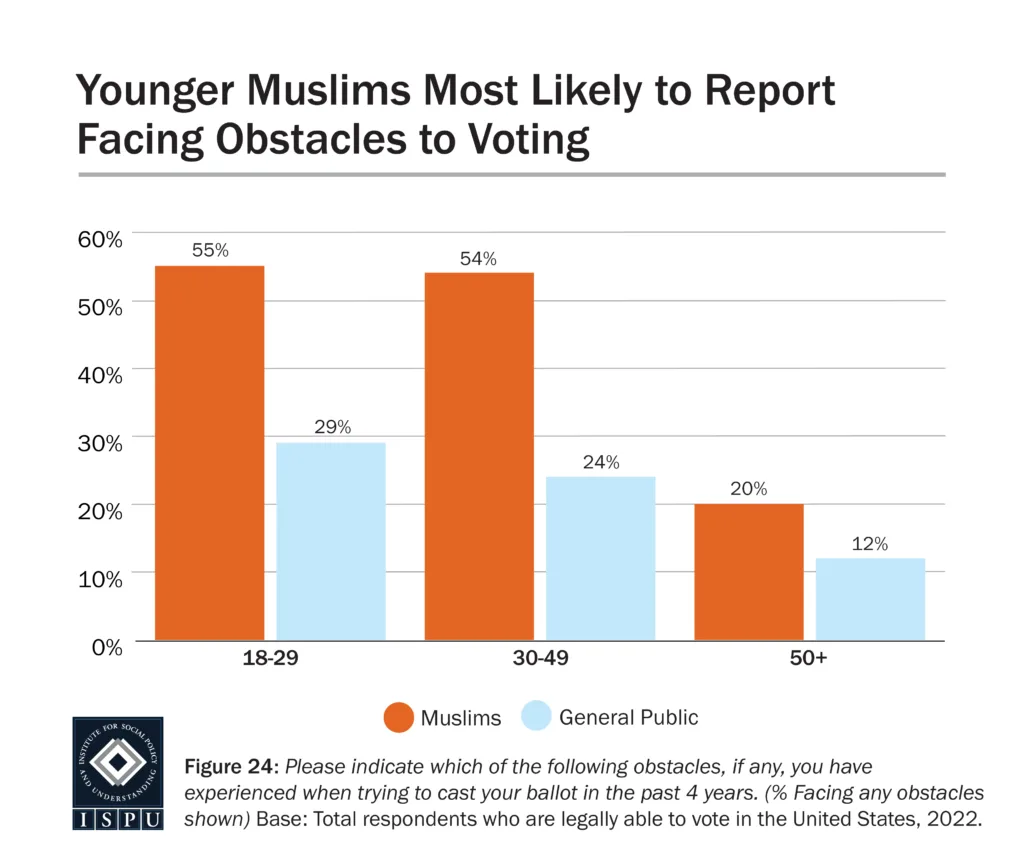
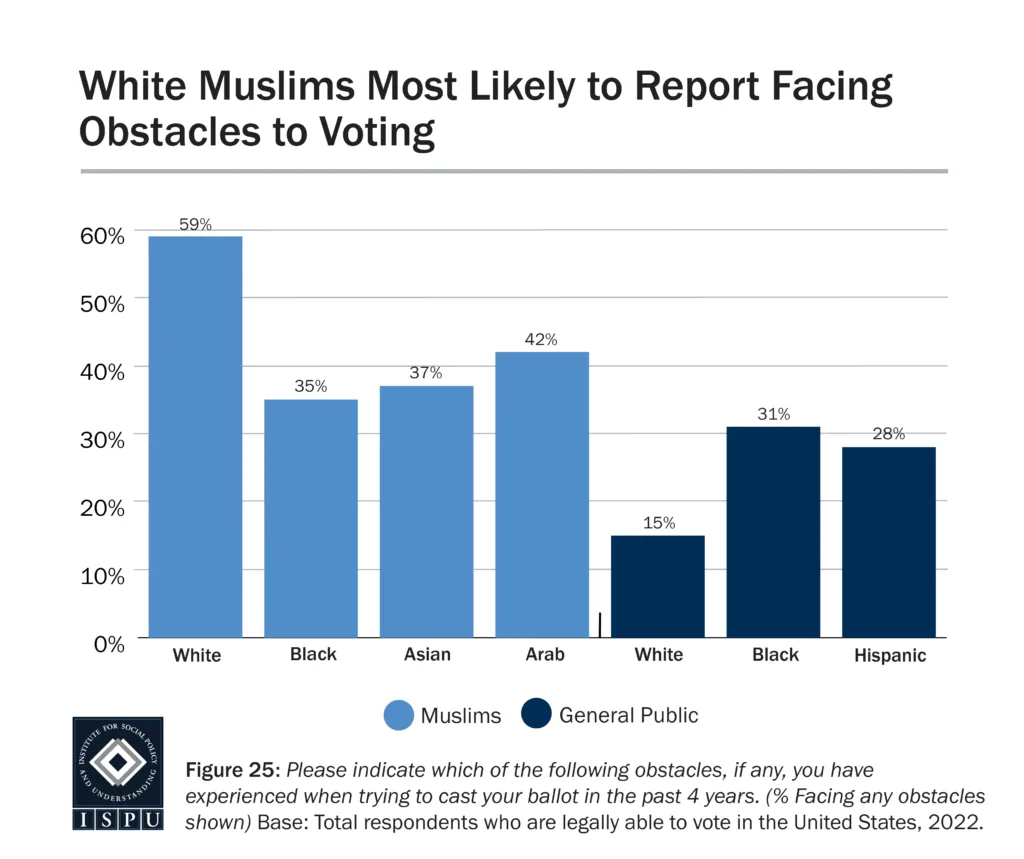
Though converts (95%) are more likely than born Muslims (75%) to be eligible to vote, among those who are eligible, converts (78%) are as likely as born Muslims (82%) to be registered to vote. However, converts (71%) are more likely than born Muslims (48%) to have faced no obstacles when trying to vote in the previous four years (since 2022). Previously published ISPU data that younger Muslims are more likely than older Muslims to report facing obstacles and white Muslims are more likely than non-white Muslims to report facing obstacles may help to provide context on this finding. In terms of political partisanship, converts and born Muslims are similar. Nine percent of converts are Republican, on par with 11% of born Muslims. Additionally, 41% of converts are Democrats, on par with 48% of born Muslims. Finally, 40% of both convert and born Muslims are independents.
Convert and born Muslims are equally likely to say that religion is important to their daily life (94% and 93%, respectively). When it comes to religious attendance, converts (42%) and born Muslims (41%) are equally likely to report attending a religious service once a week or more. However, on the other end of the spectrum, converts (22%) are more likely to report attending a mosque ‘seldom/less often than a few times a year’ than born Muslims (13%). Muslim community leaders can utilize resources like ISPU’s Reimaging Muslim Spaces research to create a more welcoming environment for converts in addition to creating programming and services tailored to their needs.

Since 2018, ISPU’s American Muslim Poll has included the National American Islamophobia Index, measured across American religious and non-religious groups. The Islamophobia Index is a measure of the level of public endorsement of five false negative stereotypes associated with Muslims in America. In 2022, convert Muslims were far less likely than born Muslims to endorse Islamophobic beliefs about other Muslims. Converts are more likely than born Muslims to disagree that:
Converts (50%) are more likely than born Muslims (34%) to say they never experienced religious discrimination in the past year. This difference was most pronounced when comparing discrimination in specific settings, namely at the airport (18% of converts vs 49% of born Muslims). This pattern holds true for the experiences of school-aged children. Born Muslims with school-aged children (55%) are far more likely than converts with school-aged children (23%) to report their children were bullied in school on account of their religion. This may be because those who convert to Islam are less likely to be recognized by those outside the religion as Muslim.
Converts (44%) and born Muslims (39%) are equally likely to have children in school. Nearly three quarters of both convert Muslim and born Muslim families with school-aged children send their kids to public school (73% and 72%, respectively). Where convert Muslims and born Muslim families with school-aged children differ is in the proportion who send their kids to Islamic schools (4% of converts vs. 28% of born Muslims). This may reflect economic obstacles among converts to access private Islamic schools, underscoring the need for more financial aid offerings. On the other hand, convert Muslims with school-aged children are more likely to report homeschooling (18%) their kids than born Muslims (3%). While convert and born Muslims are equally likely to have kids in school, convert Muslims (17%) are less likely to report taking care of an aging parent than born Muslims (40%).