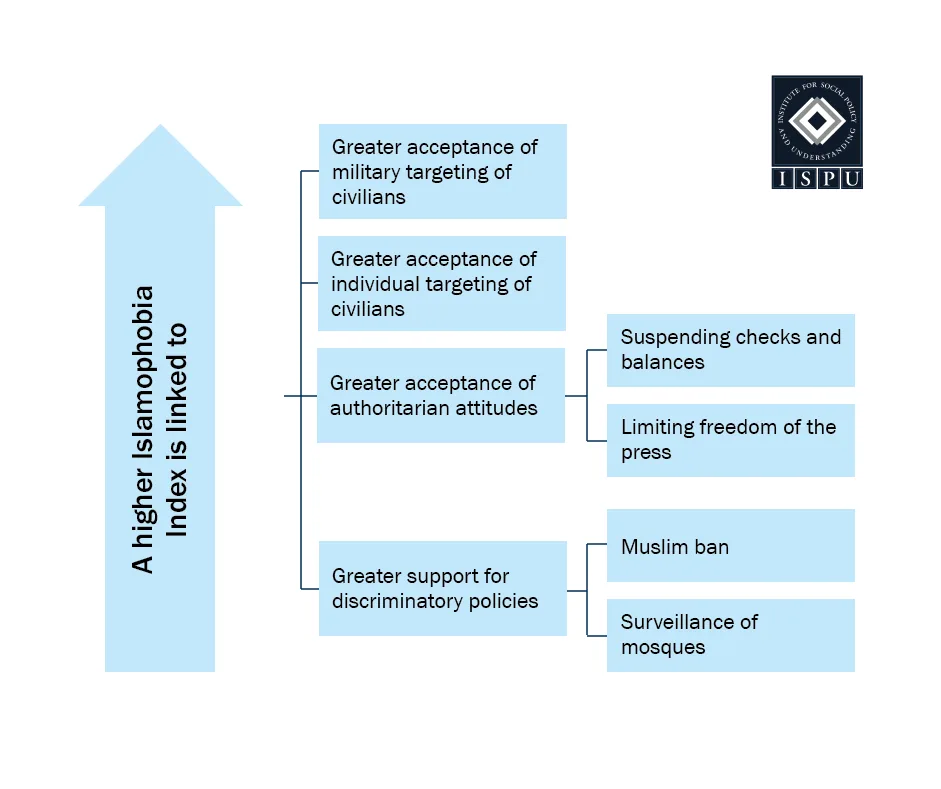
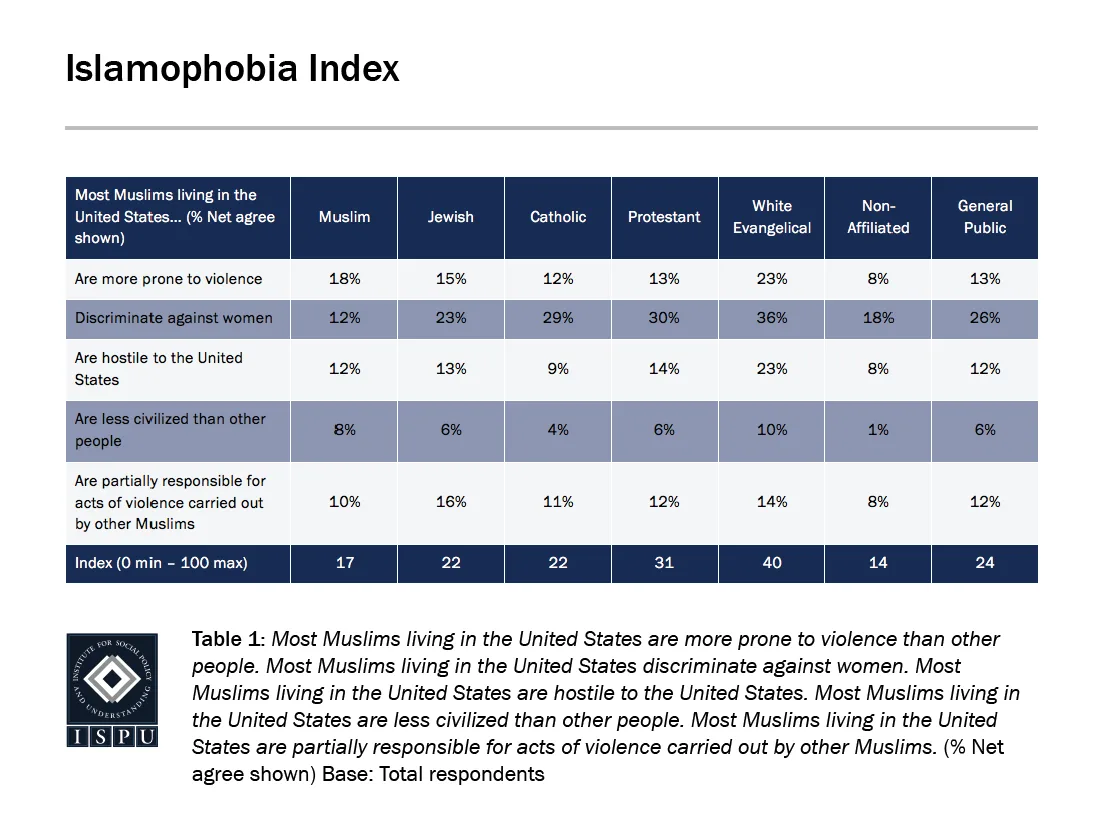
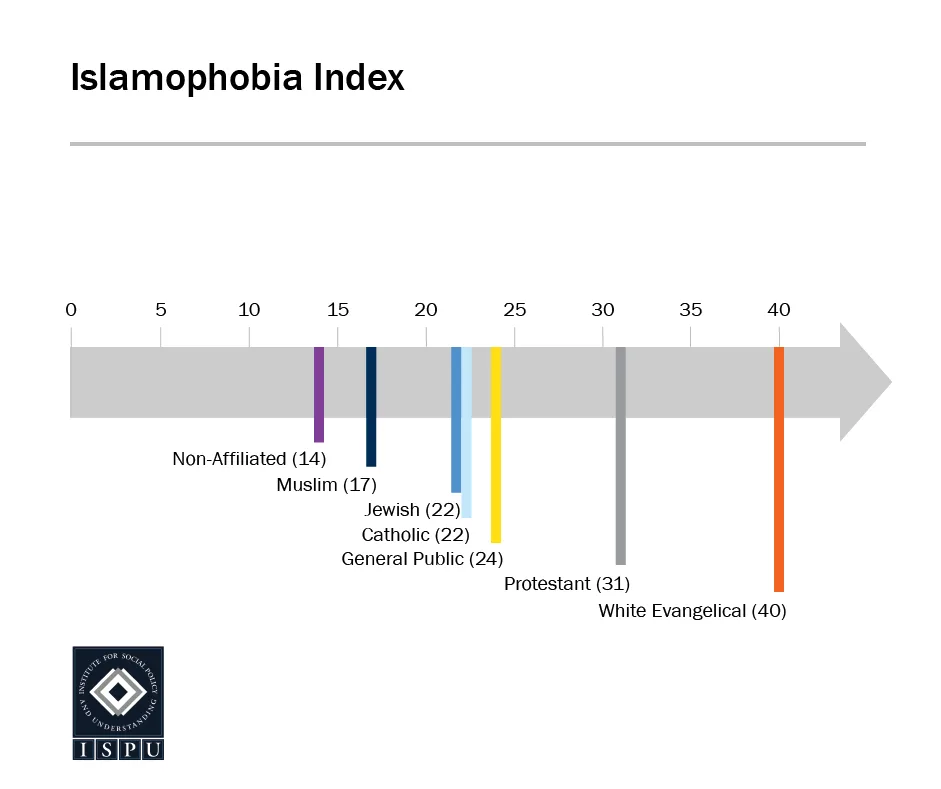
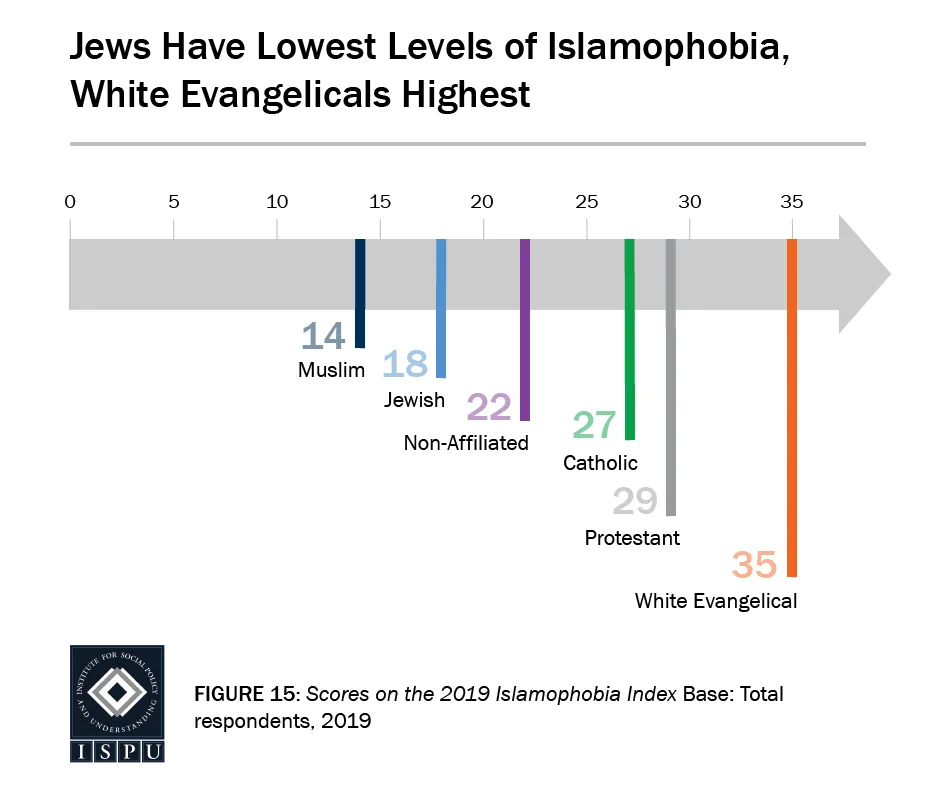
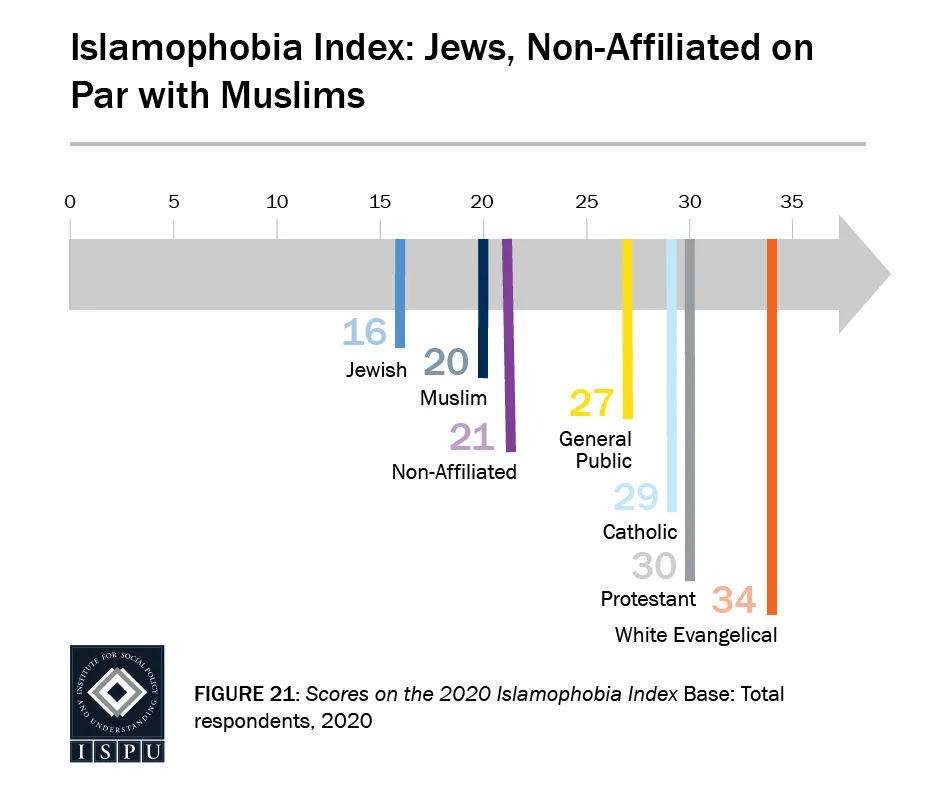
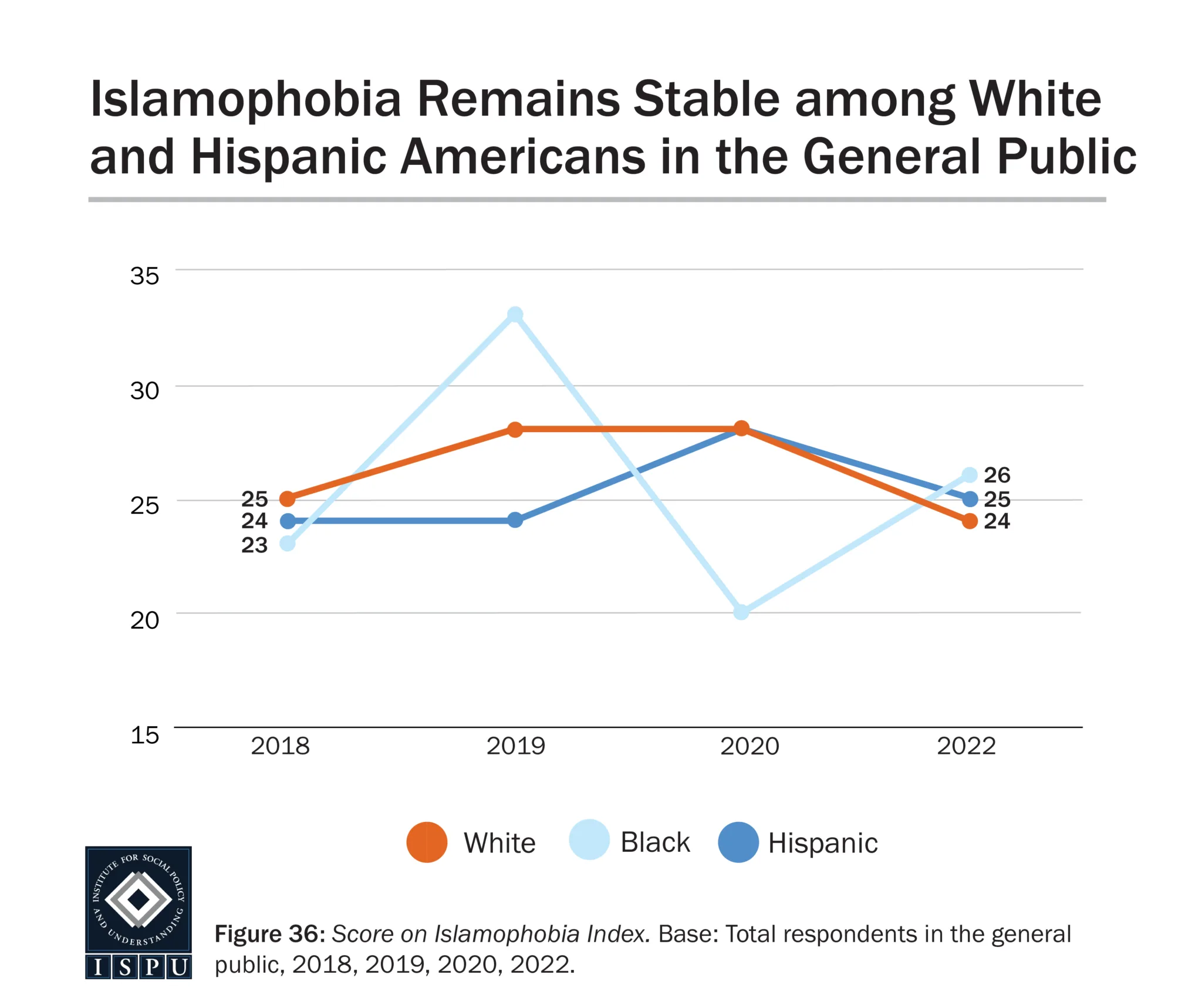
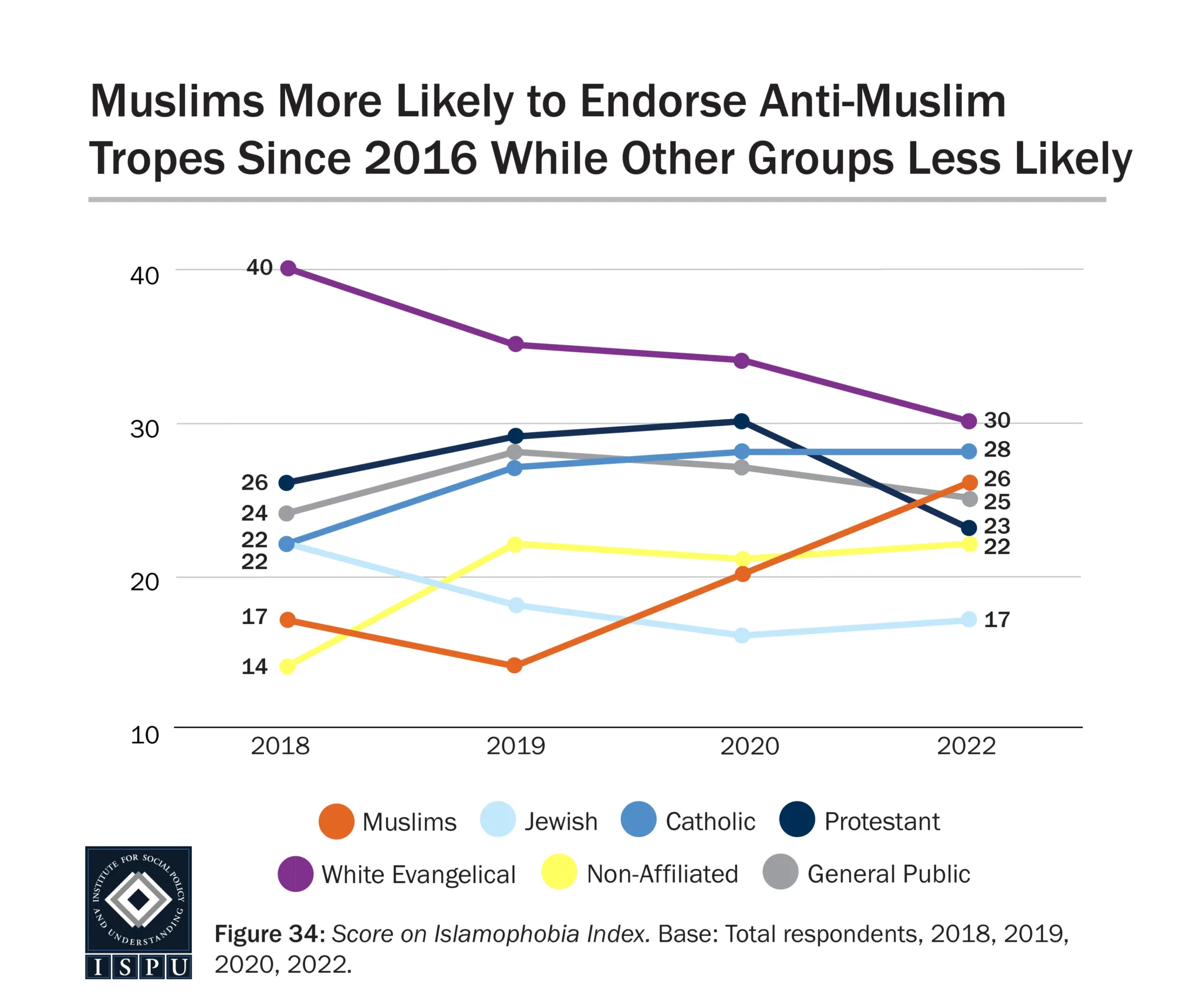
In the American Muslim Poll 2022: A Politics and Pandemic Status Report, for the fourth year, we measured the Islamophobia Index, a measure of the level of public endorsement of five negative stereotypes associated with Muslims in America. The general public scored 25 (on a scale of 0 to 100), on par with 27 in 2020. American Muslims scored 26 on the Islamophobia Index, higher than Jewish Americans who scored the lowest at 17. Protestants (23) and the nonaffiliated (22) scored similarly, while Catholics (28) and white Evangelicals (30) were highest. We find that over time, Islamophobia has declined among other groups but has increased among Muslims. For Muslims, scores on the Islamophobia Index have increased from 18 in 2018 to 25 in 2022. Between 2020 and 2022, the score increased six points from 20 to 26.
Further analysis reveals that higher Islamophobia Index scores among Muslims are driven primarily by Muslims who identify as ‘white.’ In 2020, white Muslims showed increased Islamophobia with a score of 27, followed by an even larger increase in 2022 with a score of 40, significantly higher than white Evangelicals (30). Further research is needed to explain why there has been such a large increase in Islamophobia among white Muslims.
Endorsing negative stereotypes about one’s own community is referred to as internalized oppression, or internalized bigotry or racism in the case of a racial group. It is worth noting that, compared with older Muslims, internalized Islamophobia is more prevalent among younger Muslims, who have lived the majority of their lives after 9/11/2001, in a country that has demonized their identity in popular culture, news media, political rhetoric, and in policy. Research suggests that this kind of steady drumbeat of bigoted ideas and state actions have a detrimental impact on the target group’s self-image and mental health.
Another noteworthy and alarming finding were the disproportionately negative views among white Muslims, who are also the most likely to report experiencing ‘regular’ religious discrimination. Some studies on internalized racism have surprisingly found that endorsing negative stereotypes about one’s own group is associated with a higher locus of control. This suggests that internalized prejudice may actually be a defense mechanism against the trauma of bigotry at the hands of the dominant group by agreeing with those in power but believing one has the choice (locus of control) to not be like those tropes. More research is needed to fully understand the why and how of internalized Islamophobia.