ISPU examines the impact of Islamophobia on the wider public and offers historical context as well as modern day best practices to meet this challenge.
The year 2050 is when many experts project that America will become a nation without a specific ethnic or racial majority. While some welcome this growing diversity, others see it as a demographic threat and are working to broadly erode the rights of several historically marginalized and minority groups, including American Muslims. Seeking to offer solutions to the American Muslim community’s toughest challenges through sound research, ISPU launched Islamophobia: A Threat to All.
ISPU’s Islamophobia work is powerful. I use it all the time in my work organizing for social justice. Since hearing about the research, that showed the intersectionality between anti-Muslim bigotry and other types of bigotry, we have conducted more than 50 trainings to coalition build. And it works!
– Manzoor Cheema, Movement to End Racism and Islamophobia
Restrictive Measures Map
Click the graphic above to view an interactive map that uses data from over 3100 bills across all 50 states to track which state lawmakers supported legislation targeting reproductive rights, voting rights, refugees, Muslims, and more.This infographic shows how the same legislators that target Muslims also often support laws that disproportionately harm other marginalized groups.
Countering and Dismantling Islamophobia: A Comprehensive Guide for Individuals and Organizations
This toolkit serves a dual purpose: to deepen an understanding of what Islamophobia is and how it operates and to provide tangible, actionable strategies for individuals across various fields, organizations, and positions of authority to actively dismantle it.
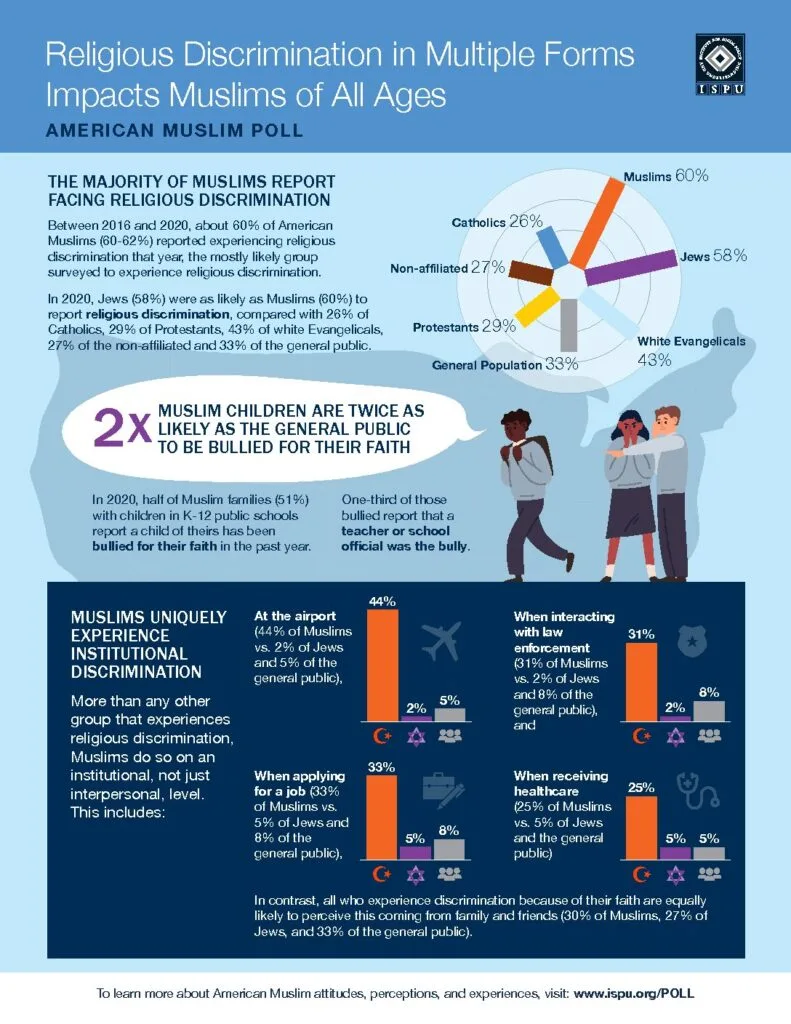
Religious Discrimination in Multiple Forms Impacts Muslims of All Ages
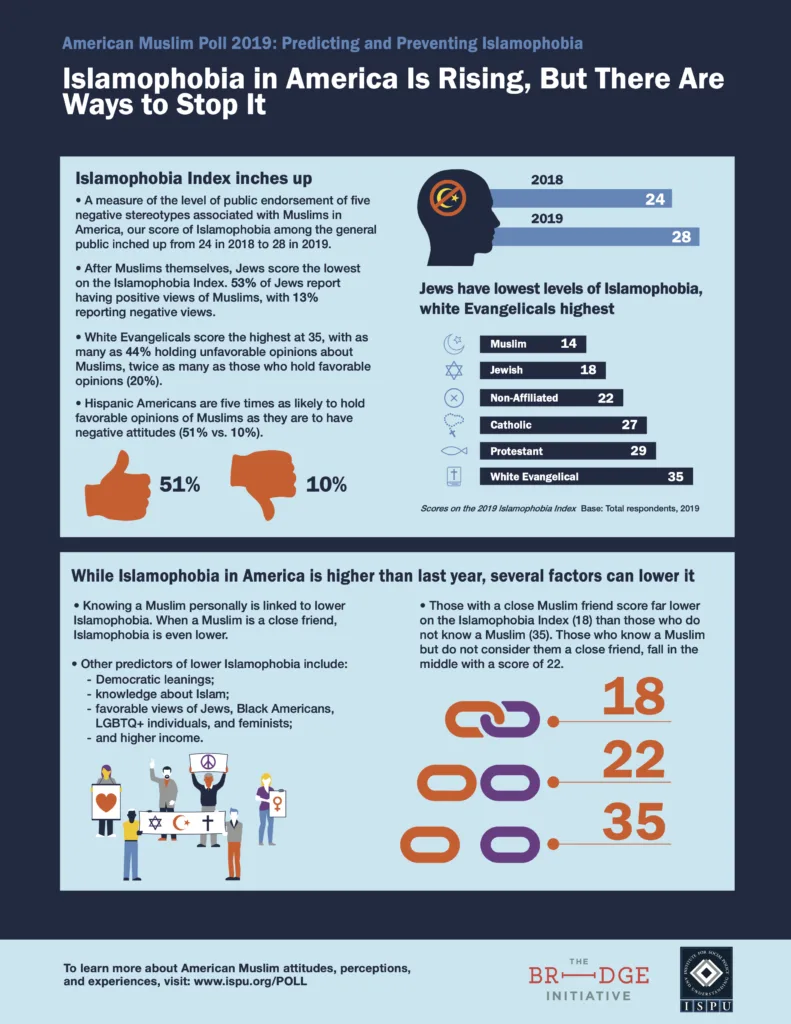
Islamophobia in America Is Rising, But There Are Ways to Stop It
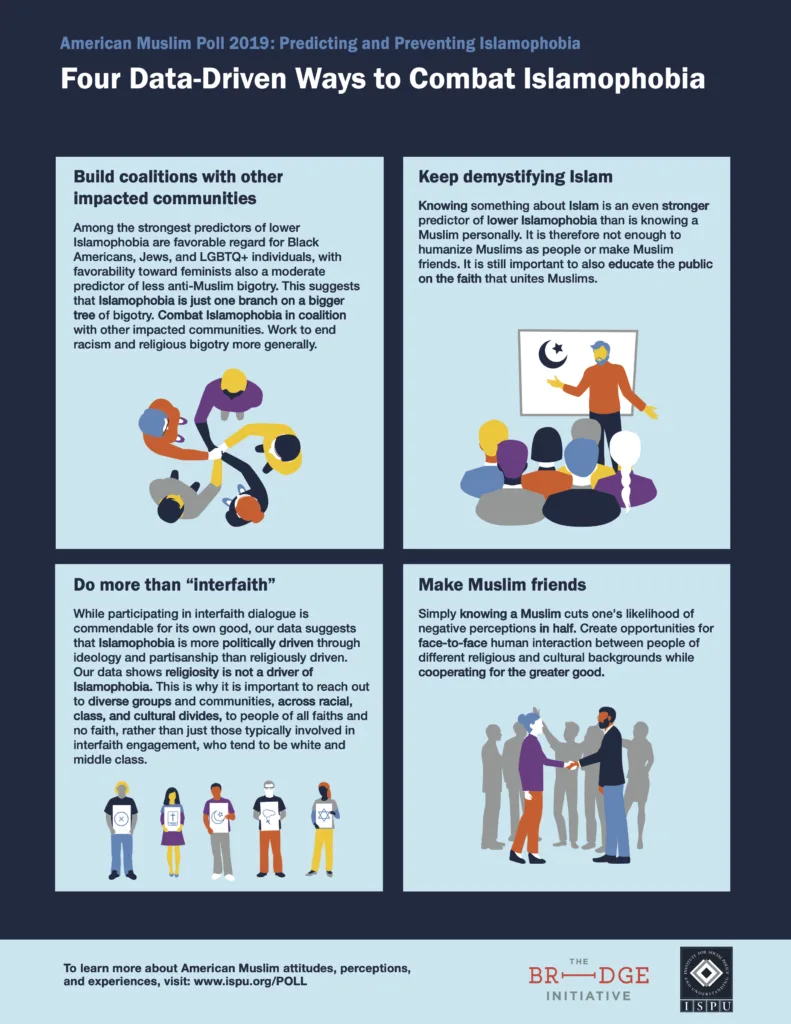
Four Data-Driven Ways to Combat Islamophobia
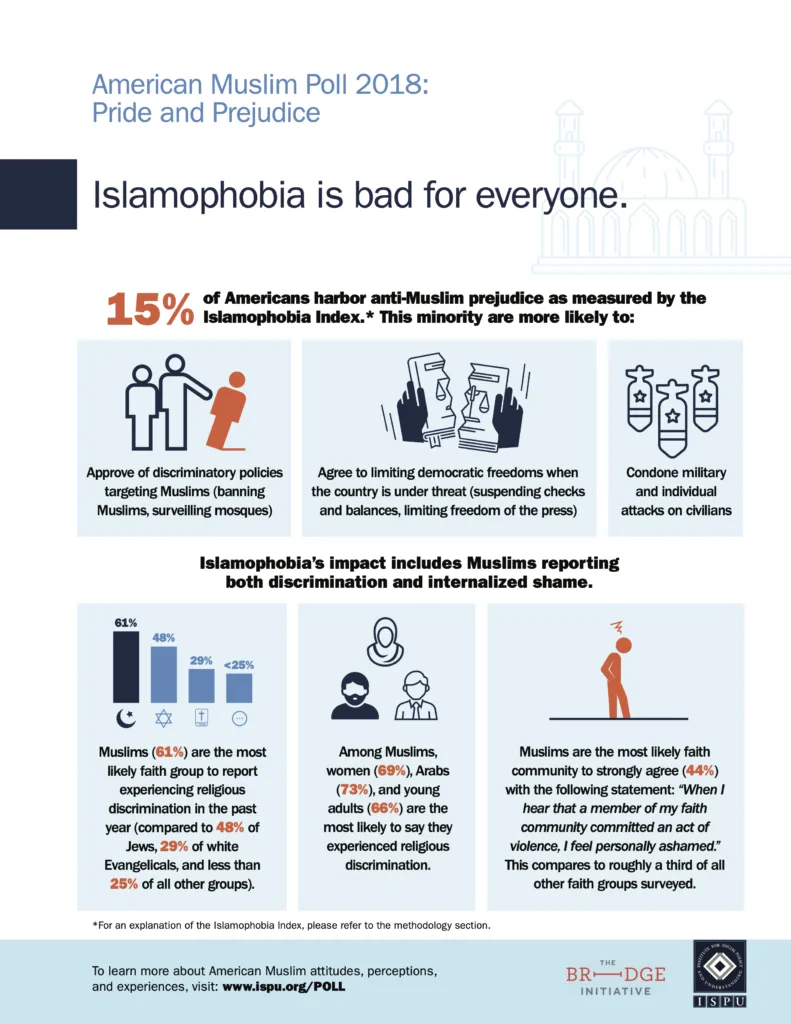
Islamophobia is bad for everyone.
Countering Anti-Muslim Opposition to Mosque and Islamic Center Construction and Expansion
Meet the Research Team
Saeed Khan
Co-Principal Investigator
ISPU Fellow and Lecturer in the Department of Near Eastern and Asian Studies at Wayne State University
Asma T. Uddin
Author, Religious Freedom and Discrimination in America – Then and Now
ISPU Legal Fellow and Counsel at the Becket Fund
Alejandro J. Beutel
Co-Principal Investigator & Project Manager
ISPU Policy and Research Engagement Fellow
Hussein Rashid
Editor & Consultant
Meet the Study Advisors
Jamiah Adams
Nubian Sisters Productions
Linda Sarsour
Arab American Association of New York
Linda Sarsour
Arab American Association of New York
Corey Saylor
Council on American-Islamic Relations, National Office
Nadia Tonova
National Network for Arab American Communities
Videos
What do Muslims, immigrants, women, LGBTQ people, labor union members, and people of color have in common? They are all targets of restrictive legislation, often by the very same lawmakers. Watch this video to learn more.
What is Islamophobia? Why is there so much of it? And how does it impact all of us? ISPU Director of Research Dalia Mogahed answers these questions.
On the one-year anniversary of the Supreme Court decision to uphold the Muslim Ban, a panel of experts discussed the law surrounding the Ban, links between societal and systematic Islamophobia, and frameworks to understand Islamophobia.
This event discussed Islamophobia in the context of an increasingly diverse America by highlighting ISPU research on anti-Muslim prejudice and its connection to bigotry targeting other communities.
Dr. Emile Bruneau, Director of the Peace and Conflict Neuroscience Lab and Lecturer at the University of Pennsylvania, presented his findings on how to effectively counteract personal Islamophobia.