This year, 2025, marks the fifth year of ISPU’s National Islamophobia Index, previously measured in 2018, 2019, 2020, and 2022. The Islamophobia Index is a measure of the level of public endorsement of five false, negative stereotypes associated with Muslims in America. These are the items used to construct the index:
Please indicate how much you agree or disagree with the following statements, where 1 means you strongly disagree and 5 means you strongly agree in regard to most Muslims living in the United States.
ISPU analysts chose these five variables based on previous research linking these perceptions with greater tolerance for anti-Muslim policies such as mosque surveillance, racial profiling, and greater scrutiny of Muslims at airports, the so-called Muslim ban, and even taking away voting rights from Americans who are Muslims (Kteily & Bruneau, 2017; Bruneau et al., 2018; Kteily et al., 2016). These five measures are not meant to cover the totality of public Islamophobia, which can and does include many other false beliefs about Muslims. They are instead meant to offer an evidence-based measure of five perceptions known to be linked to acceptance of discriminatory policies.
Answers to this battery of questions were used to construct an additive scale that measures overall anti-Muslim sentiment. The scale is standardized to range from 0 to 100. The resulting Islamophobia Index provides a single metric that is easy to understand, compare, and track over time. The Islamophobia Index measures the endorsement of anti-Muslim stereotypes (violent, misogynist), perceptions of Muslim aggression toward the U.S., degree of Muslim dehumanization (less civilized), and perceptions of Muslim collective blame (partially responsible for violence), all of which have been shown to predict public support for discriminatory policies toward Muslims.
It is noteworthy that this index, while called simply the “Islamophobia Index,” only measures anti-Muslim sentiment among the public and not the degree to which Islamophobia is institutionalized by the state. Islamophobia is not simply a phenomenon of societal sentiment but also a structural phenomenon, manifesting in legislation, budget decisions, and law enforcement practices at the local, state, and federal levels. While our index does not measure structural Islamophobia, public tolerance for many of these practices is linked to higher scores on the Islamophobia Index.
A note on the 2025 Islamophobia Index:
As of May 2026, our research team has made a correction, which includes the update of three figures from the Islamophobia Index in American Muslim Poll 2025.
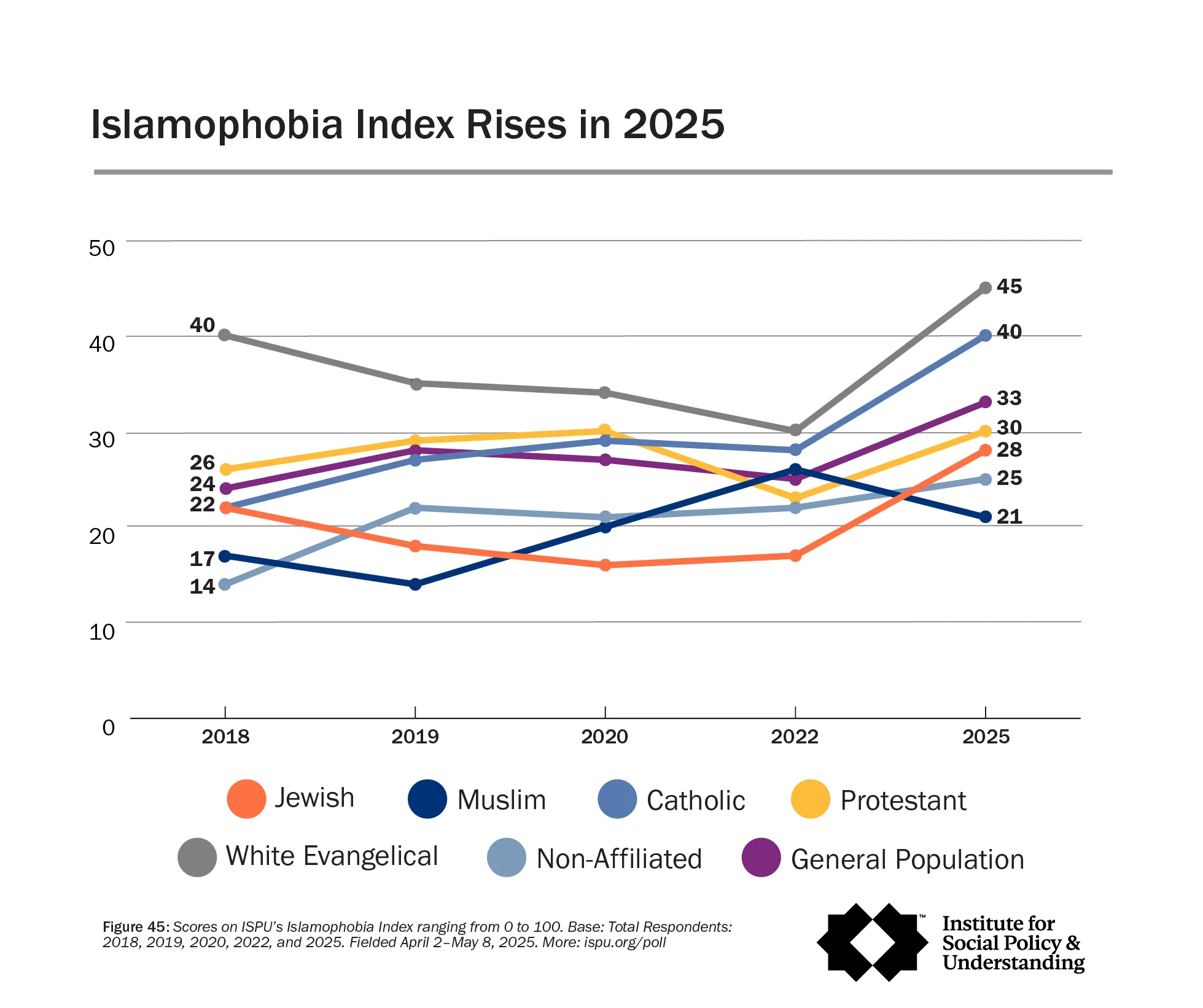
The scores initially reported for Jews (19) and Muslims (19) were the cumulative score across five years (2018, 2019, 2020, 2022, and 2025), rather than the 2025 scores alone. The correct 2025 Islamophobia Index scores are 28 for Jews and 21 for Muslims.
Due to a separate internal error that occurred during the transition to a new polling vendor in 2025, the non-affiliated score for 2025 was misreported. The correct score for the non-affiliated is 25, not 23.
No other findings in American Muslim Poll 2025 were affected, and the report has been updated to reflect these corrections. Accuracy and transparency are central to our mission, and we are committed to upholding both.
The updated results follow a troubling upward trend between 2022 and 2025 that applies to the general public and most other religious groups surveyed. This rise takes place amidst escalating anti-Muslim rhetoric since October 2023 and through contentious national and local elections where Islamophobic tropes have become far too common. The need to dismantle Islamophobia and anti-Muslim hate remains immediate and urgent. We offer the following recommendations.
Islamophobia Rises in 2025 Compared to Previous Years
For the fifth year, ISPU measures Islamophobia using the National Islamophobia Index. Among the general population in the U.S., the index jumped from 25 in 2022 to 33 in 2025. This jump was most pronounced among white Evangelicals (15 points), Catholics (12 points), and Jews (11 points). Protestants also rose 7 points from 23 in 2022 to 30 in 2025. Muslims’ score on the Islamophobia Index remained stable with no statistically significant difference between 26 in 2022 and 21 in 2025. Nevertheless, the existence of internalized Islamophobia for Muslims is a challenge to be addressed. The non-affiliated also did not significantly change on the Islamophobia Index since 2022 (22 to 25). Looking at factors that predict Islamophobia, we find that a vote for President Trump (for the general public and Muslims) and conservative political views (for the general public) were among the strongest factors associated with higher Islamophobia scores.
Islamophobia in the General Public
Islamophobia Rises Even among Young People in the General Public
Even among young people in the general public, ages 18–29, there was a marked increase in Islamophobia between 2022 and 2025, from 24 to 31, an 8 point increase. Between 2018 and 2022, Islamophobia Index scores for 18-to-29-year-olds in the general public ranged from 21 to 24.
Sharpest Increases in Islamophobia Are among White and Hispanic Americans in the General Public
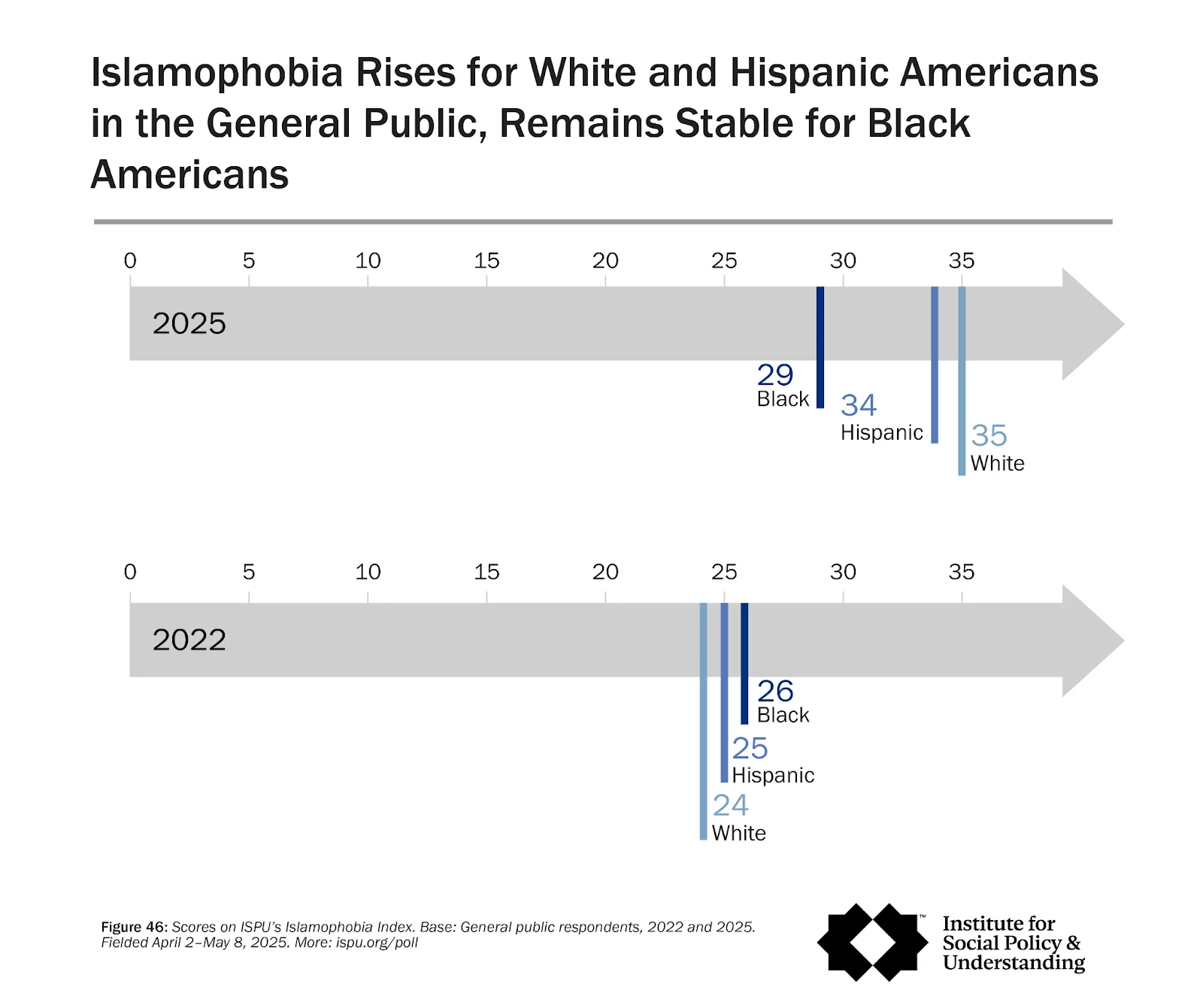
The Islamophobia Index rose from 2022 to 2025 most sharply among white (24 to 35) and Hispanic Americans (25 to 34) in the general public. Black Americans’ Islamophobia Index score stayed fairly stable with only a slight rise from 26 in 2022 to 29 in 2025.
Islamophobia among Muslims
While some may find the existence of Islamophobia among Muslims shocking, it is in line with our prior research showing that Muslims experience internalized Islamophobia by endorsing false negative stereotypes about Muslims as measured by the Islamophobia Index (Mogahed et al., 2022; Mogahed et al., 2020; Ikramullah, 2019; Mogahed & Chouhoud, 2018). Readers can refer to this prior research for a deeper understanding of internalized Islamophobia, including its predictors and the role of media.
White Muslims Score Highest on Islamophobia
Among Muslims, there is a wide range of perceptions regarding Islamophobic ideas. Muslims who identify as white are the most likely to endorse false Islamophobic tropes, scoring a 31 on the Islamophobia Index, lower than white (35) and Hispanic Americans (34) in the general public but higher than Black Americans (29) in the general public. Notably, white Muslims are also far more likely than non-white Muslims to have voted for President Trump. A plurality of white Muslims (49%) voted for Trump, compared to 14% of Asian Muslims and 21% of Black Muslims. Sample sizes of Arab and Hispanic Muslim voters are too small to report on. Black Muslims score a 24 on the Islamophobia Index, lower than Black (29), white (35), and Hispanic Americans (34) in the general public. By far the lowest Islamophobia Index scores are among Asian (12) and Arab Americans (8), revealing a fracture in the Muslim community regarding the very nature of the U.S. faith group, requiring more research, community conversations, and healing.
Islamophobia and Presidential Candidate Choice in 2024
Trump Voters, Including Muslims, Significantly Higher on the Islamophobia Index
Muslims who voted for Trump in the 2024 presidential election have a higher Islamophobia Index score than many other groups, including the general public. While Trump voters in the general public have an Islamophobia Index score of 46, his supporters in the Muslim community are not far behind with a score of 43 on this measure of endorsement of anti-Muslim stereotypes.
Likewise, Muslim Harris voters scored a 21 on the Islamophobia Index, surpassing their counterparts in the general public who scored 19. Muslims who voted for Jill Stein have the lowest Islamophobia score of 5. This pattern suggests that, for Muslims, support for either of the main candidates comes with a degree of buy-in for an Islamophobic narrative, even more so than is present in the general public among their partisan peers.
Predictors of Islamophobia
Trump Vote and Conservative Views Strongest Predictors of Islamophobia
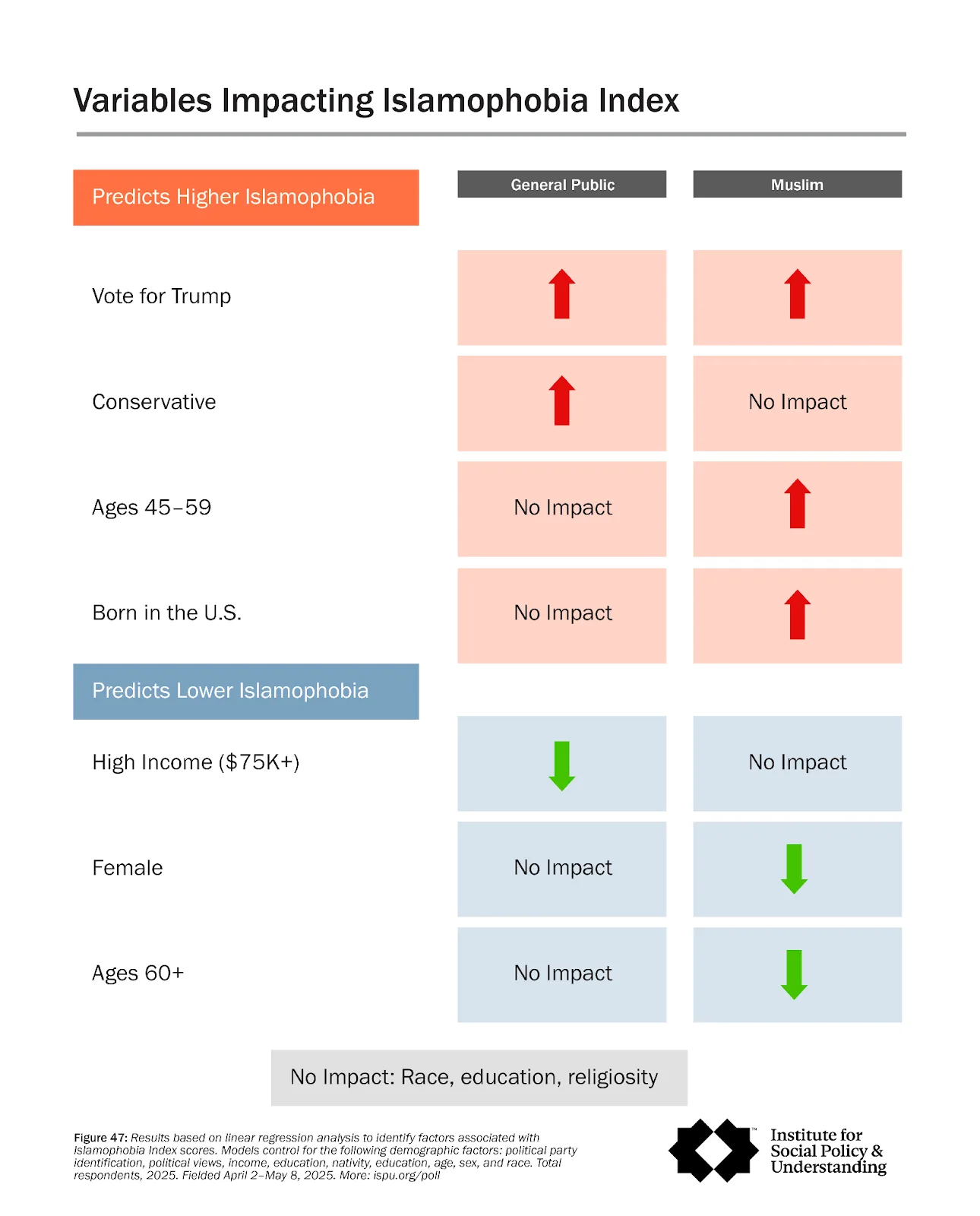
To better understand which factors are associated with higher levels of Islamophobia, we ran a linear regression analysis testing how a battery of variables predict higher Islamophobia Index scores. Overwhelmingly, we find that a vote for Trump in 2024 and conservative political views were stronger predictors of higher Islamophobia Index scores than age, race, or income in the general public and among Muslims.
A Trump Vote Predicts Higher Islamophobia
Among the general public, identifying as somewhat or very conservative closely mirrors a Trump vote in predicting Islamophobia, where a general public respondent is 13% more likely to endorse anti-Muslim tropes if they identify as a conservative. Political ideology has no impact on a Muslim’s perception of anti-Muslim tropes however, but a vote cast for Trump makes a Muslim 18% more likely to endorse anti-Muslim tropes.
Higher Income Predicts Lower Islamophobia
Among the general public, those with high income ($75,000+) are 12% less likely to score high on the Islamophobia Index. Income has no impact on Muslim Islamophobia Index scores.
Age, Gender, and Nativity Are Significantly Linked to Levels of Islamophobia
Muslims between 45 and 59 years of age (20%) and those born in the U.S. (10%) were more likely to score high on the Islamophobia Index, while women were less likely to adopt Islamophobic tropes. These factors have no impact on Islamophobia among the general public.
Religiosity Has No Impact on Islamophobic Perceptions for the General Public
Religious devotion has no impact on Islamophobia in the general public. This suggests that for the general public, political ideology and not religious differences—even strongly held ones—drive anti-Muslim prejudice. Religious devotion had no impact on the Islamophobia score for Muslims. For Muslims it suggests that Islamophobia is not driven by low religious devotion but rather age, nativism, and their support of Trump.
Higher Islamophobia Index Score Linked to Higher Support for Trump Policies
As previously reported, endorsing the false tropes about Muslims in the U.S. that comprise ISPU’s National American Islamophobia Index is linked to support for policies that are prejudicial to American Muslims as well as anti-democratic measures such as suspending the right to free speech in the wake of a terrorist attack. In prior years, we’ve examined associations between Islamophobia Index scores and voter participation and support for coalition building on a number of issues. Here we do the same. The next section will provide more information about the creation of the Islamophobia Index and an analysis of Islamophobia in 2025.
This year, we tested a number of high-profile policies championed by the Trump administration, some popular with the public and others opposed by the majority, to assess to what extent, if at all, endorsing Islamophobic tropes predicted support for these policies. Specifically, we looked at the probability of support for each policy as a function of Islamophobia, while controlling for standard demographic factors including political party identification, political views, income, education, nativity, age, sex, and race.
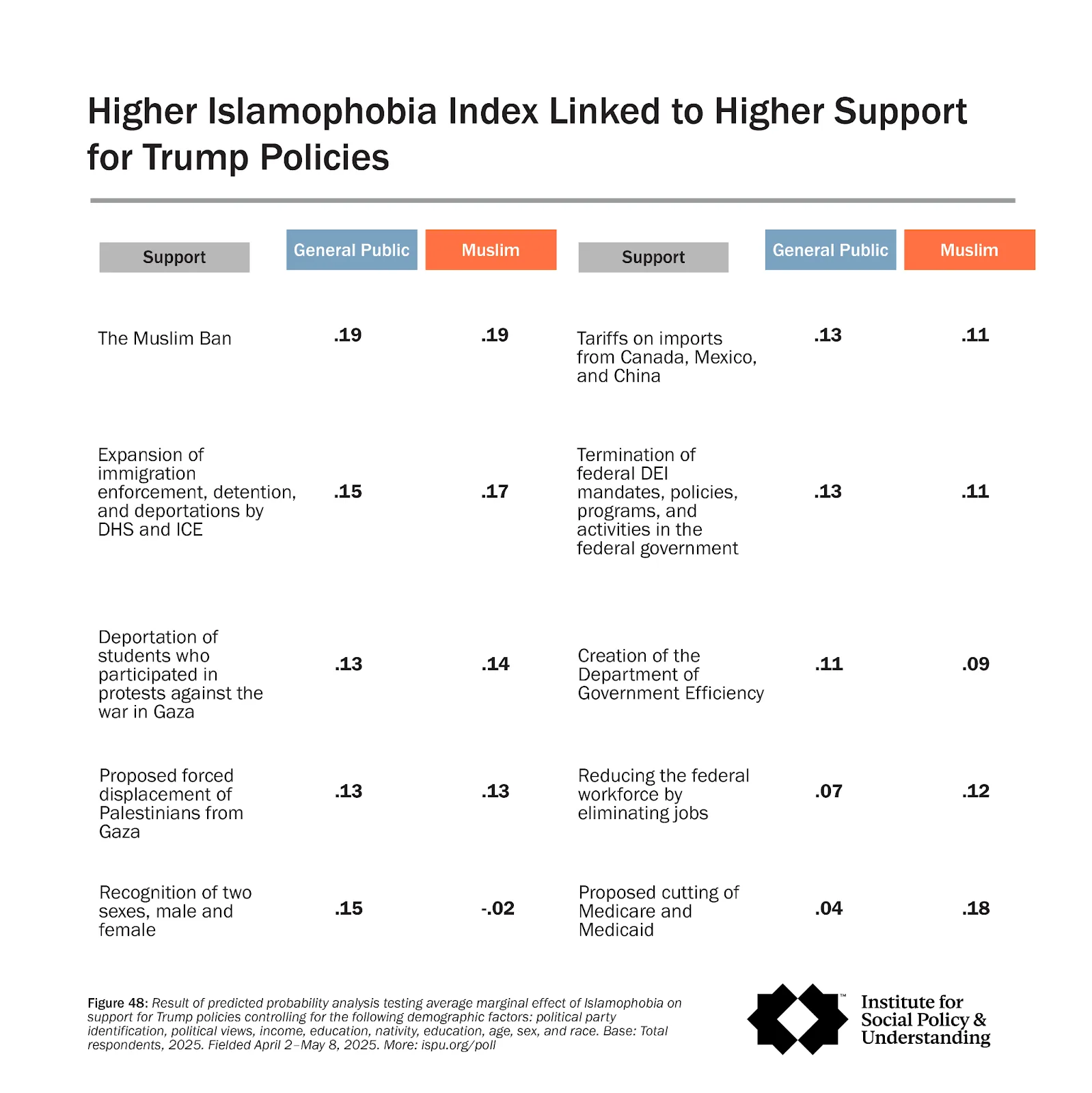
The values in Table 48 below are the average marginal effects of Islamophobia on support for each Trump policy and represent the percent increase in likelihood of support for each policy comparing the highest and lowest levels of Islamophobia, while controlling for demographic factors. The results of this analysis are as follows.
Among the general public, Islamophobia is a meaningful, significant predictor of all policies we asked about, except for two: 1) cutting Medicare/Medicaid and 2) reducing the federal workforce. On the other hand, endorsing at least one of the five anti-Muslim tropes is a predictor of support for the “Muslim ban,” with those with the highest levels of Islamophobia being 19% more likely, on average, to support this policy, higher than any other policy tested. The next policy whose support is most impacted by Islamophobia is the expansion of immigration enforcement and the recognition of two sexes. Members of the general public with the highest levels of Islamophobia are 15% more likely to support expansion of ICE and upholding the gender binary than those with the lowest Islamophobia.
Similarly, among Muslims, Islamophobia is a significant predictor of support for all of the Trump policies we tested except 1) the recognition of only two sexes; 2) support for tariffs on Canada, Mexico, and China; 3) the creation of the Department of Government Efficiency; and 4) reducing the federal workforce. Like the general public, the most impacted policy is support for the “Muslim ban,” with Muslims who agree with any of five anti-Muslim tropes being 19% more likely to support. Muslims who endorse at least one anti-Muslim trope are 17%–18% more likely than those who do not support any Islamophobic tropes to support the other policies (see Table 48).
Endorsing Islamophobic ideas is a powerful predictor of support for both domestic policies that impact all Americans as well as policies that disproportionately impact Muslims, such as deporting pro-Palestinian student protesters, the so-called “Muslim ban,” and the displacement of Palestinians in Gaza. This link between public Islamophobia and support for policies opposed by most Americans highlights how Islamophobia harms not just Muslims but society at large.
Muslims Most Likely to Experience Religious Discrimination
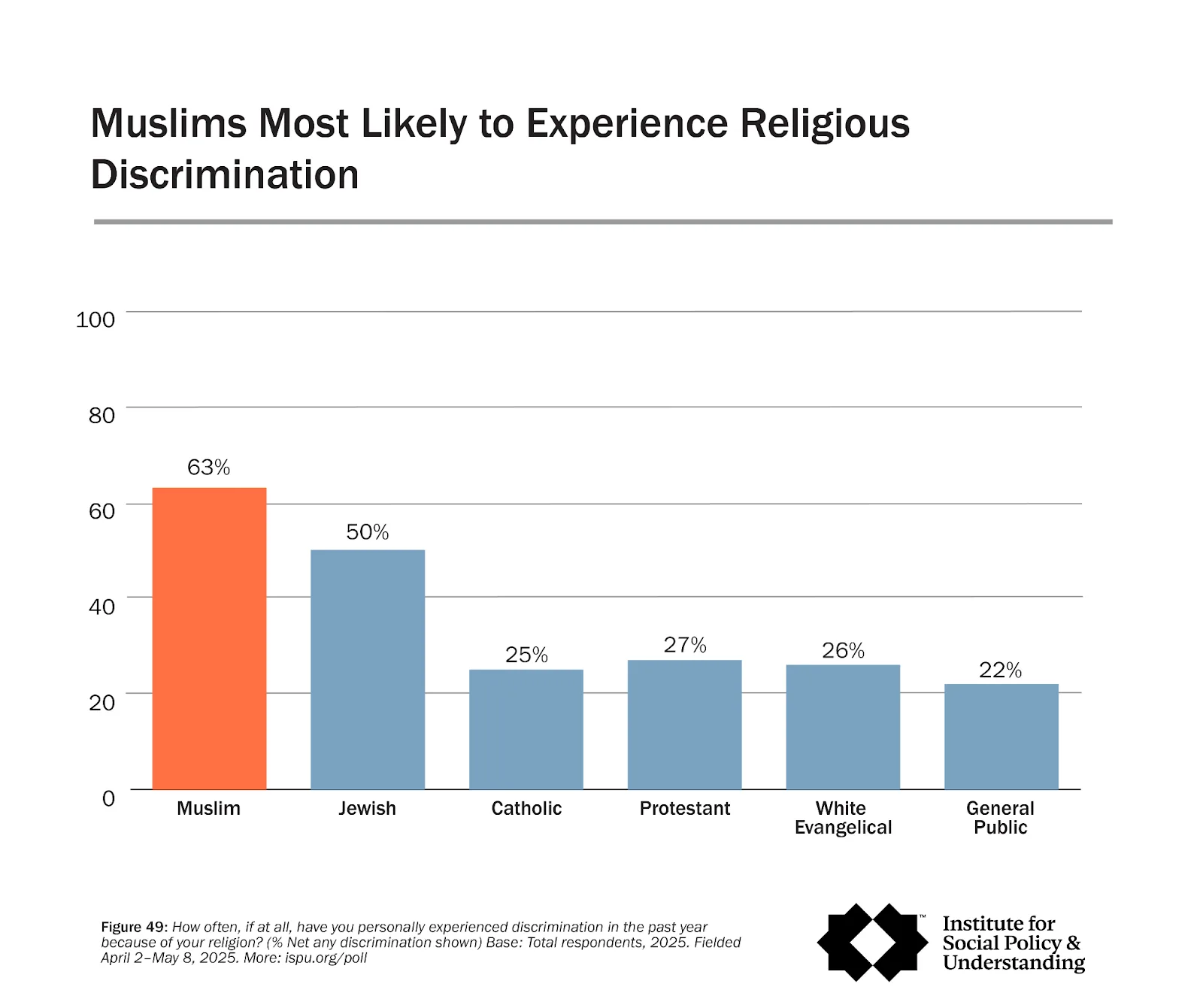
In 2025, Muslims are the most likely religious group to report having experienced religious discrimination in the prior year (63%), more so than Jews (50%), Catholics (25%), Protestants (27%), white Evangelicals (26%), and the non-affiliated (22%). Muslim men and women are equally likely to report facing religious discrimination (63% and 64%, respectively).
Proportion of Muslims Who Experience Religious Discrimination Unmoved since 2016
The portion of Muslims who experience discrimination based on their religion has held fairly steady since 2016. In 2016, when ISPU first fielded the American Muslim Poll, 60% of Muslims reported facing religious discrimination. In subsequent years, from 2017 to 2022, the proportion ranged from 60% to 62%. The lack of statistically significant differences in the proportion of Muslims reporting religious discrimination across these years suggests that who is in the White House does not impact the social and structural bias in the everyday lives of Muslims.

Muslims Most Likely to Face Religious Discrimination on Both Social and Structural Level
To those who responded that they faced any religious discrimination in the past year, we asked a series of follow-up questions asking if they faced religious discrimination in various settings. For the purpose of the following analysis, we categorized the following settings as social discrimination:
We categorize these other settings as structural discrimination:
Sample sizes for Catholics, white Evangelicals, and the non-affiliated who ever experienced religious discrimination were too small to report, so they are excluded from the analysis.
Social Discrimination
Among those who reported having faced religious-based discrimination in the past year, Muslims (28%) were on par with other religious groups to have experienced it from peers at work, including Protestants (23%) and Jews (20%). Muslims (25%) were also more likely than any other group who reported facing religious discrimination to have experienced it at their university when interacting with peers, more than twice as likely as Jews (13%) and Protestants (6%).
Structural Discrimination
Among those who reported facing religious discrimination across religious and non-religious groups, social media from social media platform companies (such as having posts removed or accounts closed) topped the list as the most likely context studied where respondents experienced it. Among Muslims who experienced religious discrimination, almost half (49%) reported experiencing discrimination on social media from social media platform companies. Among those who experienced discrimination, 46% of Jews and 24% of Protestants reported religious discrimination from social media companies on their platforms, the highest of any context measured, with Jews on par with Muslims and Protestants less likely than Muslims to have had this occur. Airports follow social media platforms as the most frequent settings where Muslims experience religious discrimination (37%), and uniquely so, as no more than 6% of all other groups studied reported the same.
Among Muslims who experienced discrimination, 20%–29% experienced it in the following settings, all representing structural bias: when applying for a job (28%), when interacting with immigration officials (29%), at their place of employment when interacting with people in authority (26%), at their university when interacting with people in authority (24%), when interacting with law enforcement (26%), when receiving healthcare (23%), when buying or leasing a home (20%), and when banking (20%). In almost all cases, Muslims are more likely than any group studied to report discrimination in these spaces.

The Role of Gender, Age, and Race in Religious Discrimination
Gender
Though Muslim men (63%) and women (64%) are statistically equally likely to report having experienced some frequency of religious discrimination in the past year, in some situations, men are more likely than women to report discrimination. These include the following situations:
This is a departure from previous years when Muslim women were more likely overall to report discrimination (68% of women vs. 55% of men in 2019).
Notably, Muslim men and women are on par when it comes to experiencing discrimination, except for these two structural issues. For example, Muslim men and women who experienced discrimination are equally likely (26% and 30%, respectively) to say it occurred when interacting with peers at work and when interacting with people in authority at work (30% for men and 20% for women). This suggests that Muslim men and women are equally likely to experience religious bias overall, with the exception of a few instances of structural racism. Muslim men have historically been seen as more of a threat than Muslim women by the state and other institutions, perhaps reflecting the popular stereotypes depicting Muslim men as violent and Muslim women as victims (Mishra, 2007). This may explain these cases of increased experiences with structural discrimination. This is also supported by our previous finding that the most agreed-upon false trope about Muslims in the U.S. is that most Muslims in the U.S. discriminate against women (Mogahed et al., 2022). It may also reflect the fact that Muslim men may do more banking and are more likely to apply for a job since they are more likely to be employed outside the home (77% of Muslim men vs. 61% of Muslim women).
Age
Young Muslims ages 18–29 (73%) are more likely to report experiencing some frequency of religious discrimination than older Muslims (58% of those ages 30–49 and 56% of those ages 50 and older).
Race
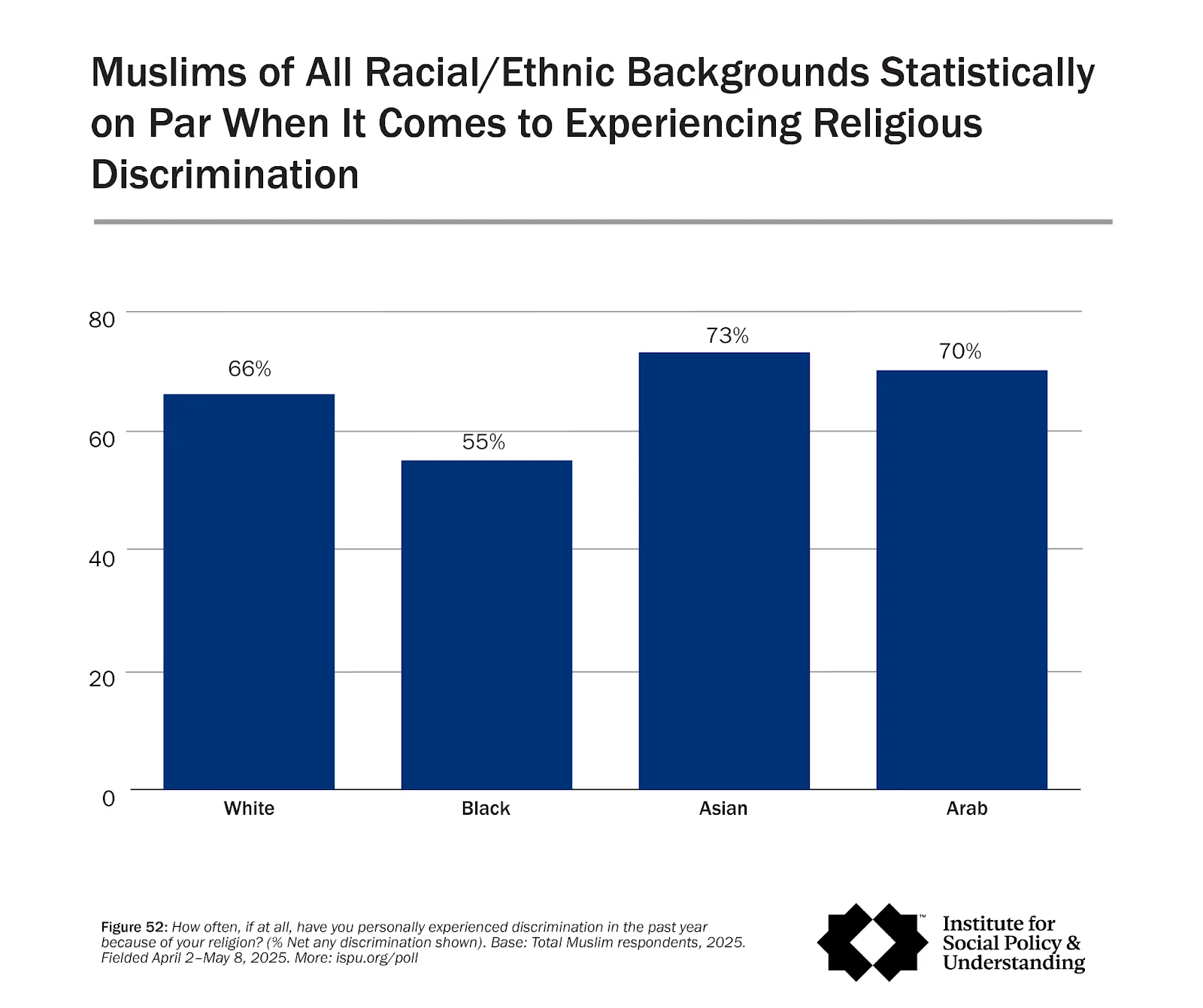
Asian (73%) and Arab Muslims (70%) are as likely to report religious discrimination as white Muslims (66%). The only significant difference in experience with religious discrimination is between Asian Muslims and Black Muslims (73% vs. 55%).
Since October 7, 2023, many scholars, activists, and academics have noted the distinction between Islamophobia and anti-Palestinian racism. It is therefore important to note that anti-Palestinian racism is unique, although there are some crossovers with Islamophobia. According to a 2022 report by the Arab Canadian Lawyers Association, anti-Palestinian racism “silences, excludes, erases, stereotypes, defames, or dehumanizes Palestinians or their narratives” (Majid, 2022). According to the Institute for the Understanding of Anti-Palestinian Racism, this includes “justifying violence against Palestinians” and “erasing the human rights and equal dignity and worth of Palestinians.” Thus, while the dehumanization of Palestinians may include anti-Muslim tropes, this type of racism differs from Islamophobia in that it is focused on a Palestinian identity.
Almost Half of Muslim Families Report Children Bullied for Religion
Almost half (47%) of Muslims with children in grades K-12 report their child or children were bullied for their religious identity in the past year. This far exceeds the 23% of families with K-12 children among the general public who reported facing religious-based bullying in the past year. For Muslim families, reports of religious-based bullying have held steady since 2017.
Nearly Half of Muslim Families with Children Who Have Been Bullied for Their Religion Say an Adult Was the Bully
As a follow-up to whether or not a child has faced religious-based bullying, we asked participants to identify who bullied their child. Participants could select more than one response and we differentiated between online versus in-person bullying (though these we grouped together in our analysis). For the first time, we included “parent of a classmate” as a response option. More than half (55%) said the bully was another student. Additionally, 49% named an adult as the bully, including 36% who said it was a teacher or other school official and 13% who reported the bully was a parent of a classmate. When we first asked the question in 2017, we did not differentiate between online and in-person bullying. In 2017, a quarter (25%) of parents with kids who were bullied reported that the source of the bullying was a teacher or school official; 86% of parents said the bullying was from another student. The bullying of Muslim children, especially from adults, should sound an alarm for better teacher and school administration training and accountability as well as the need to equip parents with the right tools to advocate for their children.