
Nina M. Fernando and Erum Ikramullah
Research shows that polarization of American politics and society is related to the erosion of democracy and social cohesion facing the nation. In the midst of these ever-increasing divisions, the Institute for Social Policy and Understanding’s (ISPU) American Muslim Poll 2025 revealed a number of findings, including that endorsement of Islamophobic tropes has risen sharply since 2022. To address and heal these political and social divides, it is important to identify and develop multi-pronged preventative and responsive solutions. One such solution is creating and cultivating intentional engagement between people of different faith, religious, and cultural backgrounds and orientations. Scholars and practitioners use terms such as interfaith, multifaith, interspiritual, interreligious, intra-faith, cross-cultural, bridgebuilding, among others, and they are defined, interpreted, and practiced in different ways, depending on the community and context. For the purposes of this piece, we will use the term “interfaith work” to encapsulate this broader field of study and practice, acknowledging that the term itself is perceived and practiced in different ways.
Though little research exists as to how many Americans participate in interfaith work, ISPU and the Shoulder to Shoulder Campaign seek to fill this gap by providing nationally representative data on interfaith participation among American faith communities, exploring the results of the American Muslim Poll 2025 survey question: Are you currently involved in interfaith work of any kind? The full methodology for ISPU’s American Muslim Poll is available here. It is worth noting that respondents answered this question from their own perception of what interfaith work is, rather than from a shared definition. This piece will focus specifically on results from this question as well as offer views from the field, showing what interfaith work looks like in the context of rising Islamophobia and a nation facing divisions, and how serves as a powerful means for positive change towards a more pluralistic, inclusive society and healthy democracy.
The United States of America was founded on the principles of religious freedom; thus, interfaith work can be defined and utilized as a means to foster tolerance and cooperation, to promote dialogue and understanding, and to participate in collaborative efforts and actions such as addressing shared community concerns, conducting service projects, building solidarity, advancing justice, and even preserving American democracy. While many in interfaith leadership roles would assert that just by living among diverse faith and cultural communities here in the United States, we all automatically participate in interfaith work to some degree, the AMP 2025 data indicate that fellow Americans may not recognize this as such.
Interfaith work has taken numerous and diverse manifestations throughout the centuries. However, it wasn’t until the late 20th century that it became an organized and funded field with its growth in the nonprofit sector and as an area of study in academic institutions and seminaries.
History reveals Muslim contributions to the United States since even before our nation’s founding, and the American civil rights movement for racial justice and equality in the 1960s was deeply faith-led and interfaith from Black leadership, cross-community alliances, and even mass protests. When it comes to American Muslim participation in interfaith work after 9/11, American interfaith engagement explicitly spotlighted Muslims, Sikhs, and other communities impacted by Islamophobia.
The Institute for Social Policy and Understanding (ISPU) provides objective research and education about American Muslims to support well-informed dialogue and decision-making. The Shoulder to Shoulder Campaign, founded in 2010, works to equip, connect, and mobilize American faith leaders to address anti-Muslim discrimination and build a more pluralistic United States that lives into its ideals of freedom and dignity for all.
Most Americans say they are not currently engaged in interfaith work.
The majority of all groups surveyed report that they are not currently involved in interfaith work, including 74% of Muslims, 92% of Jews, 90% of Catholics, 80% of Protestants, 66% of white Evangelicals, 96% of the non-affiliated, and 87% of the general public. One implication of this finding may be that most Americans have a very specific or narrow view of interfaith work. Further research is needed to assess Americans’ ideas about the scope of interfaith work.
Muslims and white Evangelicals are most likely to report current involvement in interfaith work.
While the majority of all groups surveyed report that they are not currently involved in interfaith work, 20% of white Evangelicals and 17% of Muslims reported that they were involved in interfaith work of any kind at the time of the survey (April 2025). These groups are more likely than all other groups, including 5% of Jews, 3% of Catholics, 9% of Protestants, 1% of the non-affiliated, and 6% of the general population, to report involvement. For both Muslims and white Evangelicals, men were as likely as women to report involvement in interfaith work (19% of Muslim men and 14% of Muslim women; 21% of white Evangelical men and 19% of white Evangelical women). There were no gender differences for any other group.

Levels of interfaith engagement are the same across all age groups.
Looking at age, we find similar levels of involvement in interfaith work across Muslims and members of the general public of all ages. Seventeen percent of Muslims 18-29 years old, 16% of those 30-49 years old, and 19% of those aged 50 and older reported involvement in interfaith work. Among the general public, 4% of 18-29-year-olds, 7% of 30-49 year olds, and 6% of those aged 50 and older reported involvement in interfaith work. In other words, age does not seem to affect whether someone is involved in interfaith work.

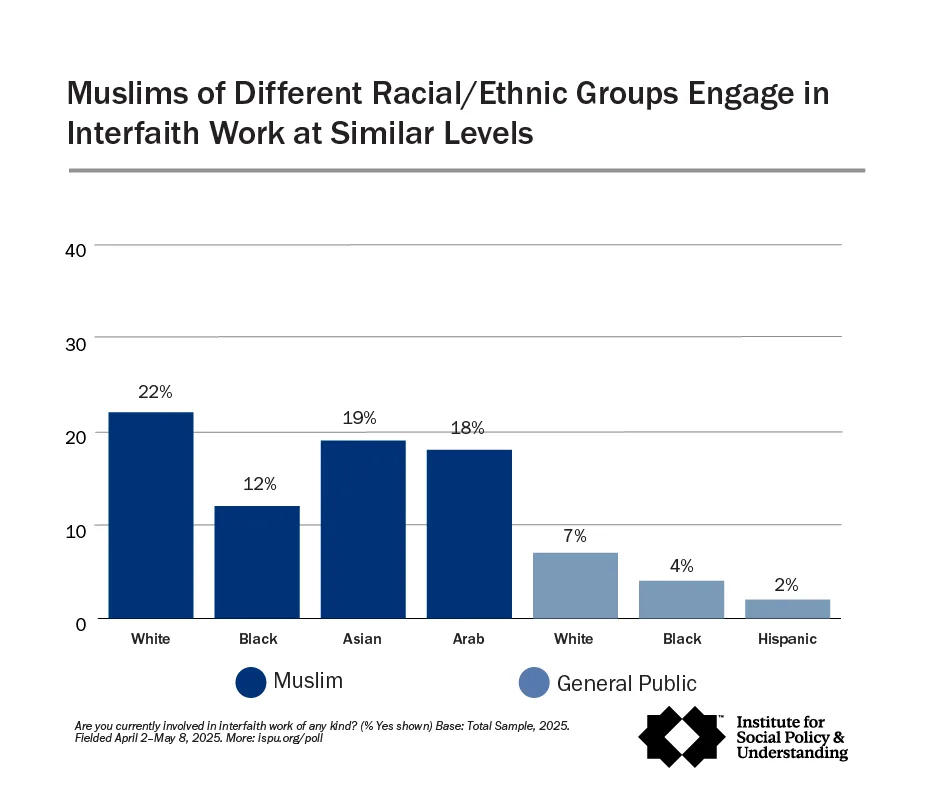
Muslims of different racial and ethnic groups are as likely to engage in interfaith work.
One in five Muslims who identify as white (22%), 12% of Black Muslims, 19% of Asian Muslims, and 18% of Arab Muslims report current interfaith involvement. When looking by race/ethnicity, we do not find any statistically significant differences in interfaith involvement. Among the general public, the only difference in interfaith involvement by race/ethnicity is between those who identify as white (7%) and Hispanic (2%). Four percent of Black Americans report interfaith involvement.
Opportunities for Interfaith Work
While there are many challenges and barriers to interfaith work, which can enable positive change, social cohesion, and advancing democratic values, there are many opportunities. According to a 2024 study “Promising Revelations: Undoing the False Impressions of America’s Faithful” identified significant perception gaps—disparities between what Americans imagine people of faith to believe and what they actually believe. Americans often misunderstand the role of religion in public life, mistakenly perceiving religious individuals as broadly intolerant. In reality, most Americans across faiths deeply value religious pluralism and aspire for the U.S. to be a place where all beliefs are respected. For example, the same study found that the public assumes only about half of Evangelicals and Muslims support religious pluralism, while 78% of Evangelicals and 75% of Muslims do. And both Evangelicals and Muslims feel that political and media elites misrepresent their religion. This indicates possibilities for dialogue and collaboration across differences that can lead to change.
A concerted effort has been made to encourage interfaith engagement among Muslim and Evangelical communities by organizations and initiatives (such as Peace Catalyst International, Multifaith Matters, Multi-faith Neighbors Network, and Neighborly Faith). Yet, still through ISPU’s Islamophobia Index, the sharpest rises in anti-Muslim attitudes were recorded among white Evangelicals (up 15 points), Catholics (up 12 points), and Jews (up 11 points) between 2022 and 2025, revealing that anti-Muslim bias is no longer confined to extremist groups but has grown within mainstream faith communities. Although one might compare these results and conclude that involvement in interfaith work does not have an impact on lowering anti-Muslim or Islamophobic attitudes, the Shoulder to Shoulder Campaign argues that in order to do so, interfaith work must be conducted more thoughtfully and purposefully. This would include avoiding proselytizing and working internally within such groups on unlearning discriminatory ideologies about Muslims and other groups, as well as learning how to live out one’s faith values in all facets of life and the public sphere, which includes those outside of one’s own group. Reaching each particular faith audience requires an invitational and specifically tailored approach for each group.
More tailored approaches to engage particular communities in interfaith work are needed, and personal reflection and intrafaith work must happen alongside it. For example, Bayan Islamic Graduate School is training the next generation of American Muslim leaders by bridging Islamic traditions and values in a modern context, and includes interfaith and intrafaith studies as part of their regularly offered core curriculum. Another more deliberate intervention, among many possibilities, could be the Foundation for Religious Diplomacy’s upcoming Rivaltrust builder; FRD affirms that this newly developing tool, Rivaltrust, equips participants to build “mutual trust under tension,” unlike civility or dialogue programs that focus mainly on agreement or politeness.
Though age and race/ethnicity among Muslims separately are not indicators for involvement in interfaith work, they certainly should be considered. Recognizing the particularities and diversity within and beyond each group allows for more compelling and effective action. Given the racial/ethnic diversity of Muslims in the U.S., there lies an opportunity to consider interfaith and intercultural dynamics that exist among racial and ethnic subgroups, including Black and African American communities and South Asian communities, and to tailor programming and intra-community conversations based on these nuances. Established or emerging interfaith efforts can be more intentionally designed to encourage intergenerational and cross-cultural connection, collaboration, and problem-solving. Some current examples include pro-democracy organizations like SACRED or ISPU’s research and dialogue exploring Perceptions of American Muslims and Islam Among Black Christians and the stories, stereotypes, and structures that shape those dialogues.
In line with recommendations from ISPU’s 2019 American Muslim Poll to expand interfaith work and build diverse coalitions to counter bigotry and hate, there are many current examples of interfaith engagement and solidarity, including sustained substantive dialogue and relationship building taking place both on and off the record that leads to meaningful solidarity and forward-facing action. From shared meals during Ramadan, collaborative service projects, joint letters and statements around shared concerns, and faith allies speaking out and leading public action in solidarity, relationships are being intentionally fostered to create an infrastructure for mutual solidarity that goes beyond dialogue to true interfaith collaboration and solidarity.
For example, coalitions like the Interfaith Immigration Coalition have come together to organize campaigns for immigration rights and justice, and the National Religious Campaign Against Torture and the Shoulder to Shoulder Campaign were created to end torture and address anti-Muslim discrimination, respectively. Muslim and Jewish advocacy organizations, such as MPAC, JCPA, and J Street have partnered on public joint statements and joint events around issues of shared concern. Faith allies have led various solidarity actions including, Christian and Jewish leaders calling for accountability regarding the uptick in anti-Muslim rhethoric among members of Congress, or Jewish Clergy Calling for the release of Mahmoud Khalil. And, at grassroots levels, there are countless examples, such as American Jews, particularly students, engaging in acts of solidarity with Muslims, or interfaith calls to action to end U.S. funding of Israel’s war on Gaza, declared a genocide by scholars in the field.
Engaging youth and young people is another opportunity area in interfaith work. Organizations like Interfaith Youth Alliance, Kaufman Interfaith Institute at Grand Valley State University, and the Interfaith Institute at Augsburg University are developing meaningful programming for youth and young adults to develop skills and practical tools for interfaith and cross-cultural engagement, visiting various houses of worship, taking part in deep conversations, conducting joint service and advocacy projects, among other activities.
Challenges to Interfaith Work
There is little doubt that interfaith collaboration in the United States at any degree has been significantly challenged since the most recent escalation of violence in the Middle East, sparked by the October 7, 2023 attacks and subsequent genocide in Gaza. That, in addition to a contentious 2024 US presidential election, and all that has followed since, interfaith relations have been strained and tested. Just as Islamophobia is rising, so are other intersecting forms of discrimination, including anti-Arab, anti-Palestinian, anti-Jewish, and anti-immigrant bigotry, driven largely by exclusivist visions of a United States that is white and Christian.
Based on a series of interviews conducted in 2025 by the Shoulder to Shoulder Campaign with those involved in interfaith work around the country, respondents identified challenges and barriers such as interfaith programs with unclear or competing goals and agendas, or surface-level engagement where there is a lack of trust and limited action. Respondents identified the hardships of conflicting narratives, conflating identities, casting collective judgment or blame, and groups prioritizing one form of bigotry over another, i.e. pitting antisemitism and Islamophobia against one another. Other issues include Christian dominance and/or the centering of Abrahamic faiths in interfaith spaces, where ecumenical Christian gatherings are mislabeled as interfaith, or other religious communities are treated as an afterthought in planning and executing programs.
When examining interfaith engagement among Muslims, respondents identified challenges and barriers, such as being tokenized and expected to represent or speak for all Muslims; being treated as a monolith; having an overrepresentation of immigrants and refugees; navigating major misconceptions about Muslims and Islam in general; feeling ostracized or unwelcomed if not perceived to be the “right kind” of Muslim, however that may be defined by a particular group.
Words, terms, labels, and slogans have proven to be a challenge in interfaith work. Even the term, “interfaith” itself has been interrogated for implying that one must water down one’s beliefs or expressions in order to engage across differences in a larger whole. Specific terms, slogans, symbols are charged, widely defined, contested, and even censored. Entire communities have been painted as monolithic entities worthy of collective blame, and the U.S. government’s actions at home and abroad have added fuel to the fire.
Though interfaith engagement is undoubtedly occurring, in order for it to more effectively address polarization and the rise in Islamophobia (among other intersecting forms of bigotry) and to build trust and pluralism, further work is needed to explore how interfaith work can be conducted more intentionally.
In a time when Islamophobia, deep political polarization, and mistrust across communities persist, the Shoulder to Shoulder Campaign’s analysis based on the findings from ISPU’s American Muslim Poll 2025 reveal both the timeliness and the potential of more intentional interfaith engagement in the United States. While relatively few Americans currently identify themselves as involved in interfaith work, the examples highlighted throughout this report demonstrate that meaningful relationships and collaboration across faith and cultural differences are not only possible, but already taking shape in communities across the country. Interfaith work alone cannot solve the many challenges facing American society, nor should it be viewed as a substitute for policy change or accountability. However, intentional engagement across lines of difference can help foster trust, challenge harmful stereotypes, strengthen democratic values, and create the conditions for collective action in the face of bigotry and injustice to shape policy. At a moment when anti-Muslim sentiment and other forms of religious and racial discrimination persist, sustained interfaith and intrafaith efforts remain essential to building a more pluralistic, inclusive, and socially cohesive society—one in which people of all backgrounds are able to live with dignity, safety, and mutual respect.


Research shows that polarization of American politics and society is related to the erosion of democracy and social cohesion facing the nation. In the midst of these ever-increasing divisions, the Institute for Social Policy and Understanding’s (ISPU) American Muslim Poll 2025 revealed a number of findings, including that endorsement of Islamophobic tropes has risen sharply since 2022. To address and heal these political and social divides, it is important to identify and develop multi-pronged preventative and responsive solutions. One such solution is creating and cultivating intentional engagement between people of different faith, religious, and cultural backgrounds and orientations. Scholars and practitioners use terms such as interfaith, multifaith, interspiritual, interreligious, intra-faith, cross-cultural, bridgebuilding, among others, and they are defined, interpreted, and practiced in different ways, depending on the community and context. For the purposes of this piece, we will use the term “interfaith work” to encapsulate this broader field of study and practice, acknowledging that the term itself is perceived and practiced in different ways.
Though little research exists as to how many Americans participate in interfaith work, ISPU and the Shoulder to Shoulder Campaign seek to fill this gap by providing nationally representative data on interfaith participation among American faith communities, exploring the results of the American Muslim Poll 2025 survey question: Are you currently involved in interfaith work of any kind? The full methodology for ISPU’s American Muslim Poll is available here. It is worth noting that respondents answered this question from their own perception of what interfaith work is, rather than from a shared definition. This piece will focus specifically on results from this question as well as offer views from the field, showing what interfaith work looks like in the context of rising Islamophobia and a nation facing divisions, and how serves as a powerful means for positive change towards a more pluralistic, inclusive society and healthy democracy.
The United States of America was founded on the principles of religious freedom; thus, interfaith work can be defined and utilized as a means to foster tolerance and cooperation, to promote dialogue and understanding, and to participate in collaborative efforts and actions such as addressing shared community concerns, conducting service projects, building solidarity, advancing justice, and even preserving American democracy. While many in interfaith leadership roles would assert that just by living among diverse faith and cultural communities here in the United States, we all automatically participate in interfaith work to some degree, the AMP 2025 data indicate that fellow Americans may not recognize this as such.
Interfaith work has taken numerous and diverse manifestations throughout the centuries. However, it wasn’t until the late 20th century that it became an organized and funded field with its growth in the nonprofit sector and as an area of study in academic institutions and seminaries.
History reveals Muslim contributions to the United States since even before our nation’s founding, and the American civil rights movement for racial justice and equality in the 1960s was deeply faith-led and interfaith from Black leadership, cross-community alliances, and even mass protests. When it comes to American Muslim participation in interfaith work after 9/11, American interfaith engagement explicitly spotlighted Muslims, Sikhs, and other communities impacted by Islamophobia.
The Institute for Social Policy and Understanding (ISPU) provides objective research and education about American Muslims to support well-informed dialogue and decision-making. The Shoulder to Shoulder Campaign, founded in 2010, works to equip, connect, and mobilize American faith leaders to address anti-Muslim discrimination and build a more pluralistic United States that lives into its ideals of freedom and dignity for all.
Most Americans say they are not currently engaged in interfaith work.
The majority of all groups surveyed report that they are not currently involved in interfaith work, including 74% of Muslims, 92% of Jews, 90% of Catholics, 80% of Protestants, 66% of white Evangelicals, 96% of the non-affiliated, and 87% of the general public. One implication of this finding may be that most Americans have a very specific or narrow view of interfaith work. Further research is needed to assess Americans’ ideas about the scope of interfaith work.
Muslims and white Evangelicals are most likely to report current involvement in interfaith work.
While the majority of all groups surveyed report that they are not currently involved in interfaith work, 20% of white Evangelicals and 17% of Muslims reported that they were involved in interfaith work of any kind at the time of the survey (April 2025). These groups are more likely than all other groups, including 5% of Jews, 3% of Catholics, 9% of Protestants, 1% of the non-affiliated, and 6% of the general population, to report involvement. For both Muslims and white Evangelicals, men were as likely as women to report involvement in interfaith work (19% of Muslim men and 14% of Muslim women; 21% of white Evangelical men and 19% of white Evangelical women). There were no gender differences for any other group.
Levels of interfaith engagement are the same across all age groups.
Looking at age, we find similar levels of involvement in interfaith work across Muslims and members of the general public of all ages. Seventeen percent of Muslims 18-29 years old, 16% of those 30-49 years old, and 19% of those aged 50 and older reported involvement in interfaith work. Among the general public, 4% of 18-29-year-olds, 7% of 30-49 year olds, and 6% of those aged 50 and older reported involvement in interfaith work. In other words, age does not seem to affect whether someone is involved in interfaith work.
Muslims of different racial and ethnic groups are as likely to engage in interfaith work.
One in five Muslims who identify as white (22%), 12% of Black Muslims, 19% of Asian Muslims, and 18% of Arab Muslims report current interfaith involvement. When looking by race/ethnicity, we do not find any statistically significant differences in interfaith involvement. Among the general public, the only difference in interfaith involvement by race/ethnicity is between those who identify as white (7%) and Hispanic (2%). Four percent of Black Americans report interfaith involvement.
Opportunities for Interfaith Work
While there are many challenges and barriers to interfaith work, which can enable positive change, social cohesion, and advancing democratic values, there are many opportunities. According to a 2024 study “Promising Revelations: Undoing the False Impressions of America’s Faithful” identified significant perception gaps—disparities between what Americans imagine people of faith to believe and what they actually believe. Americans often misunderstand the role of religion in public life, mistakenly perceiving religious individuals as broadly intolerant. In reality, most Americans across faiths deeply value religious pluralism and aspire for the U.S. to be a place where all beliefs are respected. For example, the same study found that the public assumes only about half of Evangelicals and Muslims support religious pluralism, while 78% of Evangelicals and 75% of Muslims do. And both Evangelicals and Muslims feel that political and media elites misrepresent their religion. This indicates possibilities for dialogue and collaboration across differences that can lead to change.
A concerted effort has been made to encourage interfaith engagement among Muslim and Evangelical communities by organizations and initiatives (such as Peace Catalyst International, Multifaith Matters, Multi-faith Neighbors Network, and Neighborly Faith). Yet, still through ISPU’s Islamophobia Index, the sharpest rises in anti-Muslim attitudes were recorded among white Evangelicals (up 15 points), Catholics (up 12 points), and Jews (up 11 points) between 2022 and 2025, revealing that anti-Muslim bias is no longer confined to extremist groups but has grown within mainstream faith communities. Although one might compare these results and conclude that involvement in interfaith work does not have an impact on lowering anti-Muslim or Islamophobic attitudes, the Shoulder to Shoulder Campaign argues that in order to do so, interfaith work must be conducted more thoughtfully and purposefully. This would include avoiding proselytizing and working internally within such groups on unlearning discriminatory ideologies about Muslims and other groups, as well as learning how to live out one’s faith values in all facets of life and the public sphere, which includes those outside of one’s own group. Reaching each particular faith audience requires an invitational and specifically tailored approach for each group.
More tailored approaches to engage particular communities in interfaith work are needed, and personal reflection and intrafaith work must happen alongside it. For example, Bayan Islamic Graduate School is training the next generation of American Muslim leaders by bridging Islamic traditions and values in a modern context, and includes interfaith and intrafaith studies as part of their regularly offered core curriculum. Another more deliberate intervention, among many possibilities, could be the Foundation for Religious Diplomacy’s upcoming Rivaltrust builder; FRD affirms that this newly developing tool, Rivaltrust, equips participants to build “mutual trust under tension,” unlike civility or dialogue programs that focus mainly on agreement or politeness.
Though age and race/ethnicity among Muslims separately are not indicators for involvement in interfaith work, they certainly should be considered. Recognizing the particularities and diversity within and beyond each group allows for more compelling and effective action. Given the racial/ethnic diversity of Muslims in the U.S., there lies an opportunity to consider interfaith and intercultural dynamics that exist among racial and ethnic subgroups, including Black and African American communities and South Asian communities, and to tailor programming and intra-community conversations based on these nuances. Established or emerging interfaith efforts can be more intentionally designed to encourage intergenerational and cross-cultural connection, collaboration, and problem-solving. Some current examples include pro-democracy organizations like SACRED or ISPU’s research and dialogue exploring Perceptions of American Muslims and Islam Among Black Christians and the stories, stereotypes, and structures that shape those dialogues.
In line with recommendations from ISPU’s 2019 American Muslim Poll to expand interfaith work and build diverse coalitions to counter bigotry and hate, there are many current examples of interfaith engagement and solidarity, including sustained substantive dialogue and relationship building taking place both on and off the record that leads to meaningful solidarity and forward-facing action. From shared meals during Ramadan, collaborative service projects, joint letters and statements around shared concerns, and faith allies speaking out and leading public action in solidarity, relationships are being intentionally fostered to create an infrastructure for mutual solidarity that goes beyond dialogue to true interfaith collaboration and solidarity.
For example, coalitions like the Interfaith Immigration Coalition have come together to organize campaigns for immigration rights and justice, and the National Religious Campaign Against Torture and the Shoulder to Shoulder Campaign were created to end torture and address anti-Muslim discrimination, respectively. Muslim and Jewish advocacy organizations, such as MPAC, JCPA, and J Street have partnered on public joint statements and joint events around issues of shared concern. Faith allies have led various solidarity actions including, Christian and Jewish leaders calling for accountability regarding the uptick in anti-Muslim rhethoric among members of Congress, or Jewish Clergy Calling for the release of Mahmoud Khalil. And, at grassroots levels, there are countless examples, such as American Jews, particularly students, engaging in acts of solidarity with Muslims, or interfaith calls to action to end U.S. funding of Israel’s war on Gaza, declared a genocide by scholars in the field.
Engaging youth and young people is another opportunity area in interfaith work. Organizations like Interfaith Youth Alliance, Kaufman Interfaith Institute at Grand Valley State University, and the Interfaith Institute at Augsburg University are developing meaningful programming for youth and young adults to develop skills and practical tools for interfaith and cross-cultural engagement, visiting various houses of worship, taking part in deep conversations, conducting joint service and advocacy projects, among other activities.
Challenges to Interfaith Work
There is little doubt that interfaith collaboration in the United States at any degree has been significantly challenged since the most recent escalation of violence in the Middle East, sparked by the October 7, 2023 attacks and subsequent genocide in Gaza. That, in addition to a contentious 2024 US presidential election, and all that has followed since, interfaith relations have been strained and tested. Just as Islamophobia is rising, so are other intersecting forms of discrimination, including anti-Arab, anti-Palestinian, anti-Jewish, and anti-immigrant bigotry, driven largely by exclusivist visions of a United States that is white and Christian.
Based on a series of interviews conducted in 2025 by the Shoulder to Shoulder Campaign with those involved in interfaith work around the country, respondents identified challenges and barriers such as interfaith programs with unclear or competing goals and agendas, or surface-level engagement where there is a lack of trust and limited action. Respondents identified the hardships of conflicting narratives, conflating identities, casting collective judgment or blame, and groups prioritizing one form of bigotry over another, i.e. pitting antisemitism and Islamophobia against one another. Other issues include Christian dominance and/or the centering of Abrahamic faiths in interfaith spaces, where ecumenical Christian gatherings are mislabeled as interfaith, or other religious communities are treated as an afterthought in planning and executing programs.
When examining interfaith engagement among Muslims, respondents identified challenges and barriers, such as being tokenized and expected to represent or speak for all Muslims; being treated as a monolith; having an overrepresentation of immigrants and refugees; navigating major misconceptions about Muslims and Islam in general; feeling ostracized or unwelcomed if not perceived to be the “right kind” of Muslim, however that may be defined by a particular group.
Words, terms, labels, and slogans have proven to be a challenge in interfaith work. Even the term, “interfaith” itself has been interrogated for implying that one must water down one’s beliefs or expressions in order to engage across differences in a larger whole. Specific terms, slogans, symbols are charged, widely defined, contested, and even censored. Entire communities have been painted as monolithic entities worthy of collective blame, and the U.S. government’s actions at home and abroad have added fuel to the fire.
Though interfaith engagement is undoubtedly occurring, in order for it to more effectively address polarization and the rise in Islamophobia (among other intersecting forms of bigotry) and to build trust and pluralism, further work is needed to explore how interfaith work can be conducted more intentionally.
In a time when Islamophobia, deep political polarization, and mistrust across communities persist, the Shoulder to Shoulder Campaign’s analysis based on the findings from ISPU’s American Muslim Poll 2025 reveal both the timeliness and the potential of more intentional interfaith engagement in the United States. While relatively few Americans currently identify themselves as involved in interfaith work, the examples highlighted throughout this report demonstrate that meaningful relationships and collaboration across faith and cultural differences are not only possible, but already taking shape in communities across the country. Interfaith work alone cannot solve the many challenges facing American society, nor should it be viewed as a substitute for policy change or accountability. However, intentional engagement across lines of difference can help foster trust, challenge harmful stereotypes, strengthen democratic values, and create the conditions for collective action in the face of bigotry and injustice to shape policy. At a moment when anti-Muslim sentiment and other forms of religious and racial discrimination persist, sustained interfaith and intrafaith efforts remain essential to building a more pluralistic, inclusive, and socially cohesive society—one in which people of all backgrounds are able to live with dignity, safety, and mutual respect.
