
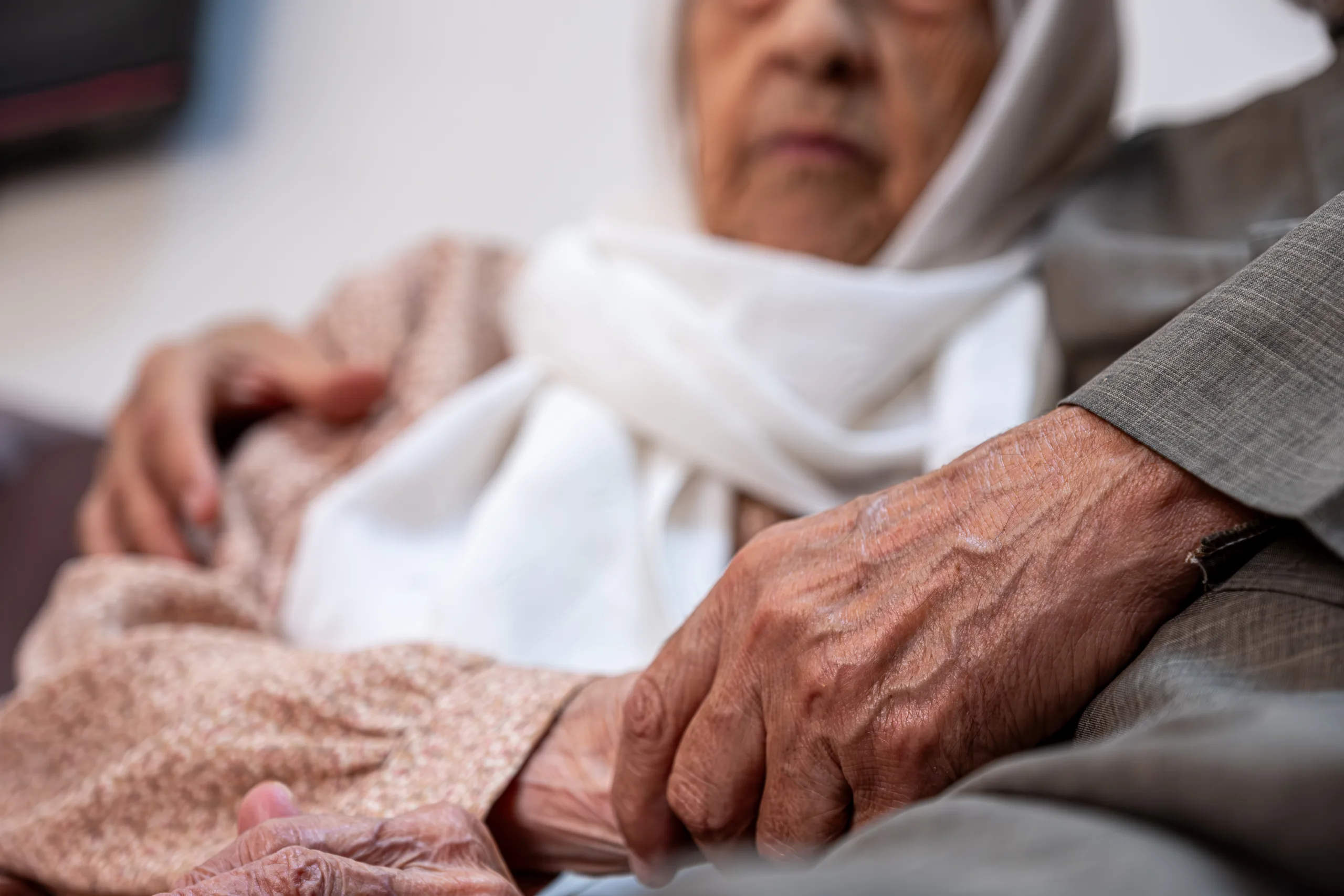
As loved ones age and face health challenges, family members often find themselves stepping into primary caregiving roles. This can involve coordinating caregiving across households, with relatives traveling, rearranging schedules, and spending extended periods away from home to meet emerging needs. Many caregivers are also balancing responsibilities such as raising children, maintaining full-time employment, and supporting their own households. While these arrangements can be rife with logistical, financial, and emotional challenges, families often have limited alternatives when striving to ensure loved ones receive appropriate care.
Millions of Americans, including American Muslims, are in these scenarios every day. However, research on these families, the support they need, and the challenges they face is scant.
To address this gap, the Institute for Social Policy and Understanding (ISPU) included questions addressing elder care in American Muslim Poll 2025, a survey of American Muslims and other religious and non-religious groups. Not only do the results reveal the prevalence of American Muslims who care for an older family member, it also highlights the main challenges facing these families, outlining the specific needs of Muslim communities. The report concludes by offering recommendations on how to address these needs.
The full methodology for American Muslim Poll 2025 is available here.
Muslims are most likely to be in the “Sandwich Generation”
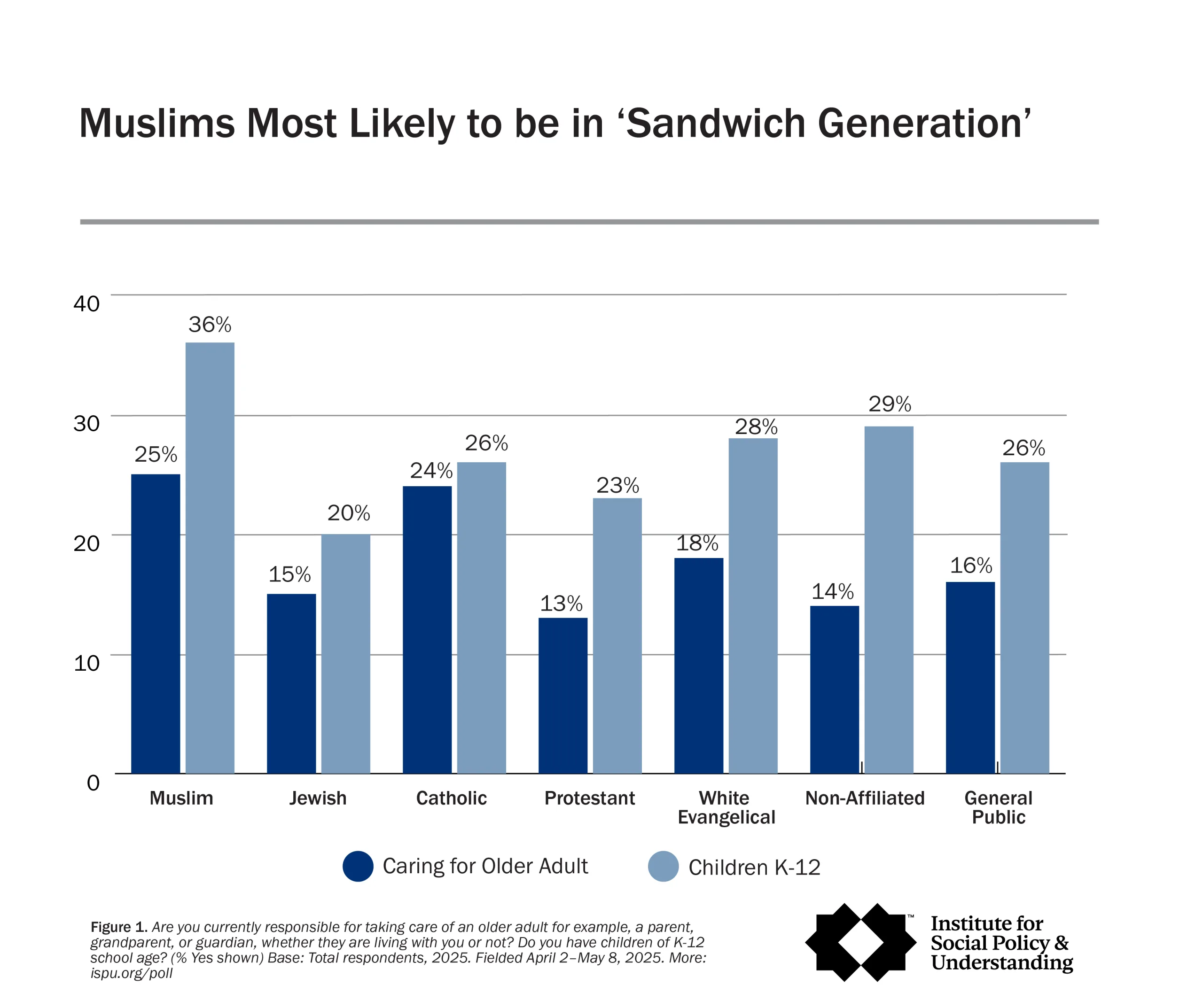
One in four Muslims care for an older adult, such as a parent, grandparent, or guardian, on par with Catholics, but more likely than the general population (16%). At the same time, 36% of American Muslims have children in K-12 schooling, more likely than the 11%-26% of all other groups studied. This results in more Muslims in the United States being part of the “sandwich generation”, a term coined to describe adults, typically in their thirties or forties, who are responsible for bringing up their own children and for the care of their aging parents. Among Muslims, 36% of those who care for elders also have children in K-12.
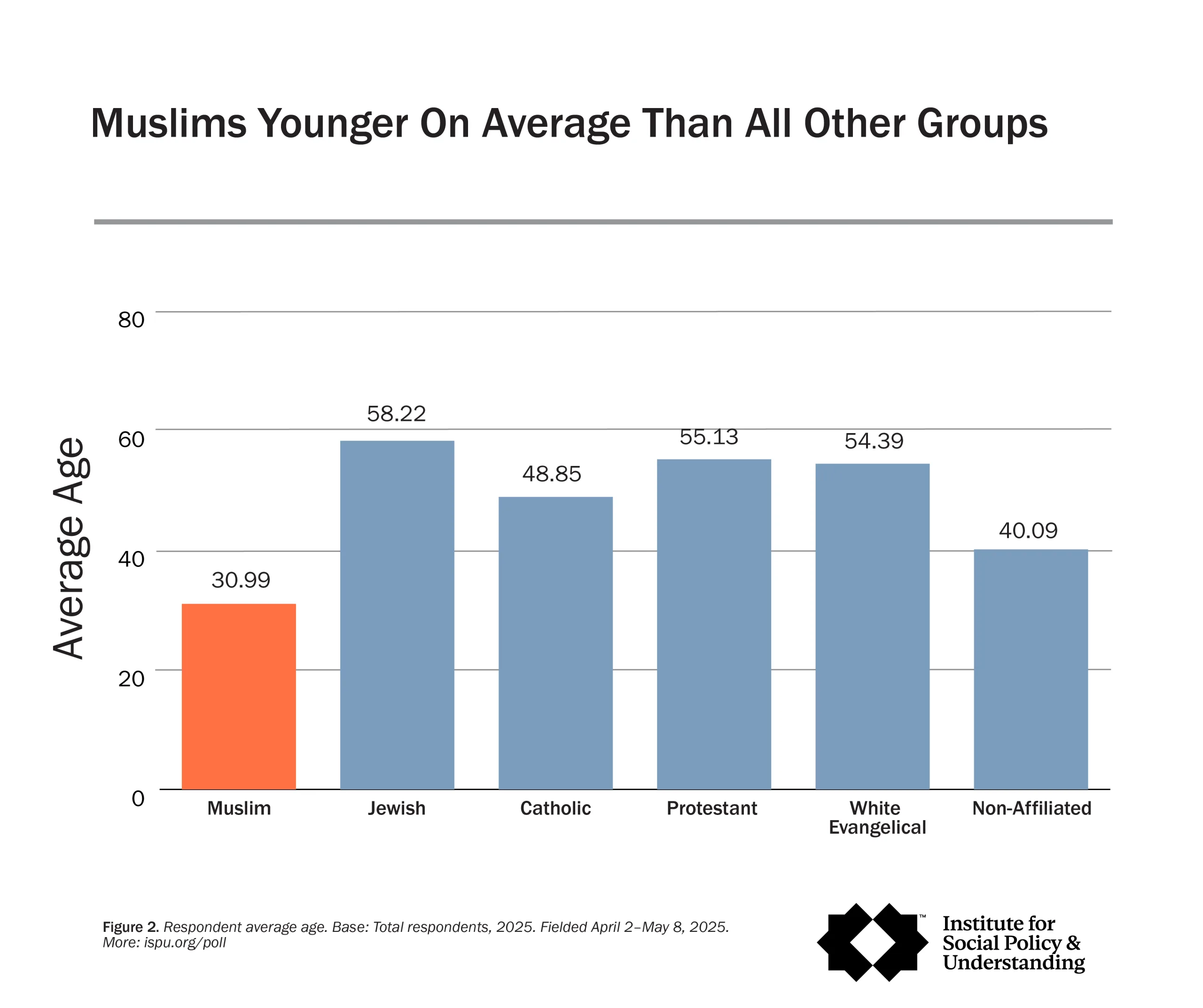
It is not surprising that Muslims are the most likely group to fall into this category. Muslims are, on average, the youngest religious group in the U.S., so they are more likely to have a living older adult to care for and children to raise.
The likelihood of caring for an older adult is shared equally across genders, with Muslim men (29%) as likely as Muslim women (20%) to do so. However, the differences are more pronounced across racial and ethnic lines. Forty percent of white Muslims report that they are responsible for caring for an older adult, which is more likely than 19% of Black Muslims and 10% of Arab Muslims. Twenty-eight percent of Asian Muslims report caring for an older adult, which is more likely than that of Arab Muslims and on par with Black Muslims. More information about the racial and ethnic composition of Muslims in the United States is available in American Muslim Poll 2025: Enduring Challenges, Evolving Electorate and Who Are White Muslims?.
Muslim women shoulder the brunt of elder care tasks
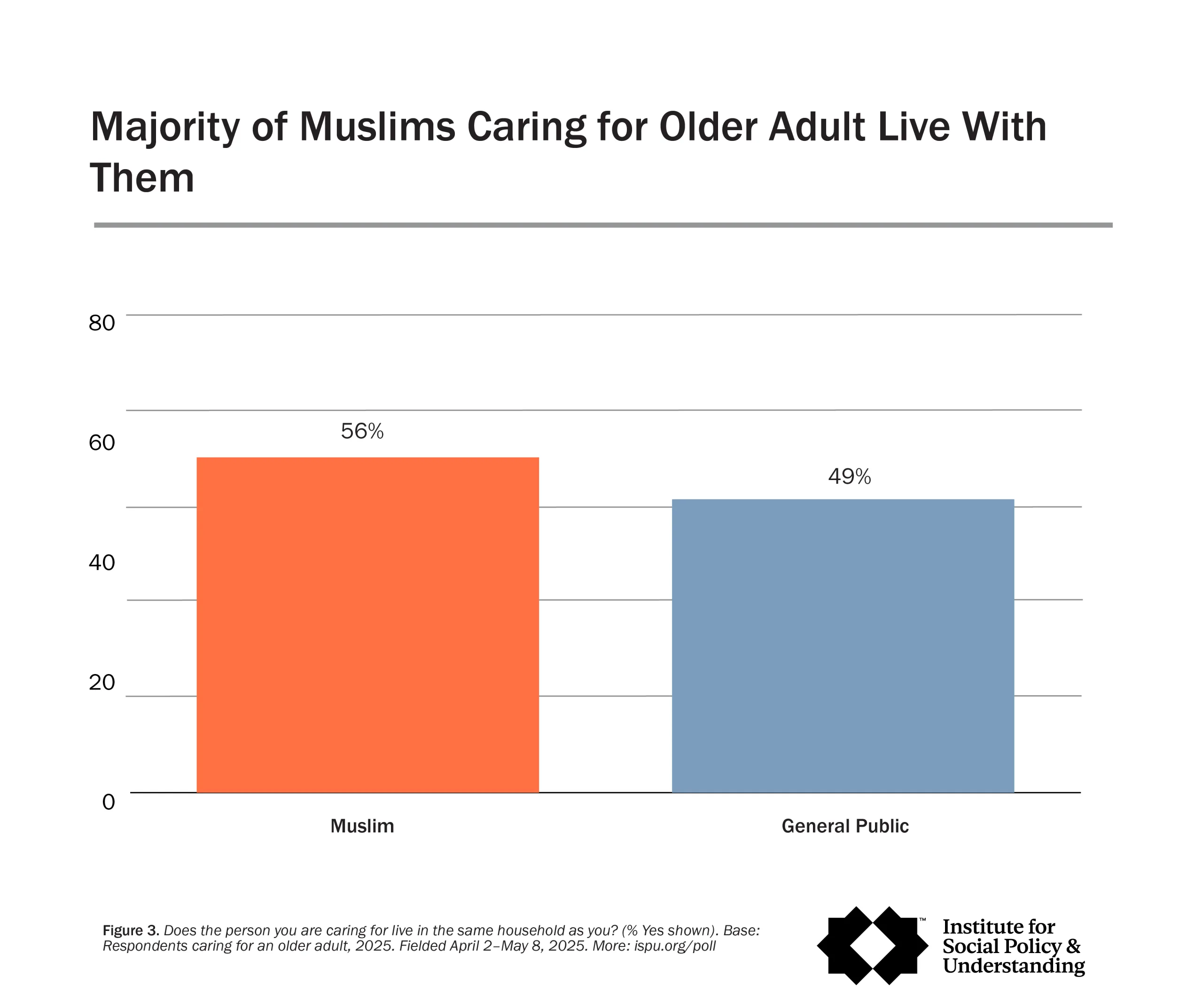
The majority of Muslims (56%) caring for an older adult do so in their home, which is more likely than the 49% among those in the general public who care for older adults at home. The majority of both Muslim men (55%) and women (58%) report caregiving within their own homes.
While similar proportions of men and women report caring for an older adult in their home, women spend a greater share of their time and social and emotional resources doing so, a trend shared across the world, while a higher proportion of men spend their financial resources.

Muslim women who care for older adults tend to take on domestic chores with shopping for groceries (64%), preparing meals (60%), and housekeeping tasks like cleaning and laundry (57%) being the most often reported types of care provided. Muslim men who care for older adults most often report providing financial support (65%) and managing the older adult’s finances (41%) as the types of care provided, in addition to 45% who report shopping for groceries. 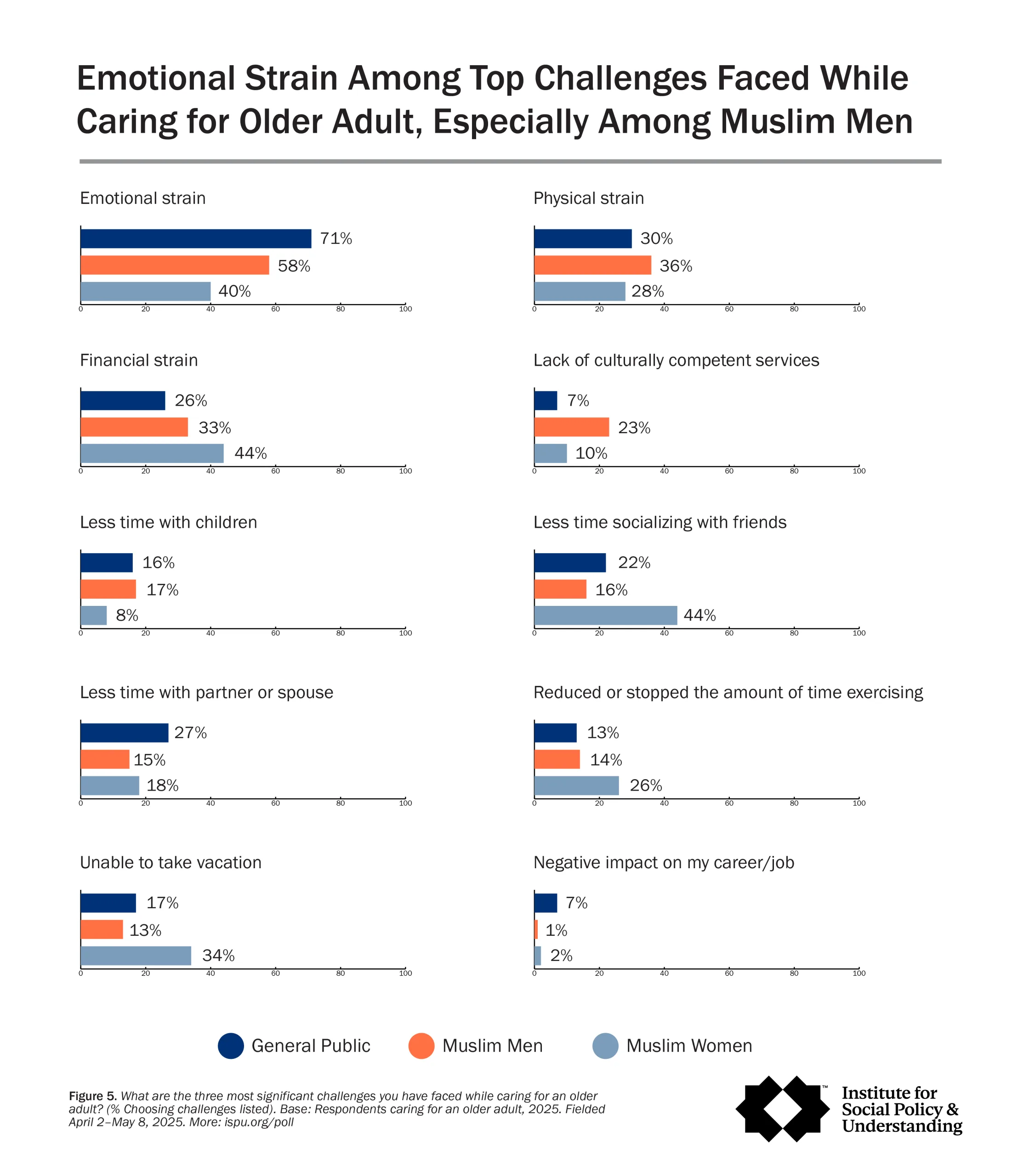
Emotional strain tops the list as the most frequently mentioned challenge faced when caring for an older adult both in the general public (71%) and among Muslims (52%). Among Muslims, 58% of men and 40% of women report emotional strain as one of the top three challenges they face when caring for an older adult. For Muslim men, emotional strain is followed by physical strain (36%) and financial strain (33%). While emotional strain is a top challenge faced by women (40%), financial strain (44%) and less time with friends (44%) are just as frequently mentioned.
The responsibilities of caring for an older adult take a toll on both men and women emotionally, financially, and physically. However, women (44%) are more than twice as likely as men (16%) to report less time with friends as a challenge faced when caring for an older adult. It is not immediately apparent why women’s social lives are impacted more than men’s. Is it that men spend less time with friends than women to begin with, or is it that they can still socialize unbothered while an older adult is under their care because someone else is performing the time-consuming hands-on work?
Where caregiving is emotionally, socially, and financially taxing for anyone, Muslim communities have the added challenge of finding culturally appropriate caregivers. This challenge was cited by 18% of Muslims caring for older adults, compared with just 7% among the general public. Developing more community-based solutions and home healthcare agencies with Muslim-friendly caregivers is vital.
In normative Islamic beliefs, caring for an older adult is praised and strongly encouraged. However, it must also be understood as an emotionally, financially, physically, and socially taxing duty requiring communal support.
Though women carry more of the hands-on burden of performing caregiving duties, men also do a fair amount of these tasks. Both men and women report emotional strain as a top challenge. This suggests that both men and women need support. Whereas more and more mosques offer senior social groups, adding caregiver support groups for both men and women at mosques can be a low-cost way for people to share information and resources and find emotional support.
Though it is praised by many and noted in Islamic tradition as immensely rewarding, many forget that caring for an older adult used to include a network of extended family members, neighbors, and friends. This is a caretaking scenario more readily available and familiar in Muslim-majority countries. A multi-generational, close-proximity network made up the proverbial village, not a single individual who is also working a full-time job while raising children. Later generations of American Muslims, especially those born in the United States, who are caring for their own parents therefore may not think it is realistic in the current social and financial context to expect their children to carry the same burden absent this village. Moreover, what do aging Muslim men and women who do not have children do? Our research shows investment in Muslim-friendly retirement communities, where older adults can maintain independence well into their senior years while enjoying culturally relevant intellectual, spiritual, and social engagement, is sorely needed as the Muslim population in the US continues to age.
Other resources:
• Caring for Aging Muslim Families: A Needs Assessment
• The Family Youth Institute Elder Care Toolkit
• Sandwiched: Muslims Are Most Likely to be Caring for Aging Parents and Have School-Aged Children
Dalia Mogahed
Dalia Mogahed is a scholar at the Institute for Social Policy and Understanding. Mogahed is the former Director of Research at ISPU, where she led the organization’s pioneering research and thought leadership programs on American Muslims. She is also the former Executive Director of the Gallup Center for Muslim Studies, where she led the analysis of surveys of Muslim communities worldwide. With John L. Esposito, she co-authored the book Who Speaks for Islam? What a Billion Muslims Really Think. President Barack Obama appointed Mogahed to the President’s Advisory Council on Faith-Based and Neighborhood Partnerships in 2009. She was invited to testify before the U.S. Senate Committee on Foreign Relations about U.S. engagement with Muslim communities. Her 2016 TED talk was named one of the top TED talks that year. She is a frequent expert commentator in global media outlets and international forums. She is the CEO of Mogahed Consulting. Dalia is also the co-host, with Imam Mohamed Magid, of the ‘Quran Conversations‘ podcast.
As loved ones age and face health challenges, family members often find themselves stepping into primary caregiving roles. This can involve coordinating caregiving across households, with relatives traveling, rearranging schedules, and spending extended periods away from home to meet emerging needs. Many caregivers are also balancing responsibilities such as raising children, maintaining full-time employment, and supporting their own households. While these arrangements can be rife with logistical, financial, and emotional challenges, families often have limited alternatives when striving to ensure loved ones receive appropriate care.
Millions of Americans, including American Muslims, are in these scenarios every day. However, research on these families, the support they need, and the challenges they face is scant.
To address this gap, the Institute for Social Policy and Understanding (ISPU) included questions addressing elder care in American Muslim Poll 2025, a survey of American Muslims and other religious and non-religious groups. Not only do the results reveal the prevalence of American Muslims who care for an older family member, it also highlights the main challenges facing these families, outlining the specific needs of Muslim communities. The report concludes by offering recommendations on how to address these needs.
The full methodology for American Muslim Poll 2025 is available here.
Muslims are most likely to be in the “Sandwich Generation”
One in four Muslims care for an older adult, such as a parent, grandparent, or guardian, on par with Catholics, but more likely than the general population (16%). At the same time, 36% of American Muslims have children in K-12 schooling, more likely than the 11%-26% of all other groups studied. This results in more Muslims in the United States being part of the “sandwich generation”, a term coined to describe adults, typically in their thirties or forties, who are responsible for bringing up their own children and for the care of their aging parents. Among Muslims, 36% of those who care for elders also have children in K-12.
It is not surprising that Muslims are the most likely group to fall into this category. Muslims are, on average, the youngest religious group in the U.S., so they are more likely to have a living older adult to care for and children to raise.
The likelihood of caring for an older adult is shared equally across genders, with Muslim men (29%) as likely as Muslim women (20%) to do so. However, the differences are more pronounced across racial and ethnic lines. Forty percent of white Muslims report that they are responsible for caring for an older adult, which is more likely than 19% of Black Muslims and 10% of Arab Muslims. Twenty-eight percent of Asian Muslims report caring for an older adult, which is more likely than that of Arab Muslims and on par with Black Muslims. More information about the racial and ethnic composition of Muslims in the United States is available in American Muslim Poll 2025: Enduring Challenges, Evolving Electorate and Who Are White Muslims?.
Muslim women shoulder the brunt of elder care tasks
The majority of Muslims (56%) caring for an older adult do so in their home, which is more likely than the 49% among those in the general public who care for older adults at home. The majority of both Muslim men (55%) and women (58%) report caregiving within their own homes.
While similar proportions of men and women report caring for an older adult in their home, women spend a greater share of their time and social and emotional resources doing so, a trend shared across the world, while a higher proportion of men spend their financial resources.
Muslim women who care for older adults tend to take on domestic chores with shopping for groceries (64%), preparing meals (60%), and housekeeping tasks like cleaning and laundry (57%) being the most often reported types of care provided. Muslim men who care for older adults most often report providing financial support (65%) and managing the older adult’s finances (41%) as the types of care provided, in addition to 45% who report shopping for groceries.
Emotional strain tops the list as the most frequently mentioned challenge faced when caring for an older adult both in the general public (71%) and among Muslims (52%). Among Muslims, 58% of men and 40% of women report emotional strain as one of the top three challenges they face when caring for an older adult. For Muslim men, emotional strain is followed by physical strain (36%) and financial strain (33%). While emotional strain is a top challenge faced by women (40%), financial strain (44%) and less time with friends (44%) are just as frequently mentioned.
The responsibilities of caring for an older adult take a toll on both men and women emotionally, financially, and physically. However, women (44%) are more than twice as likely as men (16%) to report less time with friends as a challenge faced when caring for an older adult. It is not immediately apparent why women’s social lives are impacted more than men’s. Is it that men spend less time with friends than women to begin with, or is it that they can still socialize unbothered while an older adult is under their care because someone else is performing the time-consuming hands-on work?
Where caregiving is emotionally, socially, and financially taxing for anyone, Muslim communities have the added challenge of finding culturally appropriate caregivers. This challenge was cited by 18% of Muslims caring for older adults, compared with just 7% among the general public. Developing more community-based solutions and home healthcare agencies with Muslim-friendly caregivers is vital.
In normative Islamic beliefs, caring for an older adult is praised and strongly encouraged. However, it must also be understood as an emotionally, financially, physically, and socially taxing duty requiring communal support.
Though women carry more of the hands-on burden of performing caregiving duties, men also do a fair amount of these tasks. Both men and women report emotional strain as a top challenge. This suggests that both men and women need support. Whereas more and more mosques offer senior social groups, adding caregiver support groups for both men and women at mosques can be a low-cost way for people to share information and resources and find emotional support.
Though it is praised by many and noted in Islamic tradition as immensely rewarding, many forget that caring for an older adult used to include a network of extended family members, neighbors, and friends. This is a caretaking scenario more readily available and familiar in Muslim-majority countries. A multi-generational, close-proximity network made up the proverbial village, not a single individual who is also working a full-time job while raising children. Later generations of American Muslims, especially those born in the United States, who are caring for their own parents therefore may not think it is realistic in the current social and financial context to expect their children to carry the same burden absent this village. Moreover, what do aging Muslim men and women who do not have children do? Our research shows investment in Muslim-friendly retirement communities, where older adults can maintain independence well into their senior years while enjoying culturally relevant intellectual, spiritual, and social engagement, is sorely needed as the Muslim population in the US continues to age.
Other resources:
• Caring for Aging Muslim Families: A Needs Assessment
• The Family Youth Institute Elder Care Toolkit
• Sandwiched: Muslims Are Most Likely to be Caring for Aging Parents and Have School-Aged Children
Dalia Mogahed
Dalia Mogahed is a scholar at the Institute for Social Policy and Understanding. Mogahed is the former Director of Research at ISPU, where she led the organization’s pioneering research and thought leadership programs on American Muslims. She is also the former Executive Director of the Gallup Center for Muslim Studies, where she led the analysis of surveys of Muslim communities worldwide. With John L. Esposito, she co-authored the book Who Speaks for Islam? What a Billion Muslims Really Think. President Barack Obama appointed Mogahed to the President’s Advisory Council on Faith-Based and Neighborhood Partnerships in 2009. She was invited to testify before the U.S. Senate Committee on Foreign Relations about U.S. engagement with Muslim communities. Her 2016 TED talk was named one of the top TED talks that year. She is a frequent expert commentator in global media outlets and international forums. She is the CEO of Mogahed Consulting. Dalia is also the co-host, with Imam Mohamed Magid, of the ‘Quran Conversations‘ podcast.